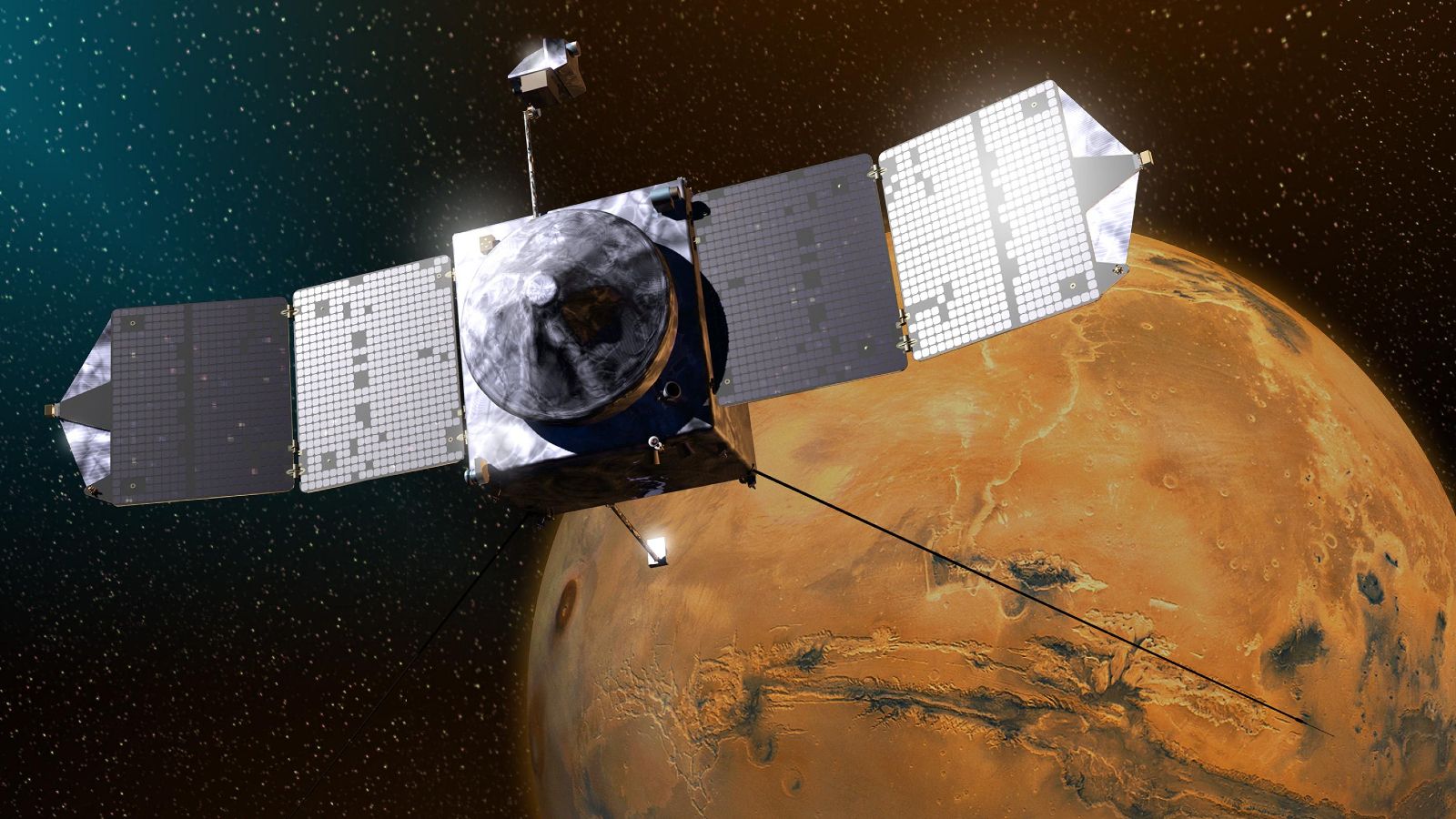
Mars may be stranger, and more magnetically complicated, than expected
A NASA spacecraft has detected evidence that Mars can produce a plasma effect that researchers once thought should not happen there at all. The phenomenon, known as the Zwan-Wolf effect, was first identified on Earth in 1976 and involves charged particles being squeezed along magnetic structures called flux tubes. Because Mars lacks a global magnetosphere like Earth’s, scientists had assumed the effect was effectively off the table on the Red Planet.
The new study challenges that assumption. Using data from NASA’s Mars Atmosphere and Volatile Evolution spacecraft during a powerful solar storm in December 2023, researchers found telltale atmospheric “wiggles” that they interpreted as signs of the Zwan-Wolf effect. The result was published May 18 in Nature Communications.
Why the finding surprised researchers
On Earth, the Zwan-Wolf effect is associated with the magnetosphere generated by the motion of the planet’s molten core. Mars does not have that kind of planetary shield. Its core long ago solidified, and without a strong global magnetic field the planet has been far more exposed to the solar wind. That exposure is one major reason Mars today has such a thin atmosphere.
The prior expectation, then, was logical: no proper magnetosphere, no Zwan-Wolf effect. The MAVEN observations suggest reality is more complicated. If localized or storm-driven magnetic structures can create conditions for this squeezing process, then the boundary between “magnetically active enough” and “not active enough” may need to be redrawn.
A solar storm opened a window
The timing of the detection matters. The source text says MAVEN observed the strange behavior after a powerful coronal mass ejection slammed into Mars in 2023. Extreme space-weather events can reorganize plasma environments and amplify subtle processes that might otherwise be hard to detect. In this case, the storm appears to have provided a natural experiment large enough for researchers to see something that would have been easy to miss under quieter conditions.
That does not mean Mars has secretly possessed an Earth-like magnetosphere all along. It means transient or localized magnetic conditions may be enough to generate a process once assumed to depend on something far more robust. That is a narrower claim, but still an important one.
Why it matters beyond Mars
The discovery has implications for more than one planet. Space weather is not merely a matter of radiation dose or communications disruption; it also reshapes how atmospheres and plasma environments behave over time. If the Zwan-Wolf effect can arise in places where scientists thought it could not, models of atmospheric loss and plasma transport may need to account for a wider range of magnetic configurations.
That is especially relevant for Mars, where the history of atmospheric escape is central to understanding how a once more hospitable world became cold, dry, and exposed. Any newly recognized process affecting the upper atmosphere could refine how researchers think about that long-term transformation.
It also has broader planetary value. The source material notes that similar effects likely occur on Jupiter and Saturn. If Mars can join that list under the right conditions, the phenomenon starts to look less like a niche Earth-centric oddity and more like part of a wider solar-system toolkit for moving charged particles around.
A reminder from MAVEN
MAVEN has been orbiting Mars since 2014, and the source text notes that NASA lost contact with the spacecraft last year. That makes this result an additional reminder of the mission’s scientific value. Even late in a mission’s life, a spacecraft can still overturn assumptions that shaped an entire field.
The main takeaway is not simply that Mars did something unexpected. It is that planetary environments can behave in ways that remain hidden until extreme events expose them. In this case, a solar storm appears to have revealed that Mars is capable of a magnetic-plasma trick scientists had already ruled out. That is exactly the kind of result that forces theory to catch up with observation.
This article is based on reporting by Live Science. Read the original article.
Originally published on livescience.com