A medieval loss preserved by accident
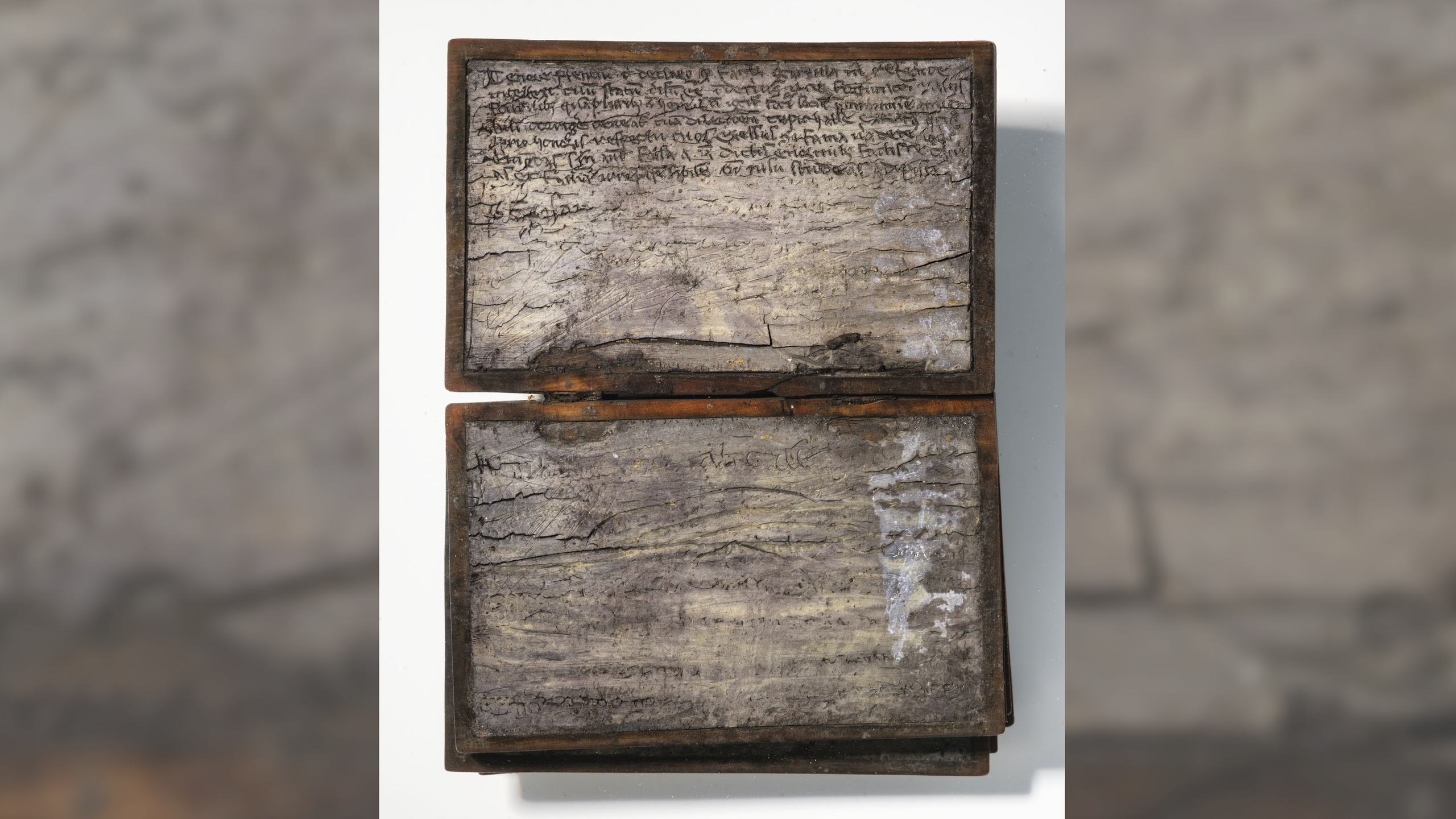
Construction work in Paderborn, Germany, has yielded one of the more unusual archaeological finds of the year: an approximately 800-year-old wood-and-wax notebook discovered inside a medieval latrine, still enclosed in a leather carrying case and preserved well enough to retain cursive Latin writing. The object appears to have belonged to a merchant and survived because the latrine chambers were sealed and airtight, creating conditions that protected fragile organic materials that would normally decay.
The find stands out not only because books and writing tools of this kind rarely survive, but because this one seems to capture an everyday object in motion rather than a ceremonial or elite archive. Archaeologists working with the Regional Association of Westphalia-Lippe said the notebook was initially mistaken for an ordinary clod of earth during lab cleaning, only to be identified as a leather case with a lid containing the writing tablet.
That kind of recovery is a reminder of how much medieval daily life remains hidden in unassuming contexts. Formal manuscripts often survive because they were stored in monasteries or libraries. Portable, practical writing tools used by merchants, however, were more likely to be worn out, discarded, or lost.
What was found
The notepad measures roughly 8.6 by 5.5 centimeters and was carried in a slightly larger leather case decorated with a fleur-de-lis pattern. It has 10 pages in total: eight are double-sided and two are single-sided. All were coated with wax so that they could be inscribed with a stylus. Wax tablets were reusable, making them well suited for notes, calculations, lists, and short texts.
Inside, experts identified numerous lines of Latin cursive writing. Some lines were overwritten and some run in different directions, which complicates transcription. Archaeologists say individual words can already be recognized, but translating the whole text will take time because of the layered writing and the possibility of nonstandard spelling.
The script characteristics indicate the notebook was used sometime between the 13th and 15th centuries. That alone makes it valuable. Portable wax tablets were common enough in the medieval world, but examples preserving actual writing are much rarer, especially when they come with their protective case.

Why a latrine matters so much
The object was found in one of five medieval latrines excavated at the site. Such places may sound unpromising, but they can be extraordinary time capsules. When pits are sealed and remain waterlogged or oxygen-poor, leather, wood, textiles, and other delicate materials can survive for centuries.
Conservator Susanne Bretzel noted that even after so many centuries underground, the find still had an unpleasant odor. That detail is more than anecdotal. It underlines how intact the preservation environment remained. In archaeology, the unusual chemistry of a site can matter as much as the object itself.
The latrine context also shaped the story that has captured public imagination. Archaeologists suggested the merchant may have dropped the notebook while using the pit, possibly at the same time he was wiping with a piece of silk cloth that also survived. If so, the site preserved not only a writing tool but an intimate and accidental moment of medieval urban life.
A window into commerce and literacy
If the notebook did belong to a merchant, it may help researchers understand how business and literacy intersected in a growing medieval town. Paderborn was part of a wider commercial world in which traders needed practical recordkeeping tools for debts, deliveries, names, and quantities. A small wax notebook would have been ideal for temporary entries that could later be copied into more formal records.
The fact that the writing is in Latin is also notable. Latin remained the language of administration, religion, and scholarship for much of medieval Europe, but its use in day-to-day commercial settings varied by place and purpose. The eventual transcription may clarify whether the notebook held accounts, memoranda, legal notes, or something more personal.
Even before the text is fully read, the object says something important about routine literacy. It points to writing as a practical technology carried on the body, not just a prestige activity confined to scriptoria or official institutions.

Why the slow work matters
Discoveries like this often arrive with dramatic headlines, but the real scientific value emerges through patient conservation and interpretation. Because some lines were written over others and orientations vary, specialists will need time to disentangle the text. Incorrect spellings may further complicate the reading. What looks at first like a quaint curiosity could become a serious historical source once the words are reconstructed.
The case itself also matters. Its decorative fleur-de-lis motif suggests attention to craftsmanship and perhaps a degree of status. Portable tools were not always purely utilitarian; they could also signal identity, profession, or taste.
Archaeology often advances through fragments rather than complete stories. Here, the fragments are unusually rich: a leather satchel, a reusable writing tablet, Latin words trapped in wax, and traces of luxury textile in a latrine sealed for centuries. Together they offer a compressed but vivid snapshot of medieval material culture.
An ordinary object, unusually intact
There is a reason finds like this resonate so widely. They collapse the distance between modern and medieval life. The owner of this notebook was not leaving behind a monument. He was carrying a working tool through a town and, apparently, lost it in the most mundane of settings. Centuries later, that accident has become a rare archive.
Once the text is deciphered, researchers may learn much more about who used the notebook and why. But even now, before the content is fully understood, the discovery expands the surviving record of how writing, trade, and personal belongings moved through medieval Europe. It is a reminder that history does not survive only in grand buildings and official texts. Sometimes it persists in the contents of a latrine, waiting for the right patch of soil to give it back.
This article is based on reporting by Live Science. Read the original article.

Originally published on livescience.com