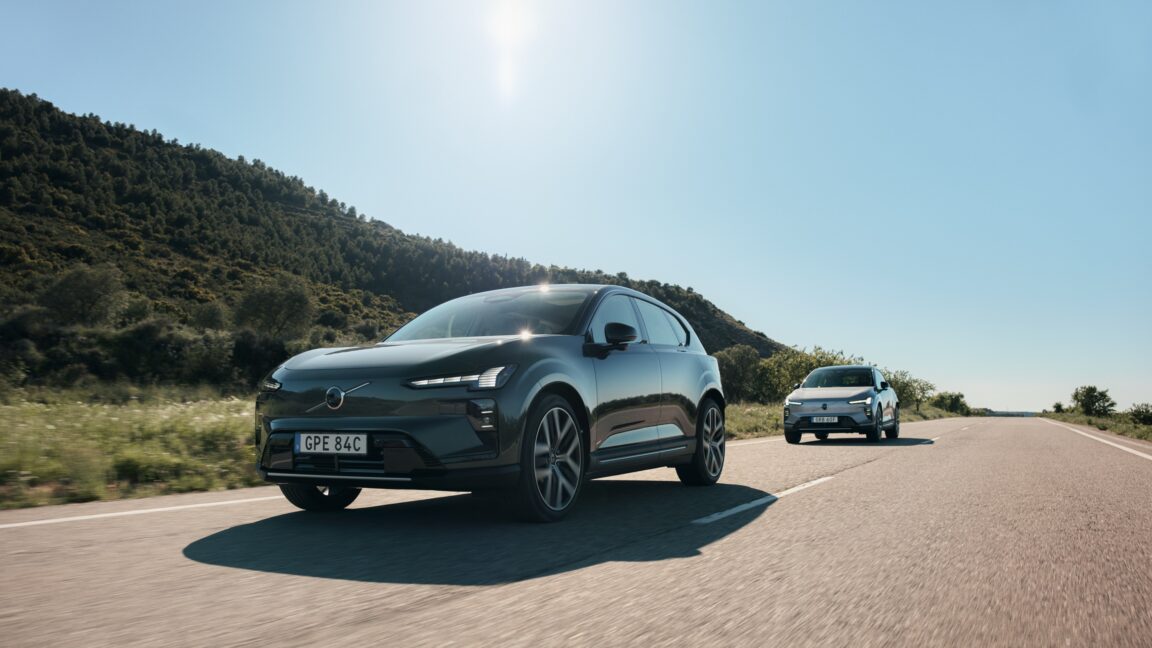
The EX60 is more than another electric SUV
Volvo’s new EX60 arrives with the usual electric-vehicle talking points: more range, faster charging, and a new model positioned at the center of a brand’s future lineup. But what makes the vehicle more interesting is not just its published capability. It is the way Volvo is presenting manufacturing architecture itself as a competitive technology.
The EX60 is the first vehicle built on Volvo’s all-electric SPA3 platform, a scalable base the company plans to use across additional EVs. It offers up to 400 miles of range and introduces 800-volt charging along with cell-to-body battery integration, which makes the battery pack a structural, load-bearing part of the vehicle’s floor and walls. Those are serious engineering changes. Yet Volvo is tying them directly to another shift: a different way of building the car.
That shift is embodied by megacasting, a production technique that turns molten aluminum into a single lightweight component rather than assembling many smaller parts. In other words, the EX60 is not just a new product. It is a test case for a new manufacturing logic.
Why megacasting matters
Megacasting has become one of the most closely watched manufacturing strategies in the EV sector because it can reduce part counts, simplify assembly, lower weight, and potentially improve cost efficiency. For carmakers trying to preserve margins while scaling electric platforms, those gains matter almost as much as battery chemistry improvements.
Volvo says it has refined every stage of production for the EX60, using the model to rethink how the company builds cars. That is an important signal. The EV competition is no longer only about who can source cells or software. It is also about who can design vehicles and factories so that the economics improve as volume grows.
The EX60 places Volvo squarely in that contest. Rather than treating manufacturing innovation as an invisible back-end detail, the company is presenting it as part of the vehicle’s public identity.

The technical package
The EX60 will initially be offered in two versions: the rear-wheel-drive P6 and the all-wheel-drive P10. Volvo says the entry-level 2027 EX60 P6 Plus starts at $59,795, while the P10 AWD Ultra reaches $68,745. A more powerful P12 variant is planned for later.
Beyond pricing, the more consequential specifications are structural. The 800-volt system promises faster charging than any previous Volvo vehicle, while the cell-to-body approach integrates battery cells directly into the vehicle structure. That can help with stiffness, weight optimization, and packaging efficiency, though it also raises the importance of repairability and production precision.
For the market, those features position the EX60 as a platform-forward vehicle rather than a simple trim-level iteration. Volvo is signaling that the car is foundational to what comes next, not just another model addition.
Manufacturing pressure in a mixed EV market
The timing is notable. EV demand remains uneven, especially in the United States, where tariffs and shifting market conditions have complicated product planning. Volvo’s compact EX30, launched at the end of 2023, has now been discontinued under those conditions, while the larger EX90 remains in the lineup.
Despite that uncertainty, Volvo is continuing to push ahead with new EV development. The EX60 therefore reflects a view shared by many automakers with large sunk investments in electrification: short-term demand fluctuations do not justify pausing platform evolution. If anything, they increase the need to cut manufacturing complexity and improve the economics of each vehicle produced.
That is why megacasting matters beyond engineering fashion. It offers a route to making EV programs more durable during periods of price pressure and competitive intensity.

Safety remains part of the pitch
Volvo is also wrapping the EX60 in a familiar brand narrative around safety. In this case, that includes an attention-grabbing claim that the vehicle has been “moose-proofed,” reflecting the company’s longstanding focus on collisions involving large animals common in Scandinavia. While that detail gives the car a memorable identity, it also fits a broader point: Volvo wants its platform and manufacturing advances to coexist with, not replace, the safety-oriented image that defines the brand.
That balance matters because EV transitions can blur brand identity. When many companies are converging on touchscreens, software updates, and battery messaging, legacy differentiators such as safety engineering risk becoming harder to read. Volvo appears intent on preserving those cues even as it overhauls the underlying vehicle architecture.
The bigger signal for the industry
The EX60 illustrates a broader evolution in the EV market. Early competition centered heavily on battery range and charging. Those metrics still matter, but the field is now maturing into a contest over platforms, factories, structural integration, and production philosophy. The winners may be the companies that can combine consumer-visible performance with behind-the-scenes manufacturing efficiency.
Volvo’s new SPA3 architecture, 800-volt system, structural battery design, and megacasting strategy all point in that direction. Together they suggest the company is trying to make production engineering part of its product advantage rather than merely its cost discipline.
The question now is whether those choices will translate into scalable commercial success. That will depend on execution, pricing resilience, and how well the new platform supports future models. But as a statement of intent, the EX60 is clear enough. Volvo is not only updating its EV lineup. It is adapting to a phase of the electric era in which how a car is made may be nearly as important as how it drives.
This article is based on reporting by Ars Technica. Read the original article.

Originally published on arstechnica.com


