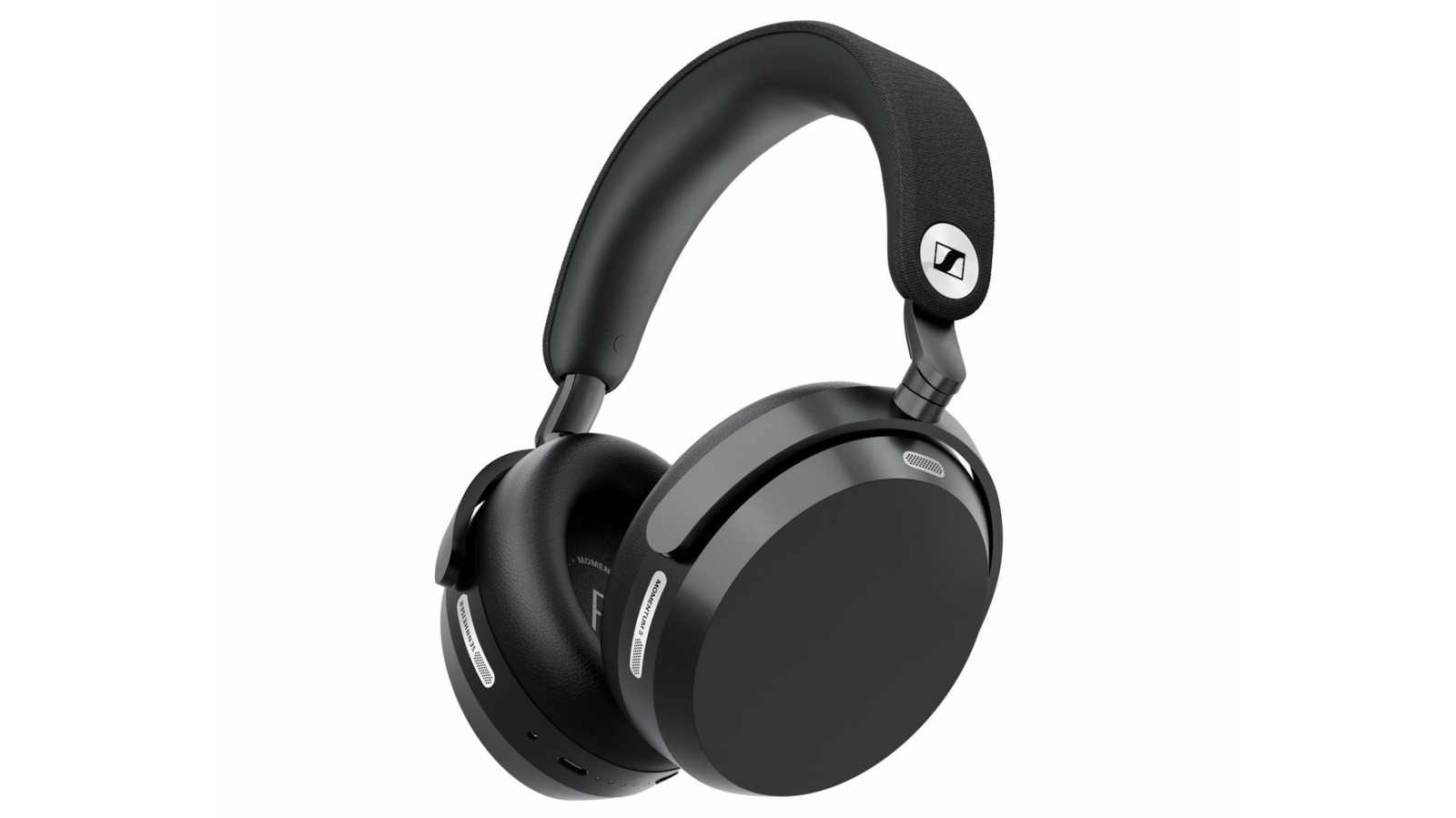
Sennheiser Updates Its Flagship Headphones Without Reinventing the Exterior
Sennheiser’s Momentum 5 Wireless headphones are arriving with a familiar silhouette and a noticeably different pitch: this generation is about internal upgrades. Nearly four years after the Momentum 4 debuted, the company is keeping the overall design largely intact while focusing on sound processing, codec support, microphone arrays, and active noise cancellation.
That is often a sensible strategy in mature product categories. Premium wireless headphones are no longer won or lost by novelty alone. They are judged on refinement, consistency, software support, and whether each new model actually improves daily listening. Sennheiser is clearly positioning the Momentum 5 as that kind of refinement release, though it comes with a higher asking price and at least one small battery-life tradeoff.
The new model will be available June 16 for $400, or $50 more than the Momentum 4, according to the supplied Engadget report.
What Has Changed in the Momentum 5
Sennheiser says the Momentum 5 uses the same 42 mm transducers found in the Momentum 4, drivers that were inspired by the company’s HD 600 series and tuned for what it describes as full-bodied sound and dynamic bass. The hardware continuity means the largest changes are not a complete acoustic reset, but enhancements around how that core system is delivered and controlled.
Those changes include Hi-Res Audio certification and Snapdragon Sound support, with Bluetooth codec support up to aptX Lossless. In practical terms, that means Sennheiser is reinforcing the Momentum line’s position among listeners who care about higher-quality wireless transmission rather than treating these as style-first travel headphones.
The Smart Control Plus app is also getting a more elaborate tuning toolkit, including an 8-band equalizer, audio presets, and sound personalization features. That points to a broader industry reality: premium headphone value now lives partly in software flexibility. Buyers expect personalization, not just a factory sound signature.

ANC Is the Headline Upgrade
Sennheiser appears to be putting particular weight behind the noise-cancellation story. The company has added two extra microphones per side, bringing the total to four microphones on each ear cup. According to the report, Sennheiser says the upgrade delivers across-the-board improvements and can make cancellation of human voices up to three times more effective.
If that claim holds up in real-world use, it would matter because speech suppression remains one of the toughest and most noticeable tests for ANC systems. Commuters, office workers, and frequent travelers often care less about abstract cancellation scores than about whether headphones can meaningfully reduce nearby voices, cabin chatter, or open-office noise.
The extra microphones are also meant to improve call quality by producing more natural voice capture. That dual use is typical of the category’s evolution: the same hardware investment increasingly has to support entertainment listening, work calls, and mobile daily use.
A Product Shipping With Future Features in Mind
One of the more interesting aspects of the Momentum 5 launch is how much of the product story depends on planned updates. Sennheiser says a day-one update will add Dolby Atmos support with head tracking when listening to or watching compatible Atmos content. At launch, the headphones support Dolby Atmos, but without the more immersive head-tracking feature.
The headphones also ship with Bluetooth 5.4 while being designed for the upcoming Bluetooth 6.0 release, which Sennheiser says will arrive later through firmware. That approach has advantages and risks. On the positive side, it suggests the company is designing the product with a longer upgrade path in mind. On the negative side, it asks buyers to evaluate some of the experience based on promised software delivery rather than solely on day-one capability.
That is becoming more common in premium electronics. Hardware platforms increasingly launch as foundations that manufacturers expect to improve through firmware. The challenge is credibility: customers have to trust that updates will arrive on time and work as advertised.

The Battery Story Is Slightly Mixed
Sennheiser’s battery numbers show a modest step backward compared with the previous generation. The Momentum 5 is rated for up to 57 hours with ANC enabled, down from the Momentum 4’s 60 hours. That is not a major loss, especially in a category where anything near that range is still substantial, but it is one of the few headline specs that moved in the wrong direction.
The company offsets that with practical usability features. A five-minute quick charge is said to provide up to three hours of use, and the 700 mAh battery is user-replaceable with only a small Phillips-head screwdriver. That last detail stands out in a consumer-electronics market where repairability and battery replacement are too often afterthoughts.
Even for users who never perform the replacement themselves, a replaceable battery changes the ownership equation. It can extend the useful life of a product that might otherwise be discarded when battery performance fades.
Where Momentum 5 Fits in the Market
The Momentum 5 does not appear to be chasing a radical redesign or a fashion reset. Instead, Sennheiser is using the model to argue that audio quality, stronger ANC, codec support, and software upgrades are enough to justify a new flagship cycle.
That makes the product strategically interesting. Premium headphones are now a heavily contested category where differentiation is difficult and customers have become more skeptical of annual or near-annual refreshes. Sennheiser’s answer is to lean on features that affect daily experience: better voice suppression, lossless-capable wireless support, customizable tuning, quick charging, and a battery that can actually be replaced.
The price increase means the company still has to prove those improvements are meaningful in practice. But based on the launch details alone, Momentum 5 looks less like a flashy reset and more like a serious attempt to strengthen the fundamentals of a mature flagship line.
This article is based on reporting by Engadget. Read the original article.

Originally published on engadget.com


