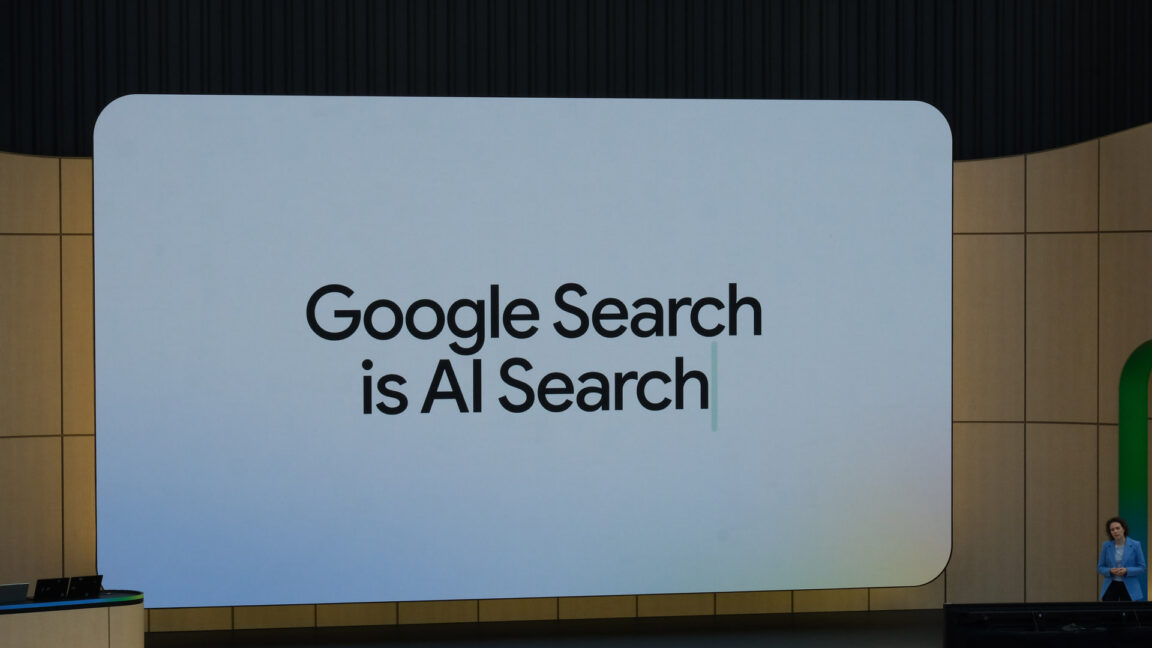
Google is no longer treating AI search as a side feature
At Google I/O 2026, the company made clear that its search future is increasingly conversational, AI-mediated, and difficult for users to avoid. Search executive Liz Reid’s message was blunt in the source material: Google search is AI search.
That framing matters because it marks a transition from testing to normalization. AI Mode began as an experimental shift in how people interact with Google. It is now being positioned as a central behavior layer across the company’s most important consumer product.
Google says AI Mode usage has been doubling every quarter and now reaches more than 1 billion users per month. Those figures, if sustained, suggest the company has already crossed the threshold where internal momentum is likely to overwhelm criticism from traditional search users, publishers, and SEO-dependent businesses.
How Google is changing the search interface
The most visible piece of Google’s AI transformation has been AI Overviews, which now appear on many searches. But the source text suggests those summaries may only be an interim step toward a deeper integration with AI Mode.
Google is expanding what it describes as a seamless path from AI Overviews into AI Mode, and that flow is now reaching desktop as well as mobile. In practical terms, the classic ranked page of links is being repositioned beneath a more interactive interface that invites follow-up questions and extended dialogue.
That has structural consequences. When the AI layer sits above or partially obscures traditional results, the ten blue links stop feeling like the main event and start looking like supporting citations. User behavior is likely to follow the design.

Why the metrics may favor Google even if users complain
Google’s stated success metric is more searches, and conversational interfaces are well suited to producing them. AI Mode asks questions back. Each refinement, clarification, or additional prompt becomes another interaction. That can create the appearance of stronger engagement even when the user is accomplishing a single underlying task.
From Google’s perspective, this is not a bug. It is a new operating model for search, one that blends retrieval, synthesis, and chat into a feedback loop. The company has also pushed AI Mode aggressively through placement and interface nudges, ensuring that casual users are repeatedly directed into the system.
Because AI search is bundled into standard Google usage rather than locked behind a separate subscription, scale is not the main obstacle. Adoption can be manufactured through distribution.
What this means for the web economy
The deeper question is what happens to everyone else. If organic links are pushed lower, clicked less, or treated as reference material for AI-generated answers, publishers may lose traffic even as their work continues to be used as input for summary systems.
This tension has been building since the first wave of AI Overviews, but AI Mode makes it harder to treat the issue as a limited experiment. A user who remains inside a conversational Google workflow may have fewer reasons to visit source pages unless the question demands depth, trust, or direct transaction capability.
That changes incentives across the web. Publishers may have to optimize for being summarized rather than being visited, while businesses that rely on discoverability through ranking could find that ranking alone matters less than before.
Google, of course, has the market power to force that adaptation. The source material’s underlying point is that objections may not alter the trajectory if usage and revenue signals remain favorable for the company.

Agentic search in 2026 means more than better summaries
The phrase agentic AI implies search systems that do more than answer questions. They can guide, suggest, ask clarifying questions, and potentially move users through multi-step tasks. That is a different ambition from classic search, which mainly organized access to external pages.
Google appears to be moving toward a hybrid model in which search becomes the first layer of an AI assistant rather than merely an index. In that world, the engine is not just helping users find information. It is shaping how information is packaged, sequenced, and consumed.
That could improve convenience for many people, especially on routine or exploratory queries. It could also make the search ecosystem more opaque, with fewer opportunities for users to inspect source diversity directly.
Why this moment matters
Google’s dominance has always meant interface decisions have ecosystem-wide effects. When it changes how search is presented, it changes traffic patterns, business models, and user expectations across the internet. The I/O 2026 announcements indicate that the company is not cautiously probing anymore. It is accelerating.
That does not mean the outcome is settled. Users may still push back on trust, quality, or relevance grounds. Regulators may take an interest in how AI-mediated search affects competition and information access. Publishers will certainly continue to argue that summary-first search weakens the open web.
But the direction is now unmistakable. Google is turning search into a conversational AI surface by default, not by exception.
The core change is strategic, not cosmetic: search is being remade from a destination for links into a managed interaction layer. For Google, that may be the future. For the rest of the web, it may be the beginning of a harsher adjustment.
This article is based on reporting by Ars Technica. Read the original article.

Originally published on arstechnica.com


