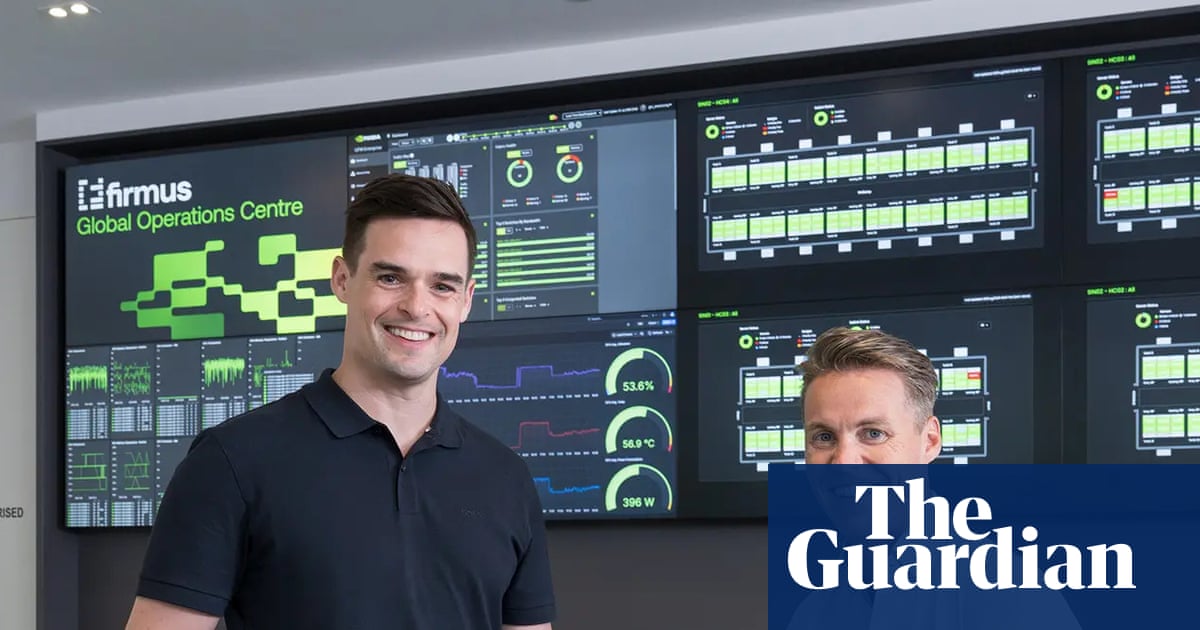
Firmus Technologies has scrapped its plan to list on the Australian Securities Exchange, abandoning what would have been the country's largest company float since Telstra's 1997 debut after investor appetite for its much-promoted AI datacentre business failed to materialise at the price its owners were asking.
The company had been seeking to raise roughly $7bn through an $11-a-share initial public offering, a deal that would have valued the business at an anticipated $44bn and placed it among the largest companies on the ASX from its first day of trading. Shares had been scheduled to begin trading on 23 October. Instead, the board walked away from the offer on Friday morning.
A pitch that unravelled within days
A Firmus spokesperson said directors had concluded that proceeding with the offer was no longer in the best interests of the company or its shareholders. The spokesperson said Firmus would now pursue capital from the private markets and would consider alternative public and private market options, with further information promised to shareholders as those routes develop.
The turnaround came together quickly. By the middle of the week, the company's bankers had concluded that demand had been vastly overestimated in their effort to raise $7bn, according to reporting on the failed raise. That realisation set off frantic discussions about a heavy reduction in the proposed $11-a-share price, before the decision was taken to shelve the listing entirely.
The investor roadshow, run with the assistance of five brokers, had been built around a straightforward proposition: that Firmus could translate global enthusiasm for generative AI into a portfolio of industrial-scale computing campuses. What it could not do was convince enough fund managers that the numbers attached to that proposition justified the entry price.

Two sites, a $44bn valuation and growing scepticism
The central difficulty was the distance between the scale of the ambition and the maturity of the underlying business. At the time of the proposed float, Firmus had just two small operational sites, leaving it firmly in its startup phase even as it marketed itself as a would-be heavyweight of the AI economy.
Investors were effectively being asked to underwrite an enormous valuation on the strength of forecast earnings rather than demonstrated revenue, and that scepticism appears to have hardened as the book-building process went on. A company with a handful of facilities and a multi-decade construction pipeline is a very different proposition in a prospectus than it is on a spreadsheet built around projected demand.
- Offer price: $11 a share
- Target raise: about $7bn
- Implied valuation: roughly $44bn
- Scheduled listing date: 23 October, later abandoned
- Operational footprint at the time of the float: two small sites
Heavyweight backers were not enough
Firmus entered the process with an unusually strong roster of supporters. Chipmaker Nvidia backed the company, alongside Wall Street firms Blackstone, Jane Street and Coatue. On paper, that combination looked like exactly the credibility a young infrastructure business needs when it asks the public market for billions.
The outcome suggests marquee names carry less weight when a listed market is asked to fund a capital-intensive build-out at a price that leaves little room for disappointment. Private investors can tolerate long horizons and illiquidity. Buyers of a public float, by contrast, tend to want nearer-term evidence that the money will generate returns, particularly when interest rates and construction costs are both live variables.

Who is behind Firmus
The company is fronted by a trio: Tim Rosenfield, Oliver Curtis, and Jonathan Levee, who is Curtis's former brother-in-law. The three have been the public faces of an enterprise that positioned itself at the centre of Australia's emergence as a data-processing hub for the wider region.
Their challenge now is to keep that story intact without the validation, and the capital, that a successful listing would have delivered. A failed float is not simply a financing setback; it is a public verdict on a business's own estimate of its worth, delivered by the investors who know it best.
The plan: liquid-cooled AI factories
Firmus's stated strategy was to build liquid-cooled facilities it describes as AI factories, beginning in Australia and then expanding across Asia. Such campuses are designed for the density of the newest accelerator chips, which generate far more heat than conventional server racks and therefore demand new approaches to cooling, power delivery and site design.
Building them at scale is capital-hungry and slow. Land must be secured, power agreements negotiated, cooling systems engineered and supply chains locked in long before a single rack is energised. None of that is impossible to finance privately, but private capital typically arrives on different terms — generally more expensive, less transparent and slower to assemble than a large public raise.

What happens next
Firmus has signalled it will seek private funding and may revisit public markets later, either through a fresh listing attempt or another route. Whether that happens will depend on whether the company can point to more than two small operating sites and convert its forecasts into contracted revenue.
The broader read-across for Australia's technology sector is uncomfortable. A float of this size, backed by this calibre of investor, was widely treated as a test of whether the local market could absorb a genuinely large AI infrastructure story. It could not, at least not at the asking price, and the failure will make the next company with a similar pitch work harder to convince investors.
A test for the country's datacentre boom
The abandoned listing lands in the middle of an active debate about how quickly Australia's datacentre construction should proceed and what that build-out costs the wider economy. Questions have been raised about whether the boom in digital infrastructure is crowding out other priorities, including housing, at a moment when the country is building a great many new homes.
Sitting alongside that question is a sharper one for investors: whether the valuations attached to AI-era infrastructure companies can survive contact with a public market. Firmus's retreat offers an early, if partial, answer — the appetite for AI is undeniable, but the willingness to pay almost any price for exposure to it is not.
For the moment, Firmus remains private, its expansion plans intact on paper and its funding path unresolved. The company's next move, whether a private round or a reworked public offer, will be watched closely as a signal of where the limits of AI infrastructure financing now sit.
This article is based on reporting by The Guardian. Read the original article.
Originally published on theguardian.com