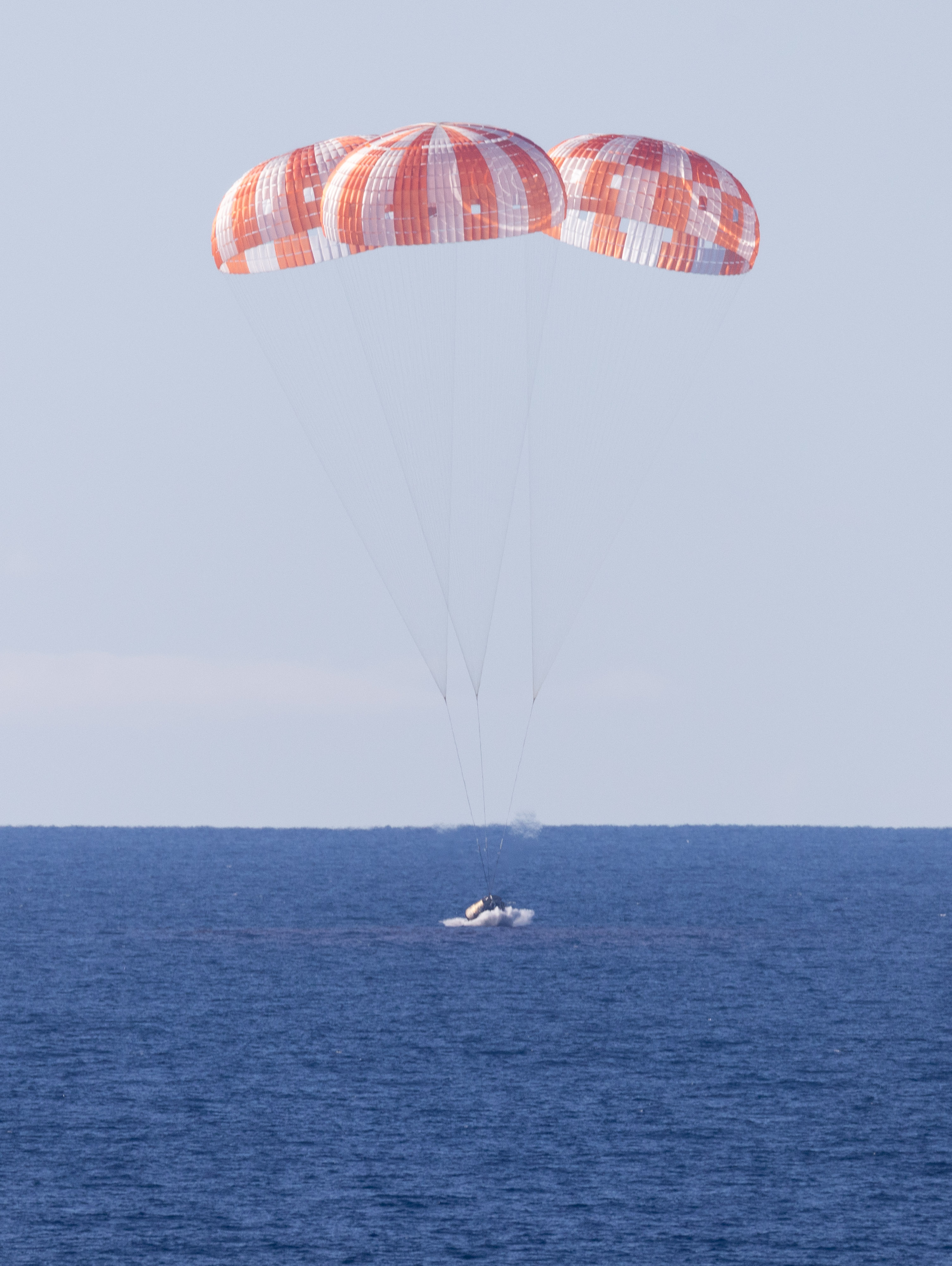
Artemis II closes with a historic splashdown
NASA’s Artemis II mission has ended with the safe return of the first astronauts to travel to the Moon in more than 50 years. The agency said its Orion spacecraft splashed down in the Pacific Ocean off the coast of California at 5:07 p.m. PDT on April 10, 2026, concluding a nearly 10-day flight around the Moon and back.
The crew included NASA astronauts Reid Wiseman, Victor Glover, and Christina Koch, along with Canadian Space Agency astronaut Jeremy Hansen. According to NASA, the mission carried them farther from Earth than any humans have gone before, surpassing the distance record previously set by the Apollo 13 crew in 1970.
NASA said the astronauts reached 252,756 miles from Earth at the farthest point of the mission and traveled 694,481 miles in total. In a separate NASA image article, the agency also highlighted that Artemis II captured views of the far side of the Moon and exceeded Apollo 13’s mark for the farthest crewed spaceflight.
Why Artemis II matters
Artemis II was not just another crewed mission. It was the first astronaut flight of NASA’s Space Launch System rocket and Orion spacecraft, making it a critical test of the hardware and operations that the agency plans to use for future lunar missions. NASA described the flight as both a technical milestone and a bridge to the next stage of the Artemis program.
That framing explains why the mission carries weight beyond its record-setting numbers. A crewed flight around the Moon demonstrates not only that the spacecraft can make the journey, but also that NASA can manage launch, deep-space operations, lunar flyby, reentry, and recovery with astronauts onboard. Those are prerequisites for more ambitious expeditions under Artemis.
NASA Administrator Jared Isaacman said the mission demonstrated the crew’s skill and the capabilities of Orion and SLS as the agency turns its focus toward Artemis III. NASA’s official statement says the next step is preparing to return astronauts to the lunar surface, continue building a sustained presence, and use that work as a foundation for future missions to Mars.
A mission built around testing, risk, and proof
Because Artemis II was a test flight, success was measured not just in destination and duration, but in the performance of the overall system. NASA said the four astronauts accepted significant risk as the first crew to fly this rocket and spacecraft combination. That made their mission a proving ground for future crews and future hardware integration.
The safe recovery sequence was therefore part of the mission’s meaning, not just its ending. After splashdown, NASA said the astronauts were met by a combined NASA and U.S. military recovery team, helped out of the spacecraft in open water, and transported by helicopter to the USS John P. Murtha for initial medical evaluations. The agency said the crew was expected to return to Johnson Space Center in Houston the following day.
Those details underscore an old truth of human spaceflight: returning home is part of the test. Launch and lunar transit draw the attention, but reentry, ocean recovery, and crew handoff remain central to whether a mission is judged operationally complete.
The Moon is again a destination, not just a memory
NASA’s release is also notable for its sense of historical continuity. Artemis II was the first time astronauts traveled to the Moon in more than half a century. That alone turns the mission into a hinge point between the Apollo era and whatever comes next.
For decades, human spaceflight beyond low Earth orbit remained aspirational. Artemis II changes that by placing a crew back on a translunar trajectory and returning them safely. Even without a lunar landing, the mission reestablishes the Moon as an active destination in human exploration.
The agency’s description of the Artemis program makes clear that NASA sees this mission as one step in a longer sequence of increasingly difficult flights. The stated goals include scientific discovery, economic benefits, and preparation for crewed missions to Mars. In that context, Artemis II functions as a systems test, a symbolic return, and a confidence-building exercise all at once.

What comes next
NASA’s statement points directly to Artemis III as the next major objective. With Artemis II complete, the program shifts from a successful lunar flyby to the harder task of turning that momentum into a surface mission. The agency says it is now focused on assembling Artemis III and preparing to return astronauts to the Moon.
The exact timing and broader program challenges are not detailed in the supplied source material, but the immediate message is clear: Artemis II was designed to clear a major threshold, and NASA believes it did. The mission gave the agency a crewed demonstration of its new deep-space transportation stack and a headline-grabbing achievement in the form of a distance record.
It also gave the Artemis program something less flashy but equally important: evidence that a modern crew can leave Earth, loop around the Moon, come home, and do so in a spacecraft intended to support a sustained exploration campaign rather than a one-off historical sprint.
That is why the return of Wiseman, Glover, Koch, and Hansen matters beyond a single splashdown. Artemis II did not complete the Moon program NASA wants to build. It showed that the path back to the Moon is operational again.
This article is based on reporting by NASA. Read the original article.
Originally published on nasa.gov