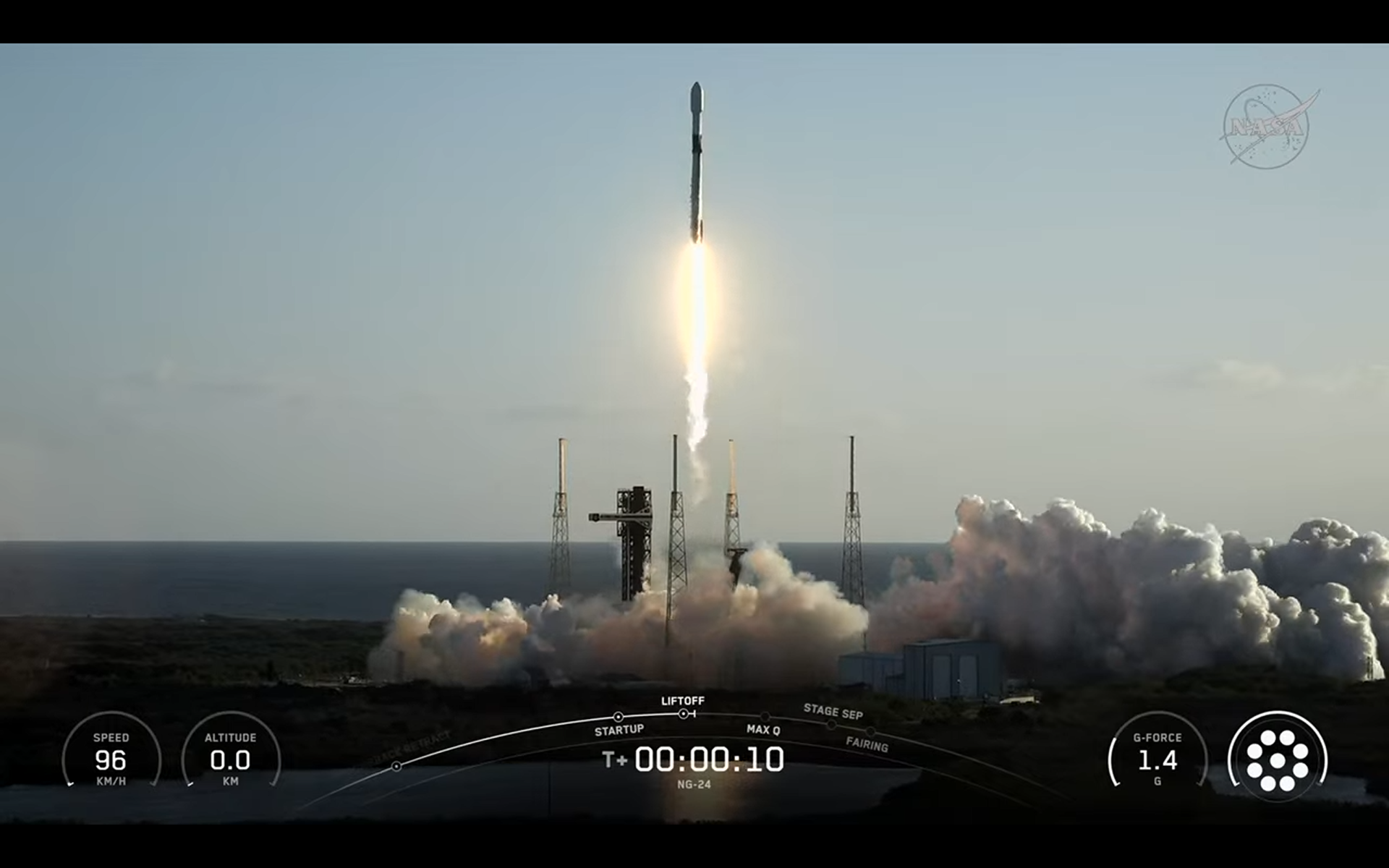
A fresh cargo flight is on the way to the space station
SpaceX launched Northrop Grumman’s NG-24 resupply mission to the International Space Station on Saturday morning, adding another major delivery run to the station’s tightly managed logistics chain. Liftoff took place at 7:41 a.m. EDT on April 11 from Cape Canaveral Space Force Station in Florida, with a Falcon 9 sending the company’s larger Cygnus XL cargo spacecraft toward orbit.
The mission is Northrop Grumman’s 24th contracted resupply flight to the station for NASA. During live commentary, NASA identified the spacecraft as the S.S. Steven R. Nagel, continuing the practice of naming Cygnus vehicles after notable figures in spaceflight. SpaceX also completed a rocket landing shortly after launch, a now-familiar but still operationally important part of Falcon 9 missions.
Why this launch matters
Station cargo flights rarely draw the same public attention as crew launches or deep-space missions, but they remain essential to keeping the orbital outpost functioning. The ISS depends on a regular cadence of deliveries to maintain food, equipment, experiments, spare hardware, and other supplies needed by astronauts living and working in orbit.
In this case, the cargo load exceeded five tons, according to the source material supplied with the candidate. That scale underlines the role of Cygnus XL as a heavy-lift logistics platform for station operations. The larger XL variant expands cargo capacity relative to earlier Cygnus versions, giving NASA and its partners more flexibility in how they bundle station deliveries.

A commercial partnership in routine operation
The launch also reflects how mature the ISS commercial resupply model has become. NASA contracted the mission, Northrop Grumman provided the spacecraft, and SpaceX supplied the launch vehicle. That multi-company arrangement has become a defining feature of low Earth orbit operations, where government needs are increasingly met through a network of commercial providers rather than through a single vertically integrated program.
The NG-24 mission shows how that system now works at industrial rhythm. The spacecraft is built for cargo delivery, the Falcon 9 is used as the transportation backbone, and the station remains the destination where the value of those systems is realized. The result is less a one-off spectacle than a demonstration of sustained orbital infrastructure.
Cygnus XL and station resilience
The Cygnus line has become one of the ISS program’s key logistics tools, and the XL version sharpens that role by carrying larger payloads on each trip. For NASA, that matters because station operations depend on redundancy. Multiple cargo systems reduce the chance that a single launch delay or vehicle issue disrupts crew schedules or research timelines.
Resupply missions also support scientific continuity. Although the supplied source text does not detail the experiment manifest aboard NG-24, NASA’s live description framed the mission broadly around “science and supplies,” a reminder that each cargo flight sustains both daily life in orbit and the station’s function as a research platform.

What to watch next
With launch complete, attention turns to the spacecraft’s trip to the station and the transfer of its cargo once it arrives. For NASA and its commercial partners, the mission’s significance lies in successful execution rather than novelty. Regular, high-capacity cargo transport is one of the foundations of long-duration human spaceflight, and the April 11 launch reinforced that foundation.
As space agencies and private operators look beyond low Earth orbit, missions like NG-24 offer a practical template: dependable vehicles, repeatable launch operations, and an ecosystem in which cargo movement is treated as critical infrastructure. That may be the most important takeaway from this launch. The station still runs on routine, and routine in space requires a remarkable amount of engineering discipline on the ground.
- Falcon 9 launched Northrop Grumman’s NG-24 Cygnus XL mission on April 11.
- The spacecraft carried more than five tons of supplies and research cargo to the ISS.
- The mission highlights the mature commercial model behind station logistics.
This article is based on reporting by Space.com. Read the original article.
Originally published on space.com