An Unexpected Fourth World
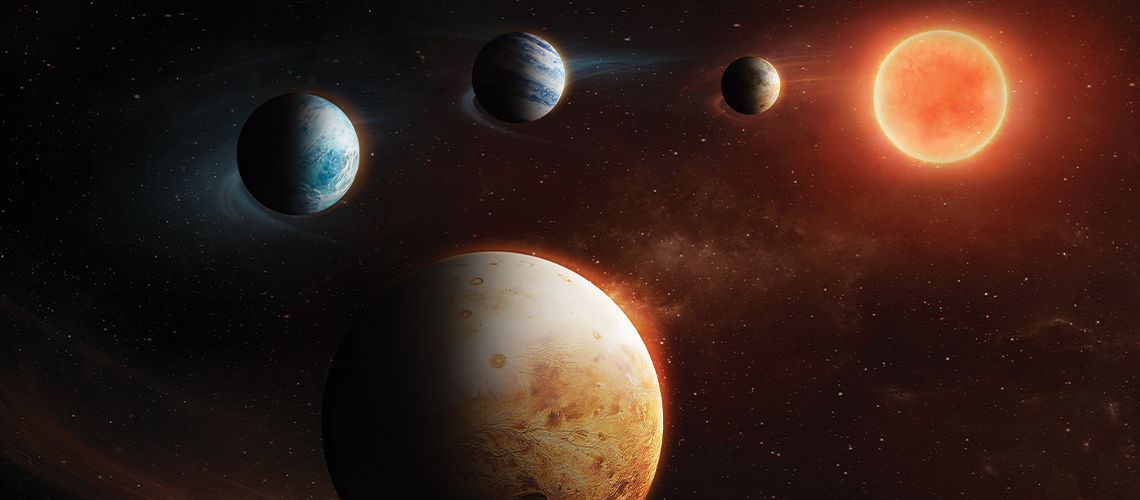
The European Space Agency's CHEOPS satellite has delivered another surprise in its ongoing survey of known exoplanetary systems. A fourth planet discovered orbiting the red dwarf star LHS 1903 does not fit any of the standard models for how planets form and arrange themselves around their host stars, forcing astronomers to reconsider fundamental assumptions about planetary system architecture.
The discovery adds to a growing body of evidence suggesting that our own solar system's orderly arrangement, rocky planets close in, gas giants farther out, everything in roughly circular orbits, may be the exception rather than the rule.
The LHS 1903 System
LHS 1903 is a small, cool red dwarf star located relatively close to Earth in astronomical terms. Three planets had previously been identified in the system through transit observations, where the slight dimming of starlight as a planet crosses in front of its star reveals the planet's presence and allows measurement of its size.
CHEOPS was conducting follow-up observations of the system when it detected the unmistakable signature of a fourth body. The new planet's orbit, size, and relationship to its three siblings immediately stood out as anomalous.
The planet occupies an orbit that, according to standard formation models, should be dynamically unstable. The gravitational interactions with the other three planets should have either ejected it from the system or caused its orbit to decay into a collision within a relatively short period of astronomical time. Yet the system shows no signs of instability, suggesting it has maintained this configuration for a significant fraction of the star's lifetime.

Why This Challenges Formation Theory
Planetary formation theory holds that planets coalesce from the disk of gas and dust that surrounds a young star. The properties of this protoplanetary disk determine what kinds of planets can form and where they end up. Over several decades, astronomers have developed sophisticated models that can reproduce the general architecture of many observed planetary systems.
The LHS 1903 system breaks several of these models' predictions simultaneously. The four planets are packed more tightly than models predict should be possible for bodies of their sizes around a star of this mass. The orbital spacing between them violates widely used empirical relationships that relate a system's stability to the separation between adjacent planetary orbits.
Adding the fourth planet where it was actually observed makes simulations go haywire. The planets should be scattering off each other, but they clearly are not. Something is stabilizing the system that current models do not capture.
Possible Explanations
Several hypotheses could explain the system's unexpected stability. One possibility is orbital resonance, a situation where the orbital periods of adjacent planets are related by simple ratios such as 2:1 or 3:2, creating a gravitational dance that actually reinforces stability rather than promoting chaos. Resonant chains are known to exist in other compact multi-planet systems, such as the famous TRAPPIST-1 system with its seven Earth-sized worlds.
However, initial analysis of LHS 1903 suggests that the planets are not in a simple resonant configuration. The orbital periods do not line up in the clean ratios that characterize known resonant chains, hinting at a more complex dynamical arrangement.
Another possibility involves the planets' internal compositions. If one or more of the planets is significantly less massive than its apparent size suggests, perhaps being unusually puffy with a thick but low-density atmosphere, the gravitational interactions between the planets would be weaker than expected, potentially allowing the tight packing to remain stable.

CHEOPS Continues to Deliver
The discovery showcases the value of CHEOPS's mission design. Unlike planet-hunting telescopes such as TESS or Kepler, which survey large areas of sky looking for new transit signals, CHEOPS focuses on individual known systems to gather extremely precise data. This targeted approach allows it to detect subtle signals that wider surveys might miss.
Since its launch in December 2019, CHEOPS has contributed to dozens of exoplanet discoveries and characterizations. The mission was originally planned for a 3.5-year operational lifetime but has been extended twice due to its continued productivity. The satellite's ability to achieve photometric precision better than 20 parts per million has made it indispensable for exoplanet science.
Rewriting the Rules of Planet Formation
The LHS 1903 discovery arrives at a pivotal moment in exoplanet science. With more than 5,700 confirmed exoplanets known and thousands more candidates awaiting verification, researchers have enough data to begin identifying systematic patterns, and systematic failures, in their theoretical models.
The emerging picture suggests that planet formation is far more diverse than the models trained on our single solar system example predicted. Planets can apparently form in configurations that should be impossible, survive in orbits that should be unstable, and organize themselves in architectures that defy mathematical frameworks.
Future observations with the James Webb Space Telescope could help resolve the puzzle by measuring the atmospheres and masses of the LHS 1903 planets in detail, providing critical data for understanding how this seemingly impossible system maintains its stability. The universe, it seems, has more ways to build planetary systems than human imaginations have so far devised.
This article is based on reporting by Universe Today. Read the original article.
Originally published on universetoday.com