An old device redesigned for a new problem
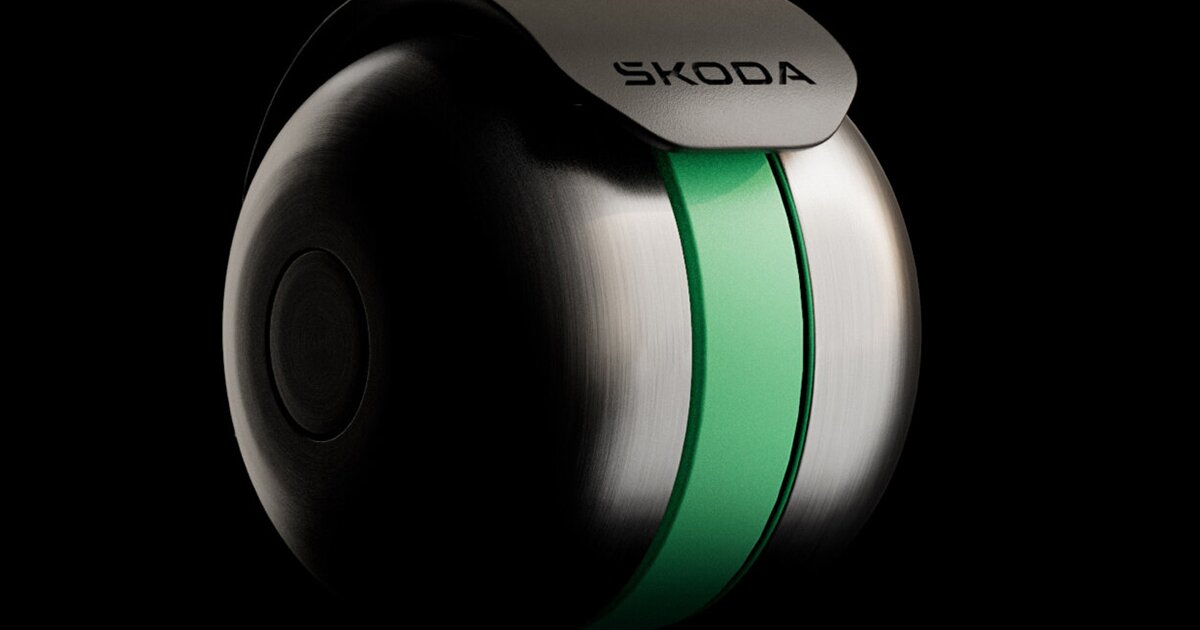
Urban mobility keeps producing peculiar engineering challenges, and Škoda’s latest answer is unusually direct. The company has developed a bicycle bell aimed at one of the stranger side effects of modern city life: pedestrians so insulated by active-noise-canceling headphones that they may not hear an approaching cyclist.
The device, called the DuoBell, is completely mechanical. There is no software, sensor suite, or app layer. Instead, Škoda says the innovation lies in acoustic tuning. Working with audiologists from the University of Salford in the UK, the team tested large numbers of audio signals across popular noise-canceling headphones from brands including Bose, Sony, and Apple to identify weaknesses in how active cancellation handles certain sounds.
Finding the gap in noise cancellation
According to the source, the researchers found that many ANC headphones were less effective at suppressing a low-frequency band between 750 and 780 Hz. That discovery shaped the first part of the bell’s design. The DuoBell was engineered to hit that low-frequency range so it could remain audible at a distance even when a pedestrian is wearing noise-canceling headphones.
The bell’s second feature is what gives it its name. It adds another resonator tuned to a higher frequency, producing rapid, irregular strikes that the source says ANC algorithms cannot process quickly enough to cancel. The result is a two-part acoustic strategy: one tone aimed at a range where headphone suppression is weaker, and another designed to be too irregular for cancellation systems to handle cleanly.

Why analog can still be smarter
There is a broader lesson in the project. A great deal of transport innovation now defaults to digitization, but this product moves in the opposite direction. Rather than adding electronics to bicycles, Škoda is using careful physical design to solve a problem created by other electronics. In that sense, the DuoBell is a small example of an increasingly important engineering pattern: low-complexity systems designed to work around the failure modes of high-complexity ones.
The company said the bell received a positive response from Deliveroo riders in London and that it hopes to fit it to more bikes across the city. That does not make it a proven large-scale safety intervention yet, but it does suggest the concept has moved beyond lab testing into at least limited real-world use.
A small invention with larger urban relevance
The problem Škoda is addressing is real enough to resonate far beyond cycling. Cities are becoming denser, quieter in some ways, and more acoustically fragmented in others. Headphones, earbuds, and personalized audio have changed how people move through public space. Cyclists, scooter riders, and pedestrians increasingly share the same streets, lanes, and crossings while operating with very different levels of situational awareness.
That makes warning signals newly important, but also harder to design well. A bell has to be noticeable without being excessive, effective without being aggressive, and simple enough to work instantly in traffic. The DuoBell is interesting because it treats sound not as a generic alert but as a targeted human-machine interface challenge.
It is also refreshingly specific. Instead of promising to solve urban safety in the abstract, it addresses one narrow but modern friction point with a device almost anyone can understand immediately. For transport innovation, that kind of precision may be more useful than grander claims.
- Škoda and the University of Salford developed a mechanical bell designed to cut through ANC headphones.
- The design uses one resonator in a low-frequency range and another producing irregular higher-frequency strikes.
- The company says the bell received positive feedback from Deliveroo riders in London.
This article is based on reporting by New Atlas. Read the original article.

Originally published on newatlas.com