Damage Claims Emerge After March 27 Attack
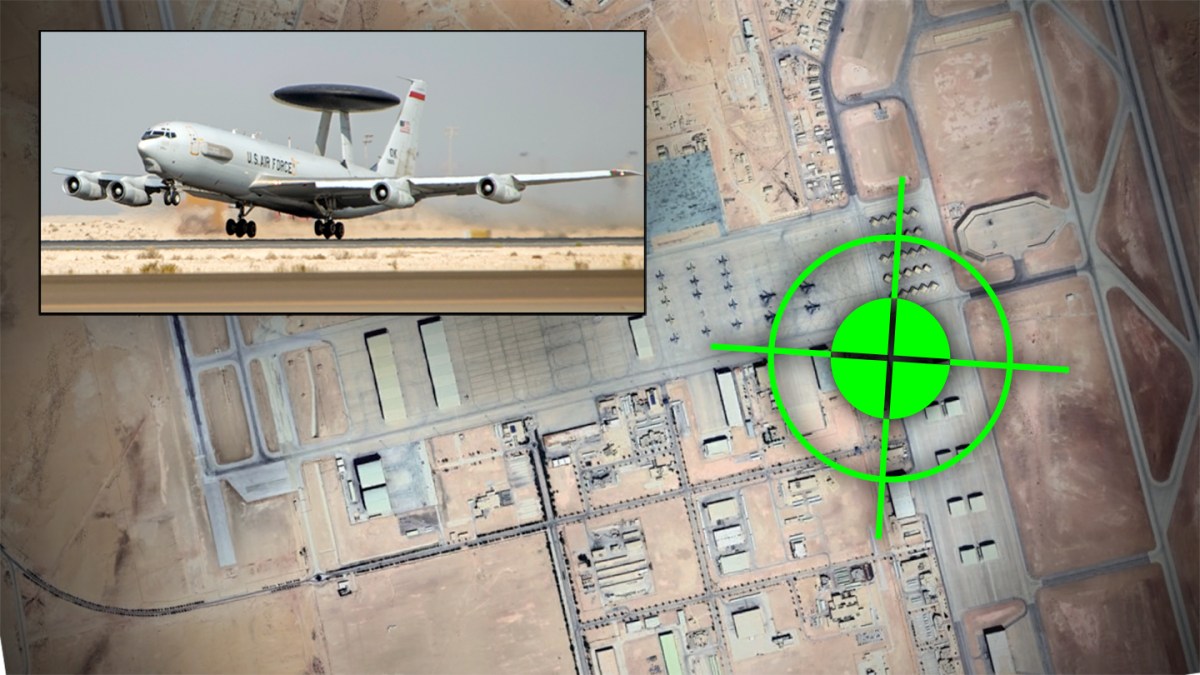
New images circulating online appear to show one of the U.S. Air Force’s E-3 Airborne Warning and Control System aircraft heavily damaged, and possibly destroyed, at Prince Sultan Air Base in Saudi Arabia following an Iranian attack on March 27. If authentic, the photos would point to a significant loss for a small and aging fleet that remains central to airborne command-and-control operations.
The source material available so far remains limited, and the status of the aircraft is not independently confirmed. The War Zone reported on March 29 that photos first posted to a Facebook page and then amplified across social media seem to show E-3 serial number 81-0005 with its rear fuselage burned out, surrounded by debris. The publication said the images appeared authentic after an initial review, but explicitly noted that it could not confirm them.
That distinction matters. In fast-moving military incidents, especially those unfolding amid regional escalation, imagery often spreads faster than verification. Analysts and reporters may identify visual consistency across angles or match details in the scene, but that still falls short of formal confirmation by the U.S. military or a fully documented geolocation and timing chain. At this stage, the available claim is narrower: images said to be from the base appear to show major damage to an E-3, and they surfaced after a real attack that reportedly damaged multiple U.S. aircraft and injured American personnel.
What Is Confirmed So Far
According to the supplied source text, the March 27 strike on Prince Sultan Air Base reportedly involved long-range one-way attack drones and ballistic missiles. The same report said multiple U.S. military aircraft were believed to have been damaged and that 10 U.S. service members were injured, some critically. It also described a slow release of information in the aftermath, with high-resolution commercial satellite imagery from major U.S. providers delayed, complicating independent assessment.
That imagery gap has increased the importance of foreign satellite images and ground-level photos. The War Zone said foreign satellite imagery purportedly showed major damage on the base’s main apron. It also noted that older satellite imagery showed aircraft spread out across the apron and on isolated taxiways, suggesting an effort to reduce the risk that a single strike could damage multiple high-value assets at once.
Even so, dispersal is not the same as protection. Aircraft parked in the open remain vulnerable to blast effects, fragmentation, and fire. The report specifically observed that a direct hit is not required to destroy an aircraft if nearby impacts throw shrapnel and ignite secondary fires. In practical terms, that means even limited penetration of base defenses can produce outsized losses when the target set includes surveillance aircraft, tankers, transports, or other specialized platforms.
Why an E-3 Loss Would Matter
The E-3 Sentry is far more than another airframe on a ramp. It is a flying radar and battle-management node designed to detect aircraft at long range, track activity across large sections of airspace, and coordinate friendly forces. In modern operations, those functions support warning, command, deconfliction, and broader situational awareness.
The War Zone characterized the E-3 fleet as dwindling and increasingly rickety, underlining the strategic importance of each surviving aircraft. That framing is significant because the operational impact of losing a specialized platform is not measured only by replacement cost. Availability, maintenance burden, trained crews, and mission demand all shape the real effect. A damaged or destroyed E-3 could reduce surge capacity, complicate regional coverage, and expose the degree to which the force depends on a limited number of legacy aircraft.
The incident would also raise broader questions about base defense. Prince Sultan Air Base is not an obscure outpost; it is a major site associated with U.S. operations in the region. If an adversary strike was able to damage multiple aircraft there, the result would intensify scrutiny of warning timelines, interception performance, passive defenses, aircraft sheltering, and dispersal procedures. It would also feed a wider debate over whether large fixed air bases are becoming more exposed in an era of cheaper drones, precision missiles, and persistent reconnaissance.
Open Questions Remain
Several key issues remain unresolved. The first is authenticity: are the photos genuine, and do they in fact show E-3 serial 81-0005 at Prince Sultan Air Base after the March 27 attack? The second is scope: if the aircraft in the images was hit, was it struck directly or damaged by blast and fragmentation from a nearby impact? The third is scale: how many additional aircraft were affected, and of what types?
The available source text does not answer those questions conclusively. It does, however, show how analysts are piecing together fragments of evidence in the absence of fresh high-resolution U.S. commercial imagery. That kind of information vacuum is now a recurring feature of modern conflict reporting, especially when military, commercial, and political considerations delay or restrict visual confirmation.
For now, the most defensible reading is a cautious one. A real Iranian strike occurred on March 27. U.S. personnel were reportedly injured. Multiple aircraft were reportedly damaged. Images now circulating appear to show catastrophic damage to an E-3, but those images remain unconfirmed. If they are validated, the incident would stand out as a serious material and symbolic blow to a high-value U.S. airborne surveillance fleet already under strain.
Until official confirmation or stronger independent verification emerges, the story remains important precisely because of that uncertainty. It sits at the intersection of military vulnerability, contested imagery, and the growing reach of long-range attack systems. Whether the aircraft was destroyed or not, the episode has already underscored a larger point: fixed airpower infrastructure is under mounting pressure, and the cost of even a partially successful strike can be far higher than a simple tally of impacts suggests.
This article is based on reporting by twz.com. Read the original article.
Originally published on twz.com