South Korea reaches a key KF-21 milestone
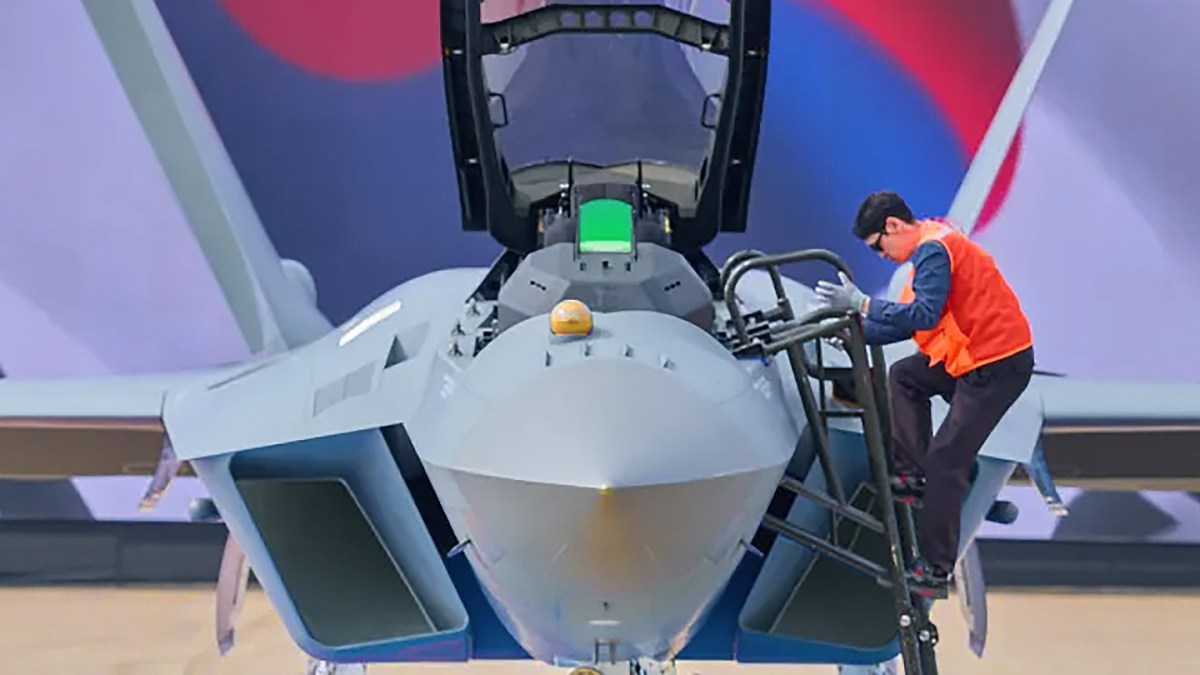
South Korea has rolled out the first series-produced example of the KF-21 fighter, marking a major step for one of the country’s highest-profile defense programs. The aircraft, also known as the Boramae, was unveiled March 25, 2026, at Korea Aerospace Industries headquarters in Sacheon, southeast of Seoul.
The significance of the moment lies not only in the aircraft itself, but in the pace of the program. According to the report, the rollout comes a little more than five years after the first prototype was unveiled. That is an unusually compressed timeline for a new-generation fighter effort, and it reinforces the sense that South Korea is trying to move quickly from prototype ambition to industrial output.
The first production aircraft unveiled in Sacheon is a two-seater. With this event, the program moves from development symbolism into the realities of series manufacturing, where national capability is measured less by concept art or flight-test milestones and more by whether aircraft can be built in quantity.
A fighter program tied to national strategy
At the ceremony, President Lee Jae Myung cast the KF-21 as more than a single platform. He said the fighter represented South Korea’s “aspirations for self-reliant defense,” linking the aircraft directly to a larger national project: reducing dependence by building more of the country’s military capability with domestic technology.
Lee also said he is committed to making South Korea one of the world’s top four defense powers. That is an ambitious statement, but it fits the broader framing presented around the rollout. The KF-21 is being positioned not just as a new aircraft for the Republic of Korea Air Force, but as evidence that South Korea’s defense industrial base is maturing into a more globally relevant force.
That message was underscored in Lee’s remarks when he pointed to other Korean-made systems that have secured foreign sales, including the K9 self-propelled howitzer and the Cheongung surface-to-air missile system. In military aviation, the report notes that KAI’s T-50 and FA-50 trainer and light combat aircraft family has also become a serious export contender.
Seen in that context, the KF-21 rollout serves two purposes at once. Domestically, it is a statement about self-reliance in airpower. Internationally, it is a statement about South Korea’s emergence as a defense manufacturer whose products are increasingly visible in export markets.
Why the production rollout matters
Prototype programs can generate headlines, but production milestones are harder to dismiss. A series-produced aircraft signals that the program has advanced beyond demonstrators and into the stage where manufacturing lines, suppliers, workforce coordination, and delivery planning begin to matter more than ceremonial unveiling alone.
That is why the March 25 event stands out. The report explicitly describes the KF-21’s development schedule as impressive when compared with other new fighter programs. It also notes that Seoul took some notable shortcuts to meet that aggressive timeline. Even without detailing those shortcuts, that point is important. It suggests the country has been willing to make atypical program choices in order to move faster.
Speed matters in defense aviation for obvious reasons: timing affects deterrence, procurement credibility, and export appeal. A fighter that reaches production faster can alter how quickly a country refreshes its own fleet and how soon it can present customers with a real, buildable product rather than a promise. In that sense, the production rollout is not just a ceremonial checkpoint. It is a sign that South Korea is compressing the gap between design ambition and industrial reality.
A broader shift in Korea’s defense industry
The report places the KF-21 inside a wider transformation. It says there is little doubt South Korea is “fast emerging as a major player” in defense manufacturing, with high-profile exports increasingly reflecting that trend. The fighter’s unveiling therefore lands at a moment when the country’s military-industrial narrative is expanding across multiple domains: artillery, air defense, trainer aircraft, and now a homegrown fighter moving into production.
That broader industrial setting makes the KF-21 more consequential. A new fighter is one of the most demanding products any defense sector can attempt. It requires not only airframe development, but sustained manufacturing discipline and long-term institutional support. Rolling out a first production aircraft does not finish that work, but it does show that South Korea has crossed into a new phase of execution.
The two-seat configuration of the first series-produced example also highlights that the program is moving through specific, concrete deliverables, not just abstract milestones. There is now a physical production aircraft that can anchor the next conversation about the program’s pace, credibility, and eventual fleet role.
What the KF-21 milestone signals now
The immediate takeaway is straightforward: South Korea has publicly unveiled the first production KF-21 a little more than five years after the prototype first appeared. That alone is enough to make the rollout a meaningful defense story.
But the larger signal is about trajectory. The KF-21 is being used to demonstrate that South Korea intends to build advanced military capability with its own technology and expand its standing in the global defense market. President Lee’s comments make that explicit, while the report’s comparison to other fighter programs emphasizes how quickly Seoul has pushed this effort forward.
There is still a difference between first production rollout and long-term program success. Yet for now, the event in Sacheon shows that the KF-21 has moved into a more serious stage. South Korea is no longer just showing what it can prototype. It is showing what it can start producing.
This article is based on reporting by twz.com. Read the original article.