Mystery Features on America's Most Secretive Bomber
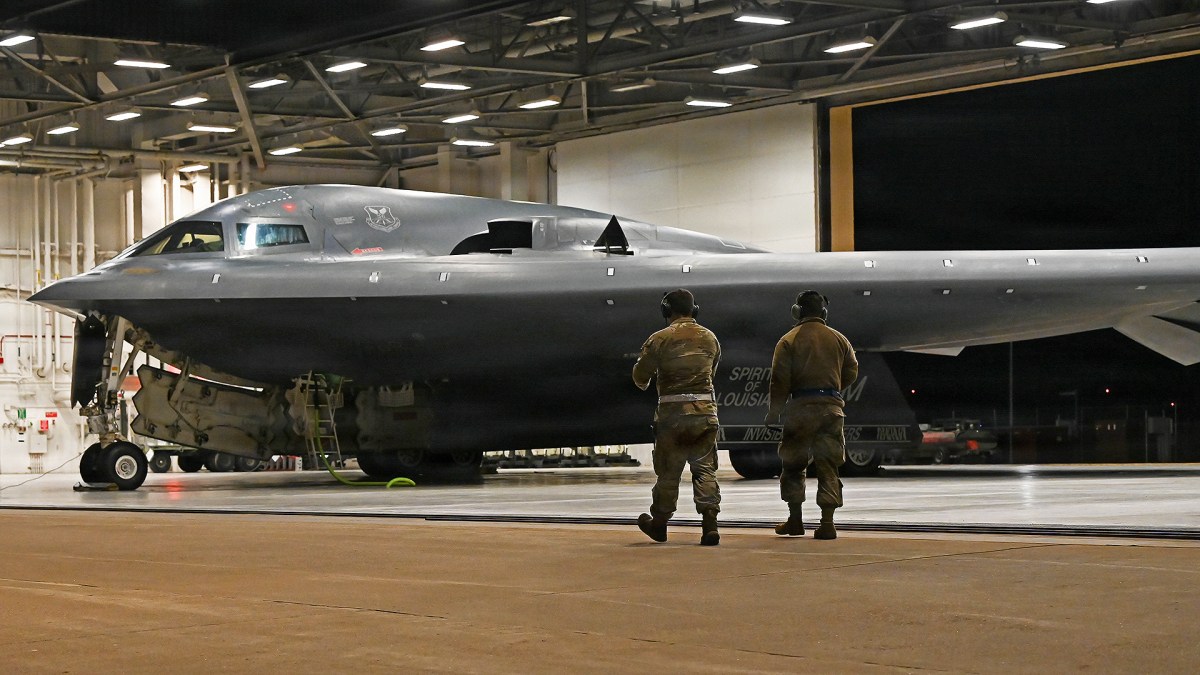
New photographs released in connection with Operation Epic Fury — the ongoing U.S. air campaign targeting Iran — have shown something unexpected on the wings of departing B-2 Spirit stealth bombers. White rectangular panels with black borders, arranged in symmetrical pairs along the aircraft's leading edges, have appeared on at least two separate jets. Defense analysts and aviation observers have been unable to definitively identify their purpose, raising questions about whether the most capable stealth bomber in the U.S. arsenal is being modified in real-time for an active combat mission.
Operation Epic Fury was launched on March 17, 2026. The B-2s involved are flying from Whiteman Air Force Base in Missouri, supported by B-1B and B-52H bombers forward-deployed to the United Kingdom. The campaign marks the first sustained operational use of the B-2 in a contested, high-threat environment since its combat debut in the 1990s.
What the Imagery Shows
The puzzling features appear as prominent white squares arranged along the leading edges of both wings, mirrored on both the upper and lower surfaces of the aircraft. The application method appears consistent with tape-sealing, which is a standard technique used in stealth aircraft maintenance to preserve low radar cross-section characteristics by covering seams and gaps. What makes these particular applications unusual is their size, regularity, and the fact that they appear on aircraft actively conducting combat operations.
Tyler Rogoway, editor at The War Zone, noted that we simply do not know what these new features are for, or if they will remain a staple on B-2s. The acknowledgment of genuine uncertainty from a publication with deep sourcing in the defense community underscores how unusual the features are — even to people with sustained access to information about stealth aircraft programs.
Theories From the Defense Community
Several explanations have circulated among analysts. One possibility is that the panels conceal new sensor apertures — openings for electronic intelligence gathering, electronic warfare emitters, or passive threat detection systems that could enhance the B-2's situational awareness in a heavily defended airspace like Iran's. The B-2 is already equipped with extensive electronic systems, but the specific threat environment posed by Iranian integrated air defense systems may have prompted real-world installation of new capabilities.
A second theory holds that the patches are related to radar-absorbent material upgrades. The B-2's stealth properties depend heavily on both its shape and its surface coatings, which must be maintained to exacting standards. The aircraft's operational history has been marked by the significant maintenance burden these coatings impose, and it is possible that new formulations are being trialed or installed on operational jets.
A third explanation is that the features are test markings or instrumentation from ongoing evaluation programs. The B-2 has previously been photographed with similar-looking markings during flight test phases, and it is not unprecedented for test configurations to migrate to operational aircraft. However, the presence of these markings on at least two jets conducting active combat sorties makes a pure test interpretation harder to sustain.
Combat Markings and End-of-Life Questions
The imagery also revealed that at least one B-2 displayed 15 bomb symbols on its nose gear door, a traditional marking used to count combat missions or weapons dropped. Analysts have noted some uncertainty about whether the symbols represent individual sorties or individual weapons released, and the count is higher than expected relative to the publicly known scope of the campaign.
The B-2 is operating in the later stages of its service life. Its successor, the B-21 Raider, is undergoing operational testing and is expected to eventually replace the Spirit fleet. The fact that modifications of uncertain purpose are appearing on B-2s in active combat may reflect a deliberate decision to push the capability envelope on an aircraft that is already in its twilight years — trading long-term maintenance predictability for operational advantage in a high-priority mission.
What Iran's Air Defenses Mean for the Mission
Iran operates one of the most sophisticated integrated air defense networks outside of Russia and China. The country has spent decades acquiring and indigenously developing surface-to-air missile systems, radar networks, and electronic warfare capabilities specifically designed to challenge American stealth aircraft. The deployment of B-2s to this environment — rather than relying solely on standoff weapons — reflects a deliberate calculation about what capabilities are needed to penetrate those defenses.
The mysterious wing modifications, whatever they ultimately prove to be, fit a pattern: when the United States deploys its most capable platforms into the most demanding environments, previously unseen configurations sometimes appear. Whether these are new sensors, new stealth treatments, or something else entirely, they represent the leading edge of an ongoing technological competition that plays out in real time over contested airspace.
This article is based on reporting by twz.com. Read the original article.
Originally published on twz.com