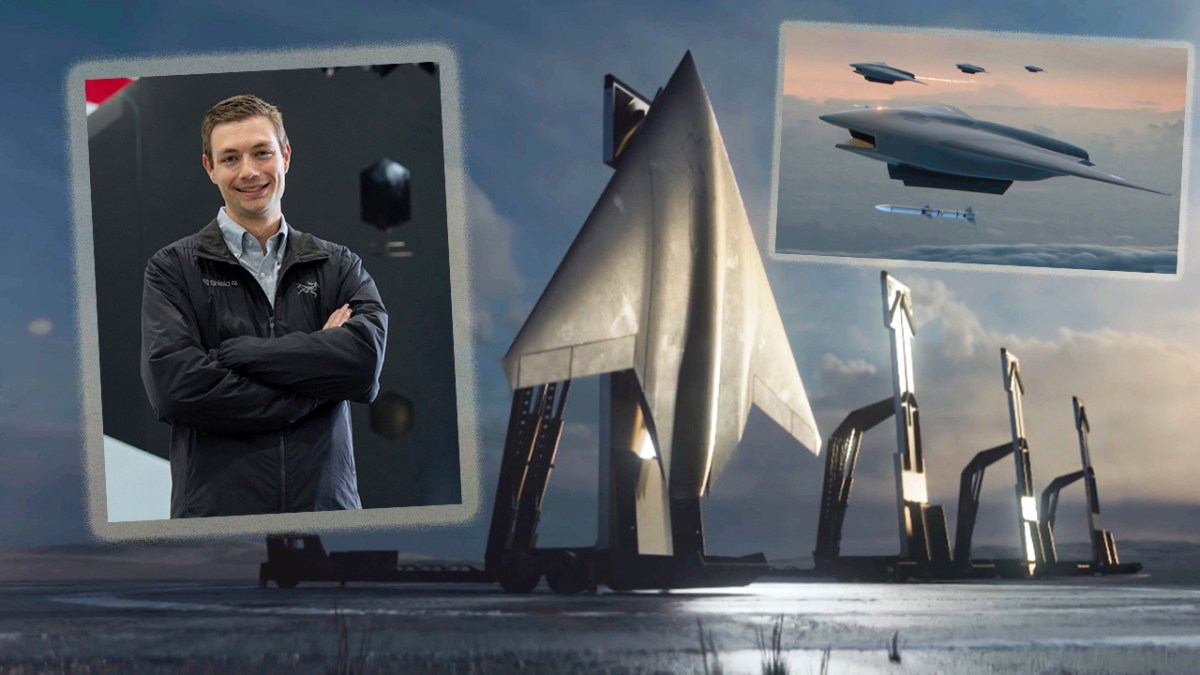
A More Ambitious Shape for the Autonomous Combat Aircraft Market
Shield AI is positioning its X-BAT project as something larger than another unmanned aircraft. Based on details discussed at Sea-Air-Space 2026 and reported by The War Zone, the company’s revised concept is a jet-powered autonomous stealth drone built around vertical takeoff and landing and intended to fly combat missions using the company’s Hivemind AI pilot. If the design can survive the jump from convention-floor concept to flight testing, it could pressure assumptions about both the future drone market and parts of the crewed fighter market.
The company revealed a revised planform configuration and additional design details at the April conference. Armor Harris, the chief designer of X-BAT, told The War Zone that the aircraft is planned to begin VTOL testing before the end of 2026. That timeline matters because the project’s central claim is not merely autonomy or stealth, but the combination of those attributes with tail-sitting vertical operations.
Why VTOL Is the Core Technical Risk
X-BAT is designed to take off vertically, transition to forward flight, and land vertically as a tail-sitter. That is an especially demanding configuration, and the source material makes clear that much of the program’s credibility rests on whether the VTOL concept works in practice. The aircraft is described as being designed around this operating mode, which means a failure in VTOL performance would threaten not just one subsystem but the broader premise of the aircraft.
That explains the emphasis on upcoming test milestones. Prototype or concept aircraft can attract attention with stealth shaping, software promises, or weapons compatibility, but for X-BAT the decisive question is whether Shield AI can demonstrate a repeatable vertical takeoff and landing sequence in a configuration that is also viable for combat use. The War Zone’s reporting is blunt on the point: a great deal rides on those tests.
The design also reportedly incorporates a GE engine and thrust-vectoring controls, both of which suggest that the company is relying on a mix of propulsion and control authority to make the tail-sitting concept practical. Those are not cosmetic decisions. They point to the fact that X-BAT is not simply a winged drone with added automation, but an aircraft attempting to solve multiple hard problems at once.

Autonomy Is Not a Side Feature
Shield AI says X-BAT is intended to fly combat missions under the control of its Hivemind artificial-intelligence pilot. That puts autonomy at the center of the aircraft’s identity rather than treating it as an assistive layer for a human operator. In the company’s framing, the aircraft is being built as an autonomous combat platform from the outset.
That matters strategically because many autonomous-aircraft efforts still present AI as a route to lower manpower demand, better mission coordination, or optional unmanned operation. X-BAT’s pitch is stronger and riskier: a stealthy aircraft that can operate in a fighter-like mission set while being controlled by an AI pilot and launched from locations that do not require conventional runways.
The concept fits a broader industry push toward autonomous aircraft able to absorb higher risk, disperse basing, and supplement or complicate the role of crewed tactical jets. But Shield AI is also going beyond the common expendable-drone logic. The company is presenting X-BAT as something with enough capability and internal volume to challenge at least some assumptions about what only a crewed fighter can do.
F-35-Sized Payload Bays Raise the Stakes
One of the most consequential details in the source text is Harris’s statement that X-BAT has been designed with internal payload bays roughly the same size as those on the F-35. If that translates into real compatibility with many of the same weapons, the aircraft would be entering a more serious class of relevance. Internal carriage is not just about firepower. It is tied to survivability, signature management, and mission flexibility.
That claim also shows how aggressively Shield AI is framing the platform. Rather than emphasizing only low cost or attritability, the company is arguing that X-BAT may be able to carry weapons associated with one of the West’s premier stealth fighters. That does not make it an F-35 equivalent, but it does signal a desire to compete in operational conversations that reach beyond typical drone roles.
If successful, a platform with VTOL flexibility, stealth shaping, meaningful internal payload space, and autonomous mission execution would be attractive for distributed operations, expeditionary basing, and scenarios where runway dependence creates vulnerability. Those possibilities help explain why the concept stands out despite the substantial technical risk still ahead.

Concept Strength Meets Program Reality
The strongest case for X-BAT is that it targets several military needs at once: runway independence, survivability, autonomy, and useful weapons carriage. The strongest case against overinterpreting it is that none of those advantages matter until the aircraft proves it can actually fly and recover in the intended mode.
The War Zone’s interview-based report captures that tension well. Shield AI has a dramatic concept and a clear thesis about disruption, but the near-term test schedule is where the program starts to earn or lose credibility. Programs of this kind often look most persuasive before the hardest integration work begins.
Still, X-BAT is worth tracking because it reflects a shift in ambition across the defense-technology sector. Autonomous aircraft are no longer being pitched only as sensors or loitering munitions. Increasingly, companies are proposing systems meant to sit closer to the tactical and operational center of air combat. X-BAT is one of the clearest examples of that trend. Whether it changes the air combat game will depend less on the elegance of its concept art than on what happens when VTOL testing starts later this year.
This article is based on reporting by twz.com. Read the original article.
Originally published on twz.com