Saab puts structure around Sweden’s unmanned combat ambitions
Saab has publicly sketched out one of Europe’s clearer roadmaps for a loyal wingman-style combat drone, using the Swedish Air Force’s centennial air show to present a three-aircraft development plan that could eventually produce an operational unmanned partner for the Gripen fighter.
At Malmen Air Base in southern Sweden, the company said it is developing three unmanned aircraft labeled A1, A2 and A3. Together they form a staged pathway toward what Saab calls an Autonomous Collaborative Platform, or ACP. The framing matters. Rather than presenting a single concept image or distant ambition, Saab described a sequence of demonstrators and capability steps, with concrete milestones attached to the first two aircraft and a rough service-entry horizon for the third.
The announcement places Sweden more visibly inside the global shift toward mixed fleets of manned and unmanned combat aircraft. The United States has been pushing Collaborative Combat Aircraft programs to pair autonomous systems with crewed fighters. Saab’s terminology differs, but the strategic logic is similar: extend reach, add mass, distribute risk, and give crewed aircraft new options for contested operations.
Three aircraft, three capability steps
The A1 is planned as a supersonic demonstrator powered by a GE F414 engine, the same American engine used in the Gripen E/F. Saab said the engine will be AI-driven, an indication that autonomy and onboard decision support are central to the concept from the start rather than later add-ons. The company expects the first of its demonstrators to fly within 15 months, while both the A1 and A2 are expected to be airborne within four years.
The A2 adds another major feature: an internal weapons bay. That signals a move beyond experimentation into design choices associated with survivability, mission flexibility and a more operationally relevant configuration. Even without a full public technical breakdown, the progression from a supersonic demonstrator to a design with internal weapons carriage suggests Saab is trying to retire risk in layers rather than jump straight to a final production system.
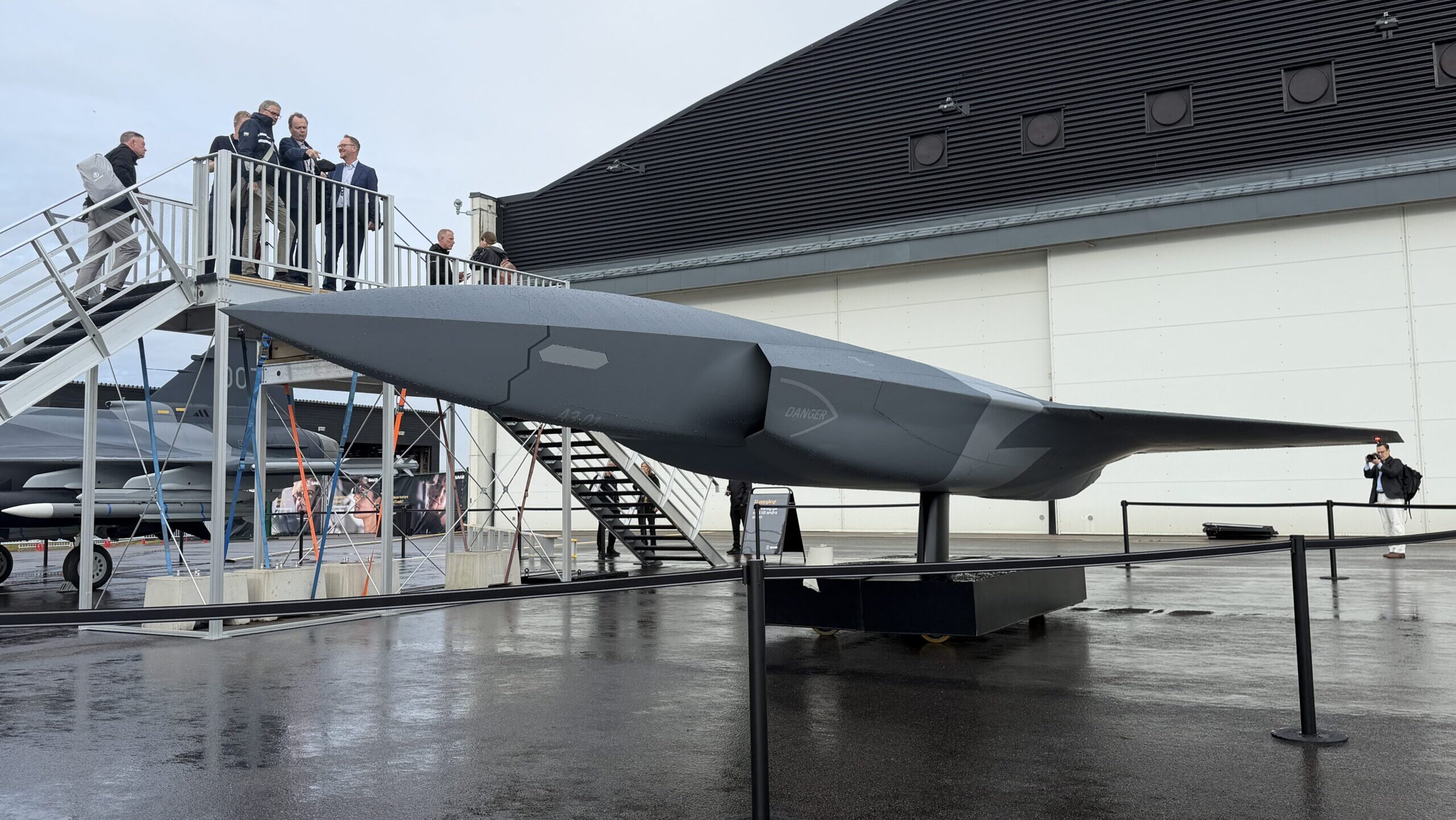
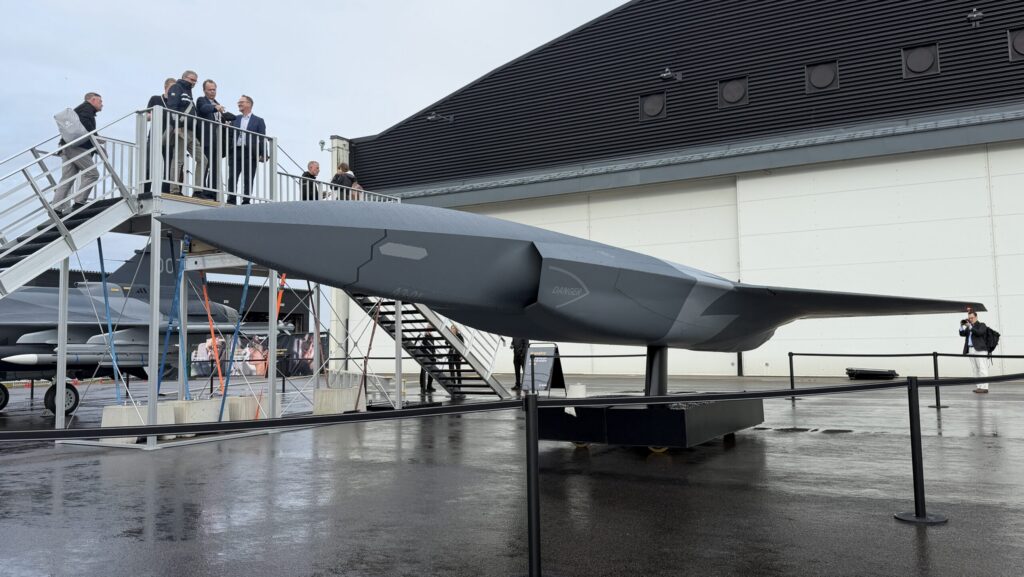
The A3 is the aircraft Saab says may become the eventual sales product. A full-scale model was displayed outside the company’s hangar at the air show. If the Swedish government decides to proceed and fund it, Saab said the A3 could enter service within ten years.
Government backing is not final, but the signal is positive
The caveat is financing. A state funding decision for the A3 has not yet been made, which means the concept remains contingent on political and budgetary support. Still, the public comments around the unveiling point to alignment rather than resistance.
Swedish Defense Minister Pål Jonson said Saab’s approach looked like a natural development of the Gripen system, specifically referencing a loyal unmanned wingman component capable of performing deep operations alongside the crewed platform. That is not a procurement contract, but it is a strategically important endorsement. It shows the company is not pitching the program in a vacuum; it is tying the aircraft directly to Sweden’s existing air combat architecture.
That linkage may be one of Saab’s strongest advantages. Countries that already operate Gripen tend to value sovereignty, modularity and affordability relative to larger allied fighter ecosystems. An unmanned companion aircraft designed from the outset as part of the Gripen family could be attractive not only for Sweden, but potentially for export customers looking for a more integrated pathway into manned-unmanned teaming.
Why Europe is moving this way
The broader military trend is straightforward. Air forces increasingly expect future operations to involve dense air defenses, electronic warfare, larger geographic theaters and higher attrition risk. Under those conditions, sending only expensive crewed fighters deep into contested zones looks less sustainable. Loyal wingman concepts promise a way to push sensing, strike, jamming or decoy functions forward without putting pilots at the same level of risk.
Saab’s own description of the effort suggests it sees these aircraft as collaborators rather than replacements. Brigadier General Niclas Magnusson, Sweden’s deputy air chief, said he expects some kind of mix between manned and unmanned assets and described the future as mixed squadrons that combine both. That is an important operational signal. It implies the Swedish Air Force is not simply exploring drones as standalone systems, but as participants in squadron-level force design.
For Europe, that matters beyond Sweden. The region has been trying to strengthen defense industrial capacity and reduce dependency in key military technologies while still remaining interoperable with allies. A viable Swedish autonomous combat platform would add another European-developed option in a field now dominated by US momentum and growing international competition.
What remains uncertain
There is still a large gap between a display model and an operational combat aircraft. Saab has not, in the supplied source text, disclosed the full performance envelope, autonomy rules, payload options, survivability approach, communications architecture or teaming doctrine. Those details will determine whether the ACP concept becomes a credible operational tool or remains a promising framework.
The timeline is also ambitious. A first flight within 15 months for the earliest demonstrator would move quickly by European defense development standards. Delivering both A1 and A2 within four years and then transitioning to a potentially operational A3 within a decade would require steady funding, disciplined execution and continued military buy-in.
There is also the usual challenge with autonomy in combat systems: how much authority the aircraft receives, how it remains controllable under jamming and degraded communications, and how the human pilot or command chain stays inside the decision loop. Saab’s use of the phrase Autonomous Collaborative Platform suggests it wants to emphasize teamwork, but the exact division between human command and machine initiative is still undefined in the available material.
A meaningful marker for the next phase of air combat
Even with those unknowns, Saab’s announcement is significant because it moves the loyal wingman discussion from abstraction to an incremental acquisition story. The company is not only showing a possible end state. It is defining a path to get there, linking that path to the Gripen ecosystem, and doing so with visible support from Sweden’s defense leadership.
If funding follows, the A3 could become one of Europe’s more consequential unmanned combat programs of the next decade. If it does not, the A1 and A2 still give Saab a way to build expertise and validate technologies that will shape future airpower. Either way, Sweden has made clear that mixed manned-unmanned combat aviation is no longer a distant talking point. It is becoming a design requirement.
This article is based on reporting by Breaking Defense. Read the original article.
Originally published on breakingdefense.com