A trainer aircraft with an intelligence mission
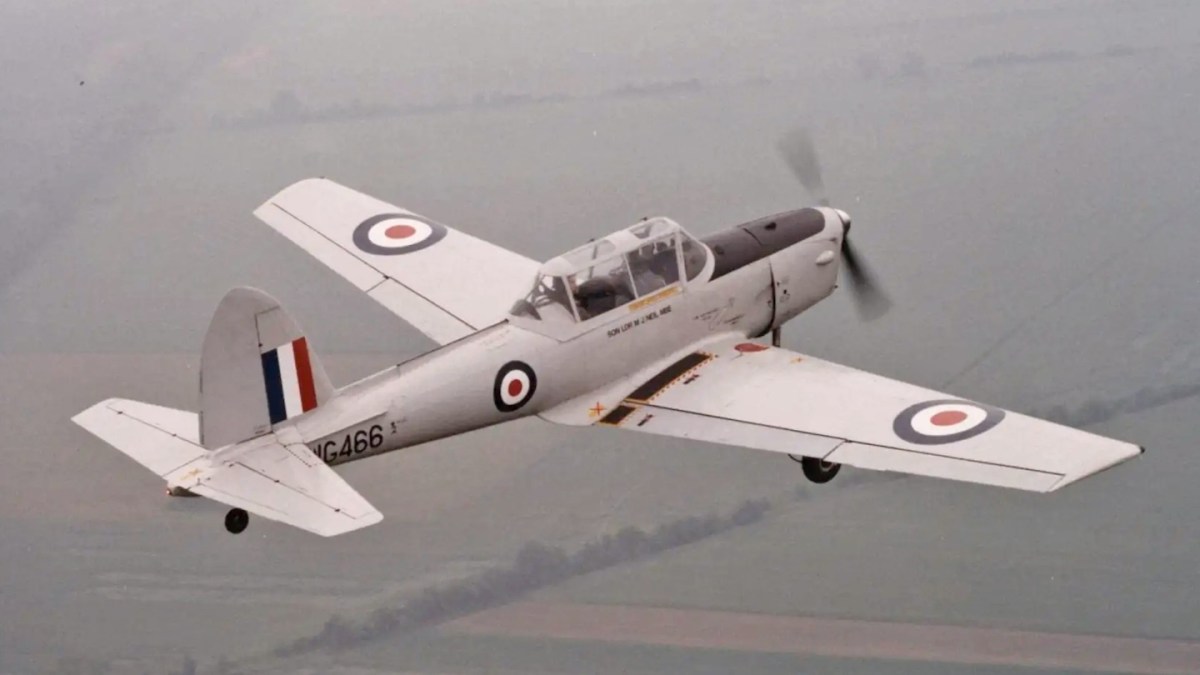
The de Havilland Canada DHC-1 Chipmunk is usually remembered as a modest basic trainer, the kind of aircraft used to teach generations of military pilots the fundamentals of flight. But one small group of Chipmunks spent much of the Cold War doing something very different. According to The War Zone, the Royal Air Force used a handful of the light propeller aircraft between 1956 and 1990 for intelligence-gathering flights connected to divided Berlin.
The timing is notable because the renewed attention comes on the 80th anniversary of the Chipmunk’s first flight. One of the aircraft recently flown by the Battle of Britain Memorial Flight, WG486, previously served with RAF Gatow Station Flight and took part in those Berlin missions. That gives the anniversary an unexpected intelligence-history angle: a training aircraft that became part of a long-running surveillance effort in one of the most politically charged places in Europe.
Why Berlin mattered
After World War II, Germany was divided among France, the Soviet Union, the United Kingdom, and the United States. Berlin was split as well, despite being deep inside the Soviet occupation zone. Under the postwar quadripartite arrangement, the Western Allies retained access rights to the city through land and air corridors that linked West Berlin to Western-controlled areas of Germany.
That framework did more than preserve logistics. It also created highly unusual operating conditions for intelligence work. The Western powers and the Soviet Union each maintained liaison missions that were formally meant to support communication. In practice, these arrangements created opportunities to observe military activity across the occupation system. The War Zone notes that the Western missions were able to move with relatively few restrictions in the Soviet zone, which later became East Germany, while Soviet missions operated in the West under similar principles.
From pilot instruction to quiet surveillance
For Britain, the key organization on the ground was the British Mission to Soviet Forces in Germany, known as BRIXMIS, based in Potsdam near Berlin. The Chipmunk’s role fit into that larger ecosystem of collection and observation. Its small size and basic design were not obvious markers of a surveillance platform, which is part of what makes the story stand out. This was not a high-speed jet or a purpose-built reconnaissance aircraft. It was a light trainer that found a second life monitoring Warsaw Pact forces around a walled and heavily defended city.
The article frames the Chipmunk assignment as one of the most unusual chapters in the aircraft’s career, and the description is hard to dispute. The type’s reputation was built on training value, simplicity, and endurance in service. Yet those same traits also made it useful in a contested political environment where persistence and access mattered as much as glamour.
A Cold War footnote worth revisiting
The Chipmunk’s Berlin service says something broader about the Cold War itself. Intelligence work in that era often depended not just on advanced hardware but on legal gray zones, postwar arrangements, and aircraft adapted for missions their designers never imagined. In Berlin, where the front line between East and West was both military and symbolic, even a humble trainer could become part of a strategic contest.
The result is a reminder that some of the period’s most interesting surveillance stories did not involve famous spy planes. They involved ordinary airframes used in extraordinary circumstances, operating because political geography made them useful. The Chipmunk’s decades over Berlin belong to that category: low-key, persistent, and unexpectedly revealing about how the Cold War actually worked on the ground and in the air.
This article is based on reporting by twz.com. Read the original article.
Originally published on twz.com