A historic fighter returns to the center of the picture
Ninety years after the Spitfire’s first flight, the Royal Air Force has marked the anniversary by pairing the iconic World War II fighter with today’s frontline aircraft in a series of formation flights across the United Kingdom. The commemorative effort culminated in a nine-leg tour completed on Friday, according to the supplied source text.
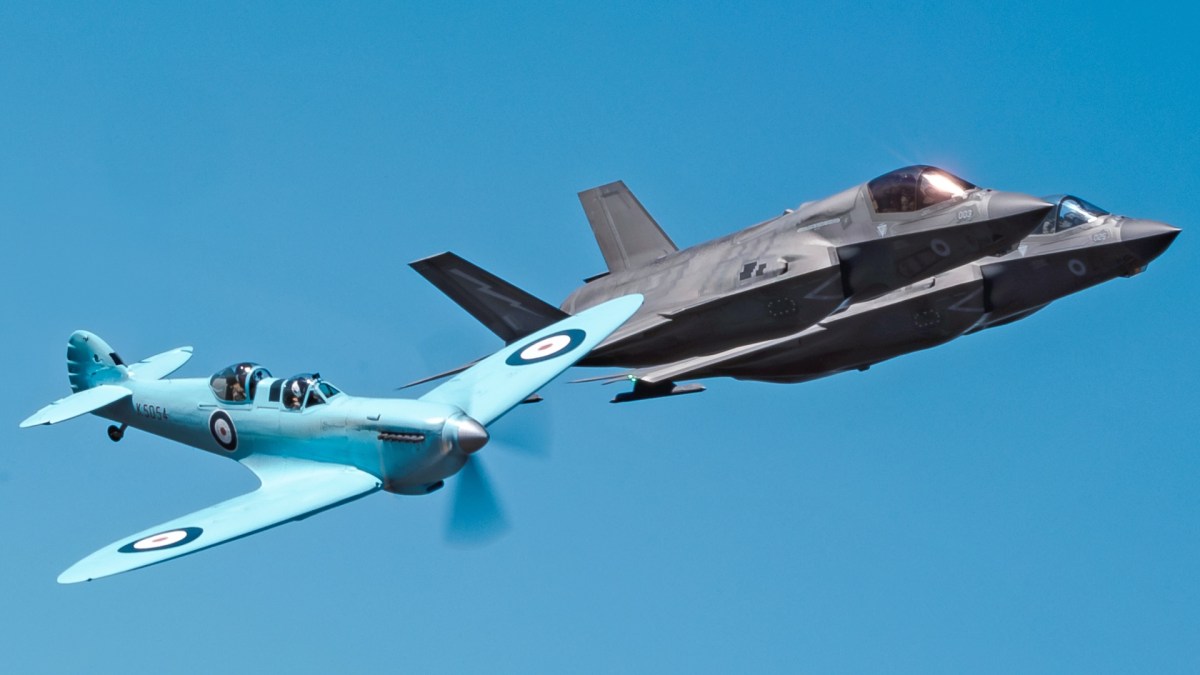
The aircraft used for the anniversary flights was not the original prototype, but a two-seat Spitfire painted blue to represent K5054, the first prototype that flew on March 5, 1936. That original aircraft was flown from Eastleigh Aerodrome, now Southampton Airport, by Capt. Joseph “Mutt” Summers. In one of the enduring stories attached to the type, Summers is popularly said to have remarked that he did not want anything changed after the first sortie, a line that became part of Spitfire lore.
Whether or not every detail of that legend is exact, the broader historical verdict is not in doubt. The Spitfire quickly impressed the Air Ministry so much that a production order followed in less than three months, even before trials were complete. More than 20,000 production examples would eventually be built, and the aircraft became one of the defining fighters of the Second World War.
The anniversary flights underline how strongly that reputation still resonates in Britain’s military identity. The Spitfire is not just an old airframe preserved for nostalgia. It remains a shorthand for design elegance, wartime urgency, and the modernization of air power. Bringing it into the sky with current Royal Air Force types compresses nine decades of aviation into one visual statement.
The aircraft used in the commemorations also has its own layered history. The source text identifies it as a Mk IX, BS410, which crashed in May 1943, was later recovered and rebuilt in the 2000s, and eventually converted into a two-seater. It is now privately owned. That restoration history matters because it shows how preservation has shifted from static display toward active airborne heritage, where historic aircraft continue to fly and to educate through presence rather than museum labels alone.
Beginning on April 7, the K5054-lookalike Spitfire joined up with a range of modern aircraft during the tour. The supplied text emphasizes that these were frontline British aircraft, making the exercise more than a ceremonial solo display. It became a sequence of encounters between generations of military aviation: the elliptical-wing fighter that helped define one era of air combat and the advanced types that define another.
That juxtaposition is especially powerful because the gap is not merely one of age, but of technological philosophy. The original Spitfire emerged in an era when speed, climb, maneuverability, and airframe refinement were central measures of fighter excellence. Modern combat aircraft add stealth shaping, sensor fusion, complex networking, vertical or short takeoff capability in some variants, and a digital ecosystem that would have been unimaginable in the 1930s. Flying them in company does not suggest equivalence. It highlights evolution.
There is also a cultural and institutional value in exercises like this. Armed forces often rely on symbols to connect current personnel with historical continuity. The Spitfire occupies that role unusually well for the RAF. It evokes not only the Battle of Britain but also a longer narrative of national resilience, aerospace engineering, and industrial mobilization. By placing it beside contemporary aircraft, the RAF effectively says that present capability sits in a lineage rather than a vacuum.
The anniversary comes with another reminder embedded in the source text: the Royal Air Force did not fly its last operational Spitfire sortie until 1954, in Malaya. That extended service life complicates the tendency to treat the aircraft as a purely wartime relic. The Spitfire endured through multiple phases of military aviation before finally leaving operational service.
Commemorative flights alone do not change force structure, procurement, or doctrine. But they can still matter. They help translate abstract heritage into something visible, audible, and immediate. For a public that may know the Spitfire more as a silhouette than as a machine, formations with modern RAF aircraft make history legible again. And for the service itself, the flights offer a disciplined reminder that today’s technology, like yesterday’s, will eventually be judged not only by performance, but by what it comes to represent.
More than a nostalgia flight
The nine-leg anniversary tour was built around an aircraft standing in for prototype K5054, but the message was broader than commemoration. By pairing the Spitfire with active RAF aircraft, the event linked Britain’s most recognizable wartime fighter to the service’s present-day identity and future-facing air power.
This article is based on reporting by twz.com. Read the original article.
Originally published on twz.com