A New Eye in the Sky
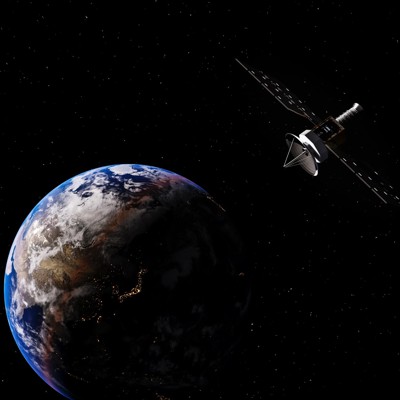
The intelligence community is watching the development of quantum camera technology with intense interest, and for good reason. Quantum sensors — devices that exploit the strange properties of quantum mechanics to detect light, gravity, and magnetic fields with extraordinary sensitivity — could fundamentally change what satellites can see from orbit and how they see it.
Current space-based intelligence relies primarily on optical cameras and synthetic aperture radar. These systems have improved dramatically over decades of development, but they operate within the constraints of classical physics. Optical cameras need clear skies and daylight. Radar can penetrate clouds and work at night but produces lower-resolution images. Both can be fooled by camouflage and concealment techniques that have been refined over generations of military practice.
Quantum cameras promise to bypass many of these limitations. By detecting individual photons with quantum-level precision, these sensors can extract information from light signals so faint that conventional detectors would register only noise. The practical implications for intelligence gathering are significant: better imagery in low-light conditions, the ability to detect objects through obscurants like clouds and fog, and sensitivity to electromagnetic signatures that reveal hidden activities.
How Quantum Sensing Works
At its core, quantum sensing exploits a property called entanglement — the ability of quantum particles to be correlated in ways that have no classical analogue. When two photons are entangled, measuring one instantly provides information about the other, regardless of the distance between them. This property can be used to create imaging systems that are fundamentally more sensitive than anything possible with classical optics.
One approach being developed involves illuminating a target with one photon from an entangled pair while retaining the other in a detector. By correlating the returned signal with the retained photon, the system can distinguish genuine reflections from background noise with extraordinary accuracy. This technique, sometimes called quantum illumination, could theoretically detect stealth aircraft or submarines by picking up signals that would be invisible to conventional radar.
Another promising application involves quantum gravity sensors. These devices measure variations in gravitational fields with extreme precision, potentially allowing satellites to detect underground tunnels, bunkers, or mineral deposits from orbit. While gravitational sensing from space exists today, quantum-enhanced versions could improve resolution by orders of magnitude.
Intelligence Applications
For the intelligence community, quantum cameras could address several persistent challenges. All-weather, day-night imaging capability would eliminate the scheduling constraints that limit current satellite reconnaissance. Intelligence analysts currently must wait for cloud-free passes over targets, and adversaries have learned to time sensitive activities to coincide with known gaps in satellite coverage.
Quantum sensors could also enable a new category of intelligence called spectral forensics — identifying the chemical composition of materials from space. A quantum-enhanced hyperspectral imager could potentially distinguish between a decoy vehicle and a real one by detecting subtle differences in paint composition, or identify facilities processing specific chemicals by their atmospheric emissions.
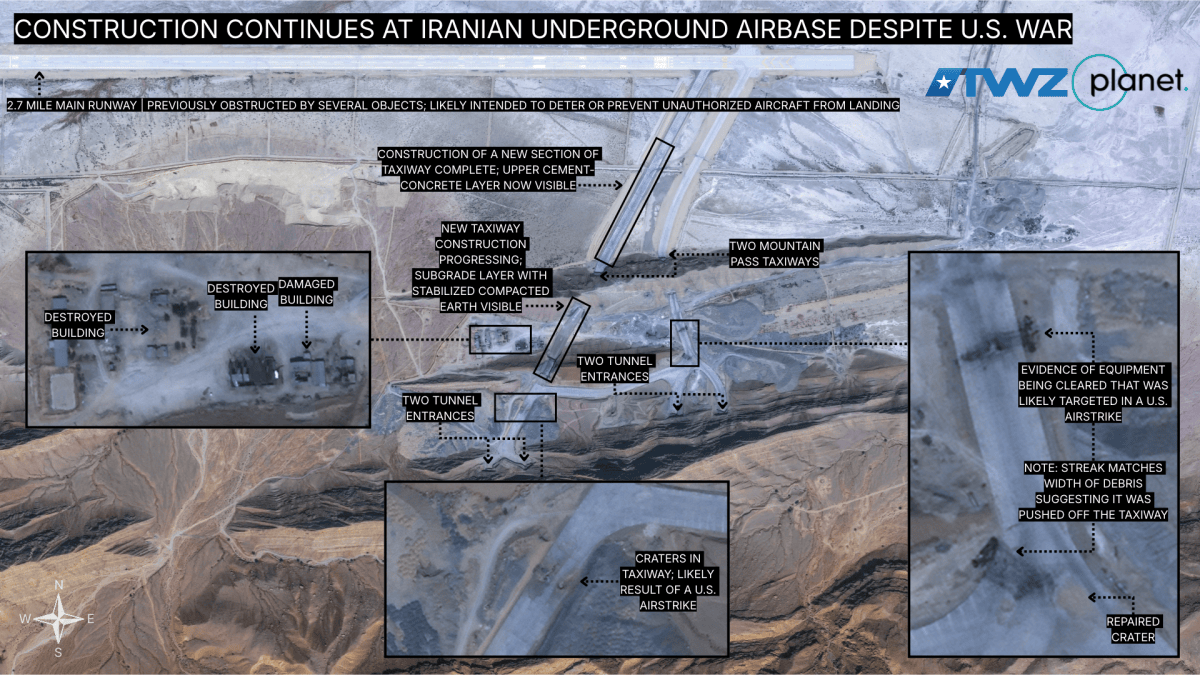
The counter-concealment implications are equally significant. As nations invest in underground military infrastructure — China's network of tunnels for mobile missile launchers, Iran's buried nuclear facilities, North Korea's extensive underground military complexes — the ability to sense what's beneath the surface from orbit becomes strategically valuable.
Technical and Practical Hurdles
Despite the promise, significant obstacles remain between laboratory demonstrations and operational space-based systems. Quantum states are extraordinarily fragile, easily disrupted by temperature fluctuations, vibration, and electromagnetic interference — all present in abundance in the space environment. Maintaining the precise conditions needed for quantum sensing aboard a satellite requires engineering solutions that don't yet exist at the required scale and reliability.
There's also the data processing challenge. Quantum sensors generate information in fundamentally different formats than classical cameras, requiring new processing pipelines and analytical tools. The intelligence community's existing infrastructure for handling satellite imagery would need substantial modification to incorporate quantum sensor data.
Power requirements present another constraint. Many quantum sensing technologies require cooling to near absolute zero, which demands significant power and thermal management systems. Satellites have limited power budgets, and every watt devoted to cooling the sensor is a watt not available for other systems.
The Timeline
Defense agencies are investing heavily in moving quantum sensing from the laboratory to practical deployment, but realistic timelines span years rather than months. Initial demonstrations of space-qualified quantum sensors are expected within the next three to five years, with operational intelligence capabilities following perhaps a decade later.
In the meantime, ground-based and airborne quantum sensing systems are advancing more quickly, providing proof-of-concept demonstrations and generating the engineering data needed to design space-based versions. Several nations, including the United States, China, and members of the European Union, have active quantum sensing research programs with defense applications.
The race to deploy quantum cameras in space is likely to become one of the most consequential technology competitions in the intelligence world. Whoever masters this capability first will possess a surveillance advantage unlike anything since the dawn of satellite reconnaissance in the 1960s.
This article is based on reporting by Defense One. Read the original article.
Originally published on defenseone.com