From Perpetual Promise to Operational Mandate
For as long as military technology enthusiasts have been paying attention, laser weapons have been five years away. The phrase has become something of a dark joke in defense circles — a shorthand for programs that consistently promised battlefield revolution and consistently delivered underwhelming results, blown schedules, and cancelled contracts. That history now weighs heavily on the Pentagon as it attempts to make good on a far more concrete and public commitment: fielding directed energy weapons at scale within the next 36 months.
Speaking at the National Defense Industrial Association's Pacific Operational Science and Technology conference in Honolulu in early March, Assistant Secretary of Defense for Critical Technologies Michael Dodd stated unambiguously that the Defense Department plans to field directed energy weapons — high-energy lasers and high-powered microwave systems — at operational scale within three years. The driver is not a new technological breakthrough, but rather an acute operational problem: waves of cheap Iranian Shahed drones exploiting a crippling cost asymmetry against conventional interceptor missiles.
The Math That Changed Everything
The economics of modern drone warfare have forced a reckoning that technical elegance and laboratory demonstrations could not. A single Patriot PAC-3 interceptor missile costs more than $3 million. The Iranian Shahed drones it's being used to shoot down cost between $20,000 and $50,000 each. For every drone destroyed, the United States spends anywhere from 60 to 150 times what it cost Iran to build the weapon. At scale — and the current Operation Epic Fury in the Middle East has involved hundreds of drone attacks — this arithmetic becomes fiscally and strategically untenable.
Directed energy weapons promise to invert this calculus. A high-energy laser doesn't require a magazine of expensive interceptor missiles. Each shot requires electricity — a few dollars' worth — to generate the beam. For countering mass drone attacks, a system that can engage targets continuously as long as it has power represents a qualitatively different kind of deterrent than one constrained by the number of expensive missiles in inventory.
Deputy Under Secretary of Defense for Research and Engineering James Mazol made the operational imperative explicit: "We need to be able to deal with mass, and we need to be able to defeat mass that's coming at us." President Trump echoed the sentiment at a White House press conference, touting laser weapons as a cheaper alternative to the Patriot systems currently bearing the brunt of drone defense operations. "The laser technology that we have now is incredible. It's coming out pretty soon," Trump said.
All Services Are Moving
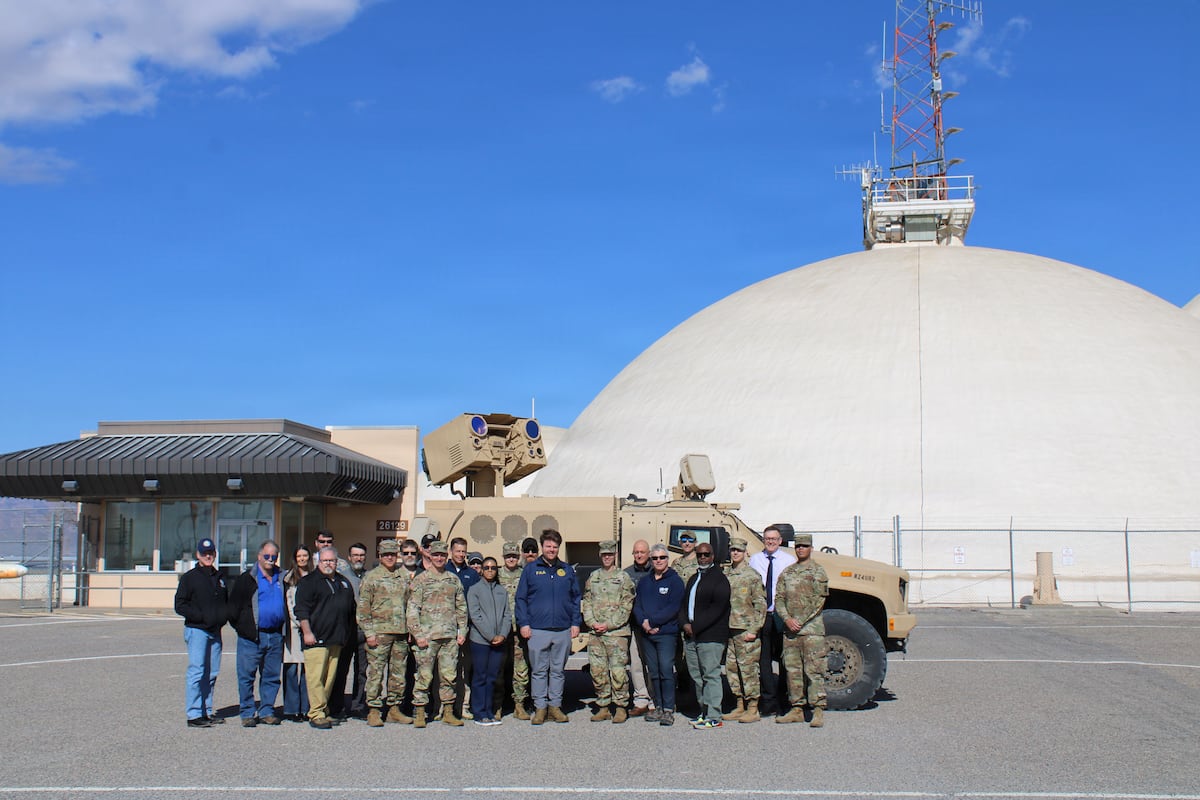
The Pentagon's 36-month mandate doesn't exist in isolation — it is accelerating programs already in motion across all military branches. The U.S. Army has published draft requirements for an Enduring High Energy Laser (E-HEL) program that would produce and rapidly field up to 24 systems, potentially representing the Army's first laser weapon program of record. The Navy has articulated a vision of a laser on every ship — a significant shift from the caution that has historically characterized the service's approach to directed energy.
The Air Force is attempting another run at airborne laser systems and ground-based base defense applications, having previously scrapped similar programs after years of disappointing results. The Marine Corps is investing in a more formal program of record for laser weapons. Perhaps most significantly, the Army and Navy are jointly developing a new laser weapon system under the Golden Dome initiative, representing inter-service cooperation on directed energy that has been rare historically.
Israel Mounts Lasers on Fighter Jets
The same week the Pentagon announced its accelerated timeline, Israeli defense contractor Elbit Systems revealed plans to mount laser weapons on Israeli Air Force fighter jets and helicopters — a program receiving new urgency from joint US-Israeli military operations against Iran. Israel already operates the ground-based Iron Beam laser defense system, which became operational at the end of 2025, but atmospheric conditions including dust, humidity, and turbulence limit ground-based systems.
"Putting a high-power laser in the air will enable us first to overcome some of the challenges of the ground, like weather and dust and turbulence," said Elbit CEO Bezhalel Machlis. "Flying above clouds will enable us to gain more range and to be more effective, and also to eliminate the threats far away from our borders." He also hinted at offensive applications: "High-Power Laser is not just a defensive weapon."

What Could Still Go Wrong
The history of directed energy weapons programs counsels humility. Laser weapons face real physical constraints: beam quality degrades in humid or dusty air; thermal management is challenging in confined platforms; and achieving the power levels needed for long-range hard kills against armored threats remains beyond current technology. The systems being discussed for near-term fielding are primarily anti-drone applications at relatively short ranges.
Procurement and testing timelines have a way of stretching. Thirty-six months is an ambitious schedule for moving from scattered operational tests to widespread fielding across multiple services. But the combination of urgent operational need, presidential attention, and a clear cost-asymmetry problem represents the best conditions the directed energy community has ever faced for turning decades of research investment into fielded capability.
This article is based on reporting by C4ISRNET. Read the original article.
Originally published on c4isrnet.com