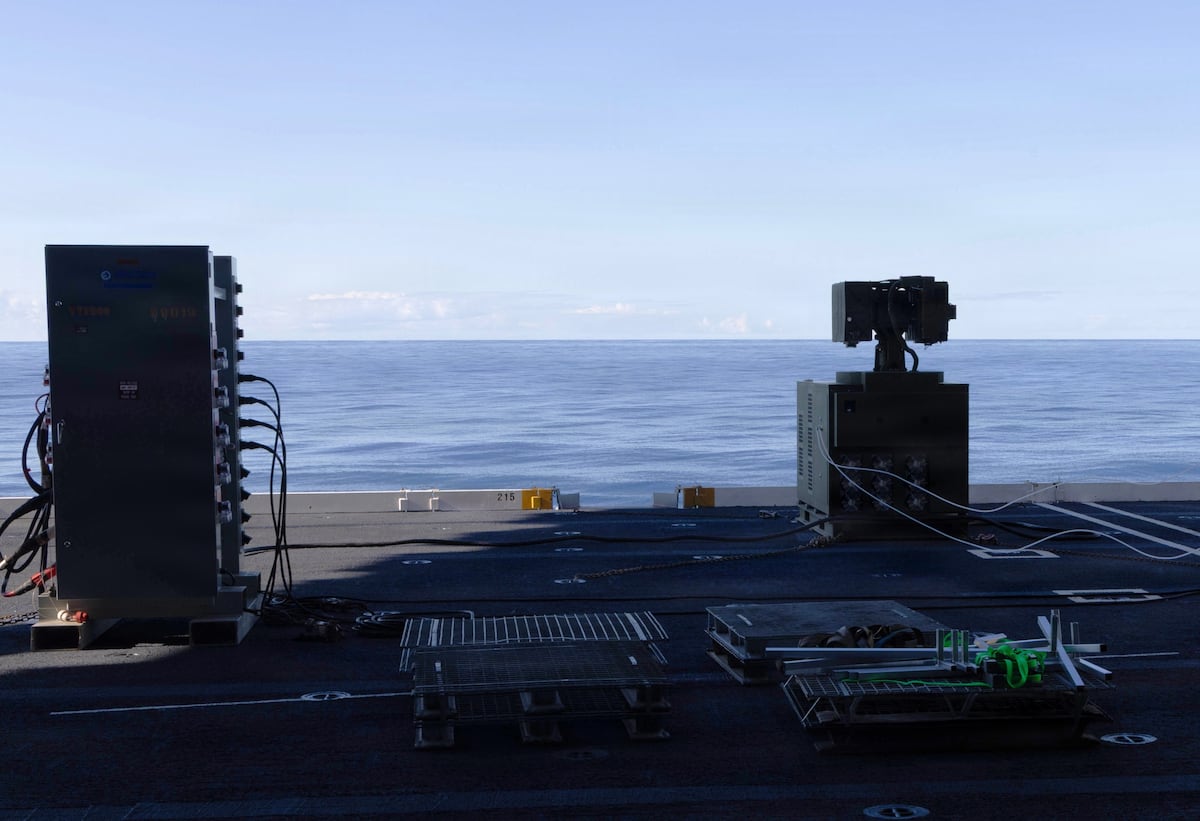
Directed energy is still a future-fleet promise
The U.S. Navy is pressing ahead with its vision for a force equipped with far more laser weapons, arguing that directed energy is becoming essential for missile defense and for preserving valuable missile-launch capacity for offensive missions. But recent testimony from Chief of Naval Operations Adm. Daryl Caudle makes clear that the service’s biggest challenge is not conceptual. It is architectural.
In a posture statement to the House Armed Services Committee on May 14, Caudle argued that high-energy lasers are a critical component of future naval warfare, particularly for ballistic missile and terminal defense. His logic is straightforward: when a destroyer uses vertical launch system cells for defensive interceptors, those cells are no longer available for long-range offensive weapons. Directed energy, in theory, reduces that tradeoff by shifting some defensive burden away from kinetic missiles.
That strategic case has become more urgent, in the Navy’s telling, because Arleigh Burke-class destroyers remain the workhorses of the fleet. Caudle explicitly linked their importance to Operation Epic Fury. But even as he pressed the argument for lasers, his testimony also underscored why the dream of “a laser on every ship” remains far from reality.
Why existing warships are the problem
The main obstacle is power and cooling. Caudle’s statement pointed toward future platforms, including a proposed nuclear-powered battleship and other future surface combatants, that would be designed with the electrical and thermal capacity needed to scale directed-energy systems to much higher energy levels. That emphasis matters because it implicitly acknowledges the limits of today’s fleet.
Those limits are not new. The article notes that even the Navy’s more modern Flight III Burke-class destroyers cannot support laser weapons at meaningful scale because their power budgets are already heavily committed, particularly to the AN/SPY-6 Air and Missile Defense Radar system. Rear Adm. Ron Boxall captured the issue bluntly in 2019 when he said the Flight III Burkes were already effectively out of room in power terms.
This is the core reality facing Navy laser advocates. Shipboard directed energy is not just another payload to bolt on. It competes for electricity, cooling capacity, integration effort, and operational space inside ships designed around earlier assumptions. Retrofitting legacy vessels for very high-energy laser use is therefore much harder than the strategic argument alone might suggest.
The Navy’s answer: build for it from the start
Caudle’s proposed path forward is to prioritize research and development in compact, high-density energy storage and thermal management systems, while also investing in digital engineering and land-based test facilities. The goal is to reduce risk before integrating directed-energy weapons with combat and ship-control systems.
That approach recognizes that naval lasers are a systems problem, not a single-technology problem. The beam itself is only one piece. A viable operational weapon also requires enough generation capacity, enough cooling, enough control integration, and enough confidence that it can coexist with other mission-critical systems on a warship.
In practice, this means the Navy’s near-term laser ambitions are likely to be constrained by ship design cycles. Future vessels can be built around the assumption that directed energy is part of the baseline combat system. Existing ships, especially those already power-constrained, are far less forgiving.
What the testimony really signals
The Navy’s messaging can be read two ways. Optimistically, it shows sustained institutional commitment to directed energy as a necessary next step in fleet air and missile defense. More cautiously, it shows that the service still lacks the fleet architecture needed to deploy those weapons broadly.
That tension matters because directed-energy systems are often discussed as if their advantages are immediate and obvious: deep magazines, low cost per shot, and the ability to preserve finite missile inventories. All of that may be true in principle. The challenge is that advantages on paper do not erase the engineering constraints inside real ships.
Caudle’s statement therefore serves less as a declaration of laser maturity than as an argument for long-term investment. The Navy appears convinced that future sea combat will require these systems. It is much less clear that the ships it relies on today can host them at the scale the concept demands.
For now, the strongest takeaway is not that a laser fleet has arrived. It is that the Navy is still trying to build the power, cooling, and integration foundation that would make such a fleet practical. Until that changes, directed energy will remain a priority in strategy documents and testimony before it becomes a routine feature of the surface force.
This article is based on reporting by Defense News. Read the original article.
Originally published on defensenews.com