An unexpected addition on a U.S. destroyer
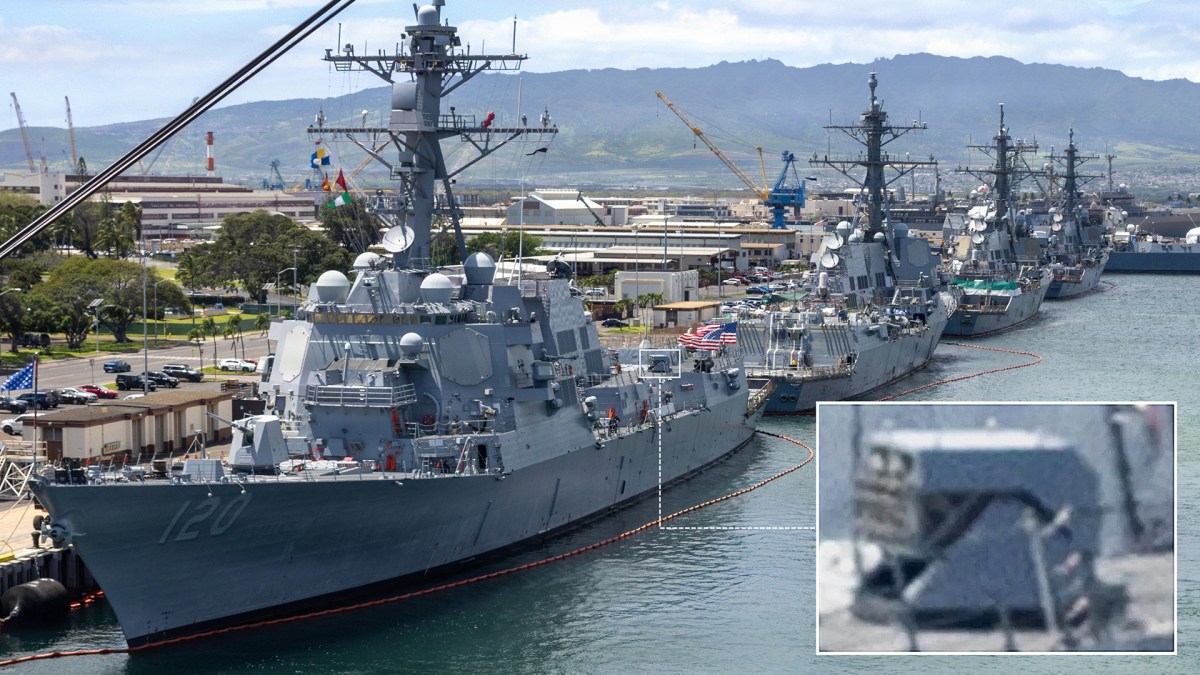
A newly observed launcher mounted on the Arleigh Burke-class destroyer USS Carl M. Levin has raised fresh questions about how the U.S. Navy is adapting warships for the growing drone threat. The launcher, visible in imagery released by the U.S. Marine Corps and highlighted by The War Zone, appears on the aft upper deck of the destroyer in a position similar to where counter-drone interceptor launchers were previously seen on other Burke-class ships.
The hardware is notable precisely because it is not immediately recognizable. The War Zone reported that the system sits between the ship’s port-side torpedo tubes and its rear Mk 41 vertical launch system array. The launcher appears to have multiple cells, and while its exact motion is unclear, it seems likely to elevate for firing. What it launches, however, remains unknown.
That uncertainty has not stopped the broader implication from coming into view. The Navy is already known to be exploring ways to integrate lower-cost anti-drone interceptors on surface combatants, and this new installation suggests that effort is expanding, diversifying or at least moving through more field experimentation.
Why the location matters
The choice of installation point is one of the more revealing aspects of the sighting. By placing a launcher on the aft section of the ship’s superstructure rather than relying only on existing vertical launch cells, the Navy may be trying to add dedicated defensive capacity without consuming the premium space reserved for larger missiles in the Mk 41 system. That would fit a wider military logic: drones and loitering threats are proliferating rapidly, and using expensive or limited-capacity missiles against low-cost targets creates both economic and tactical strain.
The War Zone noted that similar launcher positions on USS Bainbridge and USS Winston S. Churchill previously hosted systems for Coyote counter-drone interceptors. That history makes the new sighting more than a curiosity. It points to a pattern in which Burke-class destroyers become platforms for testing or introducing additional layers of defense against unmanned aerial systems.
Even if the launcher on Carl M. Levin is not a direct analog to those earlier installations, the context matters. Surface warships now face a threat environment in which drones can be launched in numbers, from multiple directions, and at costs far below the price of traditional interceptors. That is forcing navies to rethink both the composition and economics of shipboard defense.

Possible roles, limited certainty
The War Zone was careful not to overstate what the imagery proves, and that caution is warranted. The launcher could support anti-drone interceptors, but it could also be intended for other munitions, decoys or even drones of its own. Visual evidence alone is rarely enough to pin down a new naval system, particularly when only part of the hardware is visible and no official explanation accompanies the imagery.
Still, several constraints shape the most plausible interpretations. First, the Navy is publicly engaged in efforts to strengthen defenses against drones. Second, the launcher appears in a location associated with that mission on other ships. Third, the need for lower-cost and more flexible responses is becoming more urgent as unmanned threats evolve. Taken together, those factors make a counter-drone role a reasonable working hypothesis, even if not a confirmed identification.
The article also referenced outside speculation that the launcher might support Hellfire or JAGM-type munitions to improve counter-unmanned-aircraft capability. That remains speculation, but it shows how analysts are reading the sighting: not as a random modification, but as a sign of a broader adaptation in naval weapons architecture.
A bigger shift in surface warfare
The significance of the sighting extends beyond one destroyer. Naval combatants were long optimized around threats such as aircraft, missiles, submarines and other ships. Drones complicate that picture because they can be smaller, cheaper, more numerous and more expendable. A warship that expends high-end interceptors on every unmanned contact risks losing the cost exchange even when it wins the engagement.
That is why the Navy’s exploration of alternative launchers and interceptors matters. It points to a layered-defense approach in which ships carry tools better matched to the scale and economics of unmanned threats. Dedicated launchers outside the main vertical launch battery could help preserve high-end missile inventory while giving commanders more options for dealing with smaller targets.
This also fits a broader pattern across militaries: the emergence of rapid hardware modifications in response to operational pressures. Rather than waiting for entirely new ship classes, navies are increasingly experimenting with bolt-on or add-on systems that can be integrated into existing fleets. The launcher on Carl M. Levin, whether temporary, experimental or soon-to-be standard, appears consistent with that faster adaptation cycle.
What to watch next
The immediate limitation is obvious: without official Navy confirmation, key details remain unknown. Analysts do not yet know the launcher’s designation, payload, sensor integration or rules of use. That leaves open the possibility that the system serves a purpose other than counter-drone defense.
Even so, the sighting is meaningful because it adds one more data point to an unmistakable trend. The Navy is modifying ships to address emerging aerial threats, and those modifications increasingly emphasize lower-cost, mission-specific responses rather than relying exclusively on legacy missile architectures. If future imagery or official disclosures confirm the launcher’s purpose, this may come to be seen as an early public glimpse of a broader fleetwide adjustment.
For now, the destroyer’s new launcher is best understood not as a solved mystery but as evidence of an active problem-solving phase inside naval warfare. The threat is clear. The tools are still taking shape.
- A previously unidentified launcher has appeared on USS Carl M. Levin.
- Its placement echoes earlier destroyer installations linked to counter-drone interceptors.
- The sighting suggests the Navy is expanding experiments in lower-cost ship defense against drones.
This article is based on reporting by twz.com. Read the original article.
Originally published on twz.com