A near-hit over Iran has become a warning sign
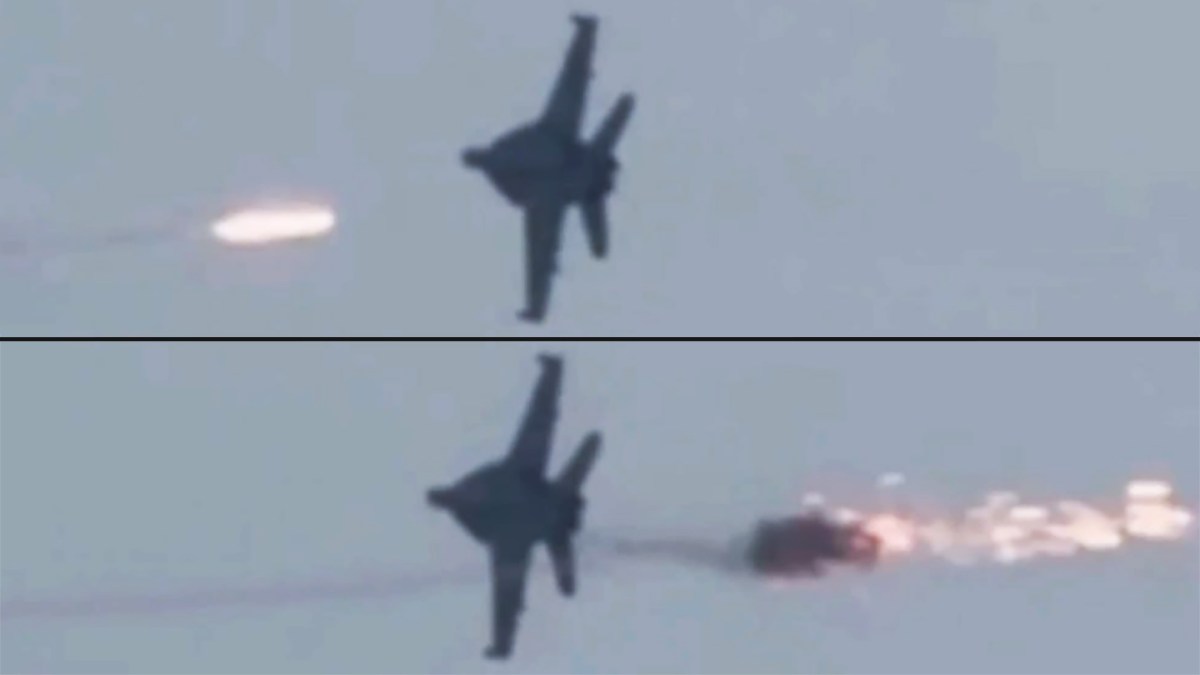
Newly circulated video appears to show a U.S. Navy F/A-18E/F Super Hornet coming very close to being struck by an Iranian surface-to-air missile while flying a low-level mission near Chabahar, a port city in Iran’s Sistan and Baluchestan province. The footage, discussed by The War Zone on March 26, adds a vivid example to a point military analysts have been making throughout Operation Epic Fury: even after extensive strikes, the threat from Iranian air defenses has not disappeared.
According to the report, the aircraft was targeted during a low-level strafing run. The publication says the available videos have been geolocated to the Chabahar area on Iran’s eastern shore near the Pakistan border. That location matters because it helps explain both the tactical choice and the broader risk environment. Coastal operations can offer some advantages, including easier combat search and rescue access over or near water and a better understanding of what hostile air defense systems may still be active compared with deeper operations inland. But the footage also shows that “lower threat” does not mean safe.
The report does not present independent confirmation of the exact date of the incident. It says the event is reported to have occurred the previous day. It also cites Iranian claims that the fighter crashed in the Indian Ocean, a claim not established by the published evidence. The more durable point supported by the material described is narrower and still significant: a U.S. tactical jet appears to have faced a very real and very close missile threat during operations over Iranian territory.
Why the Chabahar location matters
Chabahar is not just another dot on the map. As presented in the report, it sits in a coastal region that had already been hit hard by strikes from the beginning of the conflict. That context makes the apparent missile shot more revealing. A low-altitude flight profile in such an area may reflect an assessment that the surviving air defense picture there is more manageable than in other parts of Iran.
Yet the incident described by the video demonstrates how surviving threats can remain acute even after broader suppression efforts. Man-portable air defense systems, or MANPADS, are especially dangerous in exactly these circumstances. They do not require a large, intact, fixed-site air defense network. They can remain mobile, distributed, and difficult to eradicate completely. For aircraft descending into the engagement envelope during a strafing run or other low-level mission, they present a persistent hazard.
The War Zone explicitly frames the episode as evidence that “true air supremacy” over Iran still is not a reality. Based on the source text provided, that is a reasonable characterization of the operational risk picture. Air superiority in practice is not measured only by the number of enemy radars destroyed or missile batteries suppressed. It is also measured by whether crews can execute low-altitude missions without facing credible shots from residual defenses. By that standard, the threat remains active.
What the reporting does and does not establish
It is important to separate the supported facts from the unresolved claims. The supplied source text states that videos have emerged showing an apparent close call for a U.S. Navy F/A-18E/F after it was targeted by an Iranian MANPADS while carrying out an Operation Epic Fury mission. It also says the footage has been geolocated to Chabahar and that one of the shared location references placed the aircraft near or above the Imam Ali Independent IRGC Naval Base.
What remains uncertain is the exact date of the encounter and whether the aircraft sustained damage beyond the narrowly avoided missile strike visible in the clip. Iranian public claims about a crash are included in the report but not verified there. That distinction matters because wartime information environments are noisy, and visual evidence often arrives faster than official confirmation.
Still, even with those caveats, the incident is strategically important. One close call does not by itself redefine the campaign, but it can reveal the operational reality on the margins where pilots and planners live. It suggests that mission sets involving low flight profiles over Iranian territory continue to carry meaningful exposure to residual air defenses.
The operational lesson is about persistence, not surprise
The existence of Iranian air defense danger at this stage should not be surprising. The report notes that this is a risk it has repeatedly highlighted before. Modern air campaigns rarely erase every threat, especially when defenders have mobile systems, local knowledge, and the ability to exploit terrain, urban cover, and short engagement windows.
What the Chabahar footage appears to capture is the military reality after the early wave of strikes, when surviving systems matter more than the original inventory. A campaign can severely degrade an air defense network and still leave behind enough capability to kill aircrew. In fact, those remaining fragments can become disproportionately dangerous because operators may assume some sectors are relatively permissive.
This is particularly relevant to missions that require pilots to come down from safer altitudes to identify, attack, or suppress targets directly. The closer an aircraft gets to the ground, the more it can become vulnerable to weapons that do not need long-range radar support to be lethal.
For military planners, the lesson is not simply that Iran still has missiles. It is that residual, local, short-range air defense threats may continue to shape sortie design, route selection, altitude choices, rescue planning, and battle damage assumptions. One video can crystallize that more clearly than many briefings.

A tactical clip with strategic implications
The near-miss over Chabahar is a tactical event, but it carries broader meaning because it exposes the limits of attrition-based confidence. Even in a coastal zone viewed as comparatively better understood, a Navy strike fighter appears to have encountered a live and dangerous missile shot. That suggests continued caution for all lower-flying aircraft operating over or near Iranian territory.
It also reinforces the burden on crews conducting these missions. A sortie flown in what looks like a reduced-threat area can still end with a split-second survival margin. From outside the cockpit, that may appear as one dramatic clip on social media. Inside a campaign, it is a reminder that risk persists after the headlines move on.
Based on the source material provided, the safest conclusion is also the clearest one: the Chabahar footage indicates that Iranian air defense threats remain real enough to challenge U.S. aircraft during low-level operations. Whatever damage has already been done to Iran’s broader network, surviving systems are still shaping the fight.
This article is based on reporting by twz.com. Read the original article.
Originally published on twz.com