A rare angle on the Raider
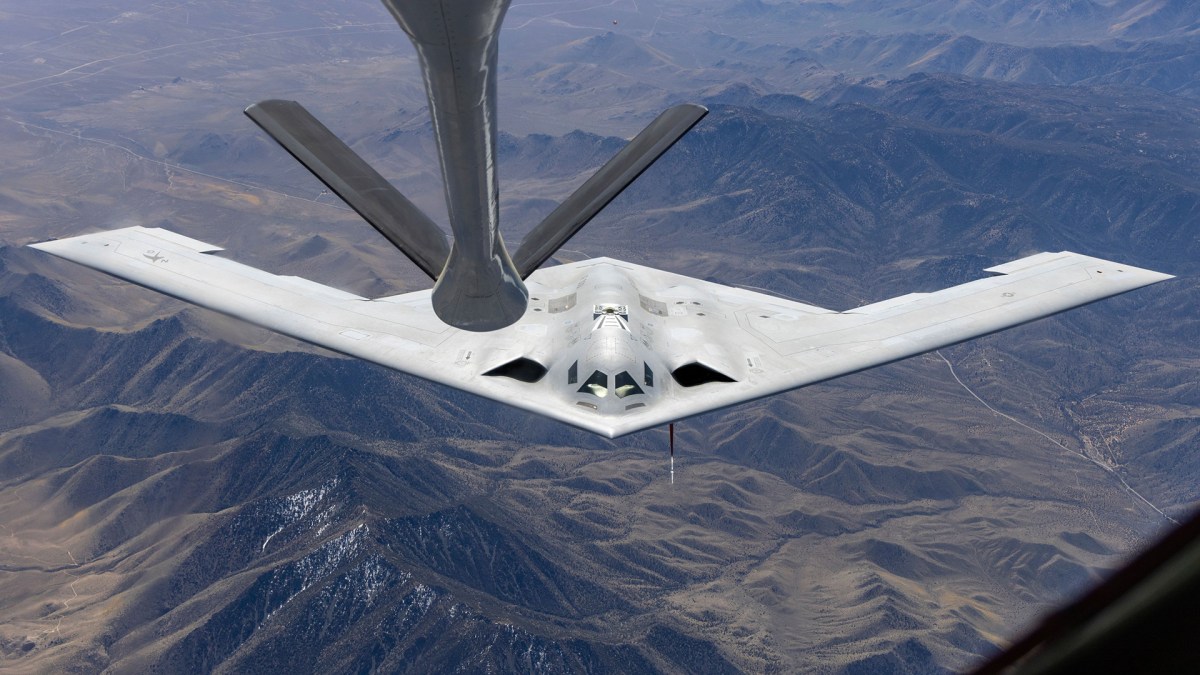
A newly released image from Northrop Grumman has provided the first full overhead view of the B-21 Raider, the U.S. Air Force’s next-generation stealth bomber, during early aerial refueling trials. The image shows the first B-21 test aircraft, known as Cerberus, flying in the pre-contact position behind an Edwards Air Force Base tanker. For a program that has revealed only tightly controlled views of the aircraft, the picture is notable not simply because it is new, but because of what the angle exposes about the bomber’s overall planform and its low-observable design priorities.
Images of advanced stealth aircraft are managed carefully for a reason. The shape of the airframe, the treatment of edges and exhaust, and the geometry of upper surfaces all influence radar and infrared signatures. In the B-21’s case, even a partial look at the aircraft’s upper side and rear quarter has been rare. This new release therefore gives analysts and observers an unusually useful reference point for understanding how the Raider differs from the B-2 Spirit it is set to complement and eventually replace.
What the image suggests
The overhead perspective reinforces a point that has been made before but is easier to appreciate from above: the B-21 is smaller than the B-2, but its shape appears optimized for long-range efficiency at altitude. The aircraft’s broad flying-wing configuration remains familiar, yet the contours visible in the new photo suggest a refined layout intended to reduce drag while preserving the low-observable characteristics essential to its mission set.
The release is also important because it offers one of the first clear looks at the bomber’s exhaust area, among the most sensitive parts of any stealth aircraft. Exhaust treatment matters because it affects infrared signature management as well as the way an aircraft’s rear aspect can be detected and tracked. Public imagery of the Raider has so far revealed very little in this area, so even a limited view contributes to the broader picture of how Northrop Grumman is balancing range, survivability, and maintainability.
The War Zone notes that available imagery and contrail behavior appear consistent with a two-engine configuration rather than the B-2’s four-engine arrangement. That remains an analytical conclusion rather than a formal confirmation in the supplied material, but it fits with the broader design logic described around the bomber: a smaller aircraft carrying a large internal fuel load to maximize reach while depending on efficiency rather than raw size.
Endurance as a defining feature
Northrop Grumman used the image release to underline a core claim about the aircraft’s role. The company described the B-21 as the most fuel-efficient bomber ever built and said it consumes only a fraction of the fuel used by fourth- and fifth-generation aircraft. Whether that language is read as marketing or mission framing, it points to a central idea behind the Long-Range Strike Bomber concept: a platform able to travel very long distances with less dependence on tanker support than shorter-range strike aircraft.
That endurance matters operationally. A bomber that can reach farther with fewer refueling demands changes force planning, especially across vast theaters such as the Indo-Pacific. Reduced tanker dependency can lower logistics burdens and complicate an adversary’s targeting problem. It also gives commanders more flexibility in how they package missions, particularly when tankers themselves may be vulnerable and scarce.
Northrop also said it has invested more than $5 billion in digital technologies and manufacturing infrastructure for the B-21 program and is accelerating production, with the first aircraft planned to arrive at Ellsworth Air Force Base in 2027. That timeline is significant because it signals the transition from a highly secretive development phase toward the early stages of operational fielding. Much still depends on continued test progress, but the program is increasingly moving from symbol to force structure.
Why the tanker matters too
The refueling aircraft seen in the images is Edwards Air Force Base’s so-called Ghost tanker, tail number 61-0320. Its appearance is a reminder that aerial refueling trials are not just photo opportunities but a crucial step in validating how the bomber will operate in realistic conditions. A long-range aircraft’s promise is only as credible as its ability to integrate smoothly into refueling procedures, timing, and fleet support systems.
For the B-21, that matters twice over. The bomber is being sold as a platform with exceptional reach, but it will still need to prove it can plug into the wider U.S. strike enterprise, where tankers, bases, mission planning, and stealth routing all interact. Early refueling imagery therefore acts as a public marker of quiet but essential progress in the test campaign.
The new top-down photo does not answer every question about the Raider, and it was never meant to. What it does is sharpen the outline of a program whose strategic importance has been obvious for years, even while its technical details remained obscured. The aircraft now appears a little less abstract: still secretive, still carefully managed, but increasingly visible as a real operational system taking shape.
This article is based on reporting by twz.com. Read the original article.
Originally published on twz.com