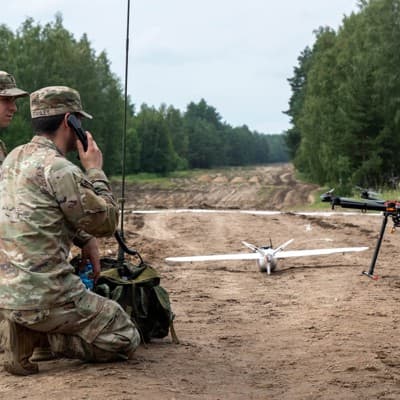
From Specialist Skill to Universal Capability
At Fort Stewart, Georgia, the 3rd Infantry Division is undertaking one of the most significant doctrinal shifts in modern Army history. The division's 1st and 2nd Armored Brigade Combat Teams are developing the training courses, tactics, and organizational structures needed to integrate small drones into every element of a tank formation. The goal is as simple as it is ambitious: make every soldier a drone operator.
This represents a fundamental departure from how the Army has traditionally employed unmanned aerial systems. For years, drones were the domain of dedicated operators, soldiers in the 15-series military occupational specialty who received specialized training and were assigned to specific units. The rest of the force interacted with drones primarily as consumers of the intelligence they provided, receiving imagery and video feeds filtered through a chain of analysts and commanders.
The lessons of recent conflicts, particularly the war in Ukraine, have made it clear that this model is inadequate for the modern battlefield. In Ukraine, small commercial drones have become ubiquitous on both sides, used for everything from reconnaissance and artillery spotting to direct attacks on armored vehicles and personnel. The ability to rapidly deploy a drone for situational awareness or to deliver a precision strike has become a basic tactical requirement, not a specialized capability.
The Training Pipeline
The 3rd Infantry Division is building a training pipeline designed to produce drone-capable soldiers at scale. The program begins with approximately 40 hours of simulation training, where soldiers learn the fundamentals of drone flight, navigation, and mission planning in a virtual environment. This simulation phase allows large numbers of soldiers to develop basic proficiency without consuming the limited flight hours of actual aircraft.
From simulation, soldiers progress to flying first-person view drones, the small, agile quadcopters that have become the workhorses of modern drone warfare. FPV flying requires a different skill set than operating larger, more automated systems. Pilots must develop the hand-eye coordination and spatial awareness needed to navigate at high speed through complex terrain, often while the drone is under electronic attack.
Only after demonstrating proficiency with FPV systems do soldiers move on to operating the larger, more capable platforms in the Army's growing drone inventory. The progression is designed to build skills incrementally, ensuring that each soldier has a solid foundation before handling more complex and expensive systems.
A Growing Arsenal of Unmanned Systems
The 6th Squadron, 8th Cavalry Regiment, part of the 2nd Armored Brigade Combat Team, has already fielded more than 150 small drones across its formation. These are Group 1 and Group 2 systems, classified as weighing under 55 pounds, and they represent a diverse portfolio of capabilities.
The Anduril Ghost-X provides long-endurance surveillance and reconnaissance, capable of loitering over an area of interest for extended periods and transmitting high-resolution video back to commanders. The Performance Drone Works C100 offers a different capability set, optimized for rapid deployment and short-range missions. The Neros Archer and Teal 2 add additional layers of capability, while the AeroVironment Switchblade 600 brings a loitering munition capability that allows soldiers to identify and engage targets at significant distances without relying on artillery or air support.
This diversity of systems is intentional. Different mission requirements call for different tools, and by fielding a range of platforms, the Army ensures that soldiers can select the right drone for each tactical situation. A reconnaissance patrol might carry a lightweight quadcopter for quick area scans, while a tank platoon might deploy a Ghost-X for persistent surveillance and keep Switchblades in reserve for engaging targets of opportunity.
Hunter-Killer Tactics
The integration of drones into tank formations is enabling new tactical concepts that combine the reconnaissance and strike capabilities of unmanned systems with the firepower and protection of armored vehicles. The hunter-killer format pairs reconnaissance drones that locate and identify targets with strike drones or conventional weapons that engage them.
In practice, this means a tank platoon can push drones forward to scout terrain, identify enemy positions, and assess threats before committing its armored vehicles. If the drones locate an anti-tank missile team or a concealed fighting position, the platoon can engage with a Switchblade or direct tank fire onto the precisely located target. The result is a dramatic increase in the lethality and survivability of armored formations, reducing the risk of ambush and allowing commanders to make better-informed decisions about how to employ their forces.
The electronic warfare dimension adds another layer of complexity. Adversaries are developing sophisticated drone jamming and spoofing capabilities, and the Army's training program includes instruction on operating in contested electromagnetic environments. Soldiers must learn not only how to fly drones, but how to maintain communications and navigation when the enemy is actively trying to disrupt them.
Transformation in Contact
The 3rd Infantry Division's drone integration effort is part of the Army's broader Transformation in Contact initiative, which seeks to modernize the force while it remains prepared for deployment. Rather than waiting for a peacetime reorganization, the Army is fielding new technologies and developing new tactics in units that could be called upon to fight at any time.
This approach carries risks. Units must balance the demands of training on new systems with maintaining proficiency in their core missions. Leaders must manage the organizational disruption of integrating new equipment and doctrine while keeping their formations combat-ready. But the urgency of the threat environment, driven by the rapid proliferation of drone technology to potential adversaries around the world, makes waiting an unacceptable option.
The work at Fort Stewart is being closely watched by the rest of the Army and by allied militaries. The lessons learned by the 3rd Infantry Division's armored brigades will form the foundation of doctrine that will eventually be adopted across the entire force, making drone operations as fundamental to soldiering as marksmanship and land navigation. The era of the specialist drone operator is ending. The era of the drone-enabled soldier is beginning.
This article is based on reporting by Defense One. Read the original article.


