A New Kind of Defense Contract
The U.S. Army has awarded Anduril Industries the first task order under a newly established $20 billion contract vehicle designed to accelerate counter-unmanned aerial systems procurement. The contract structure — formally a contract vehicle rather than a funded award — is intended to reduce bureaucratic friction in how the military acquires cutting-edge drone defense technology from companies like Anduril that operate outside the traditional defense industrial base.
Anduril President Matthew Steckman moved quickly to manage expectations after news of the $20 billion figure circulated. We got a lot of messages over the weekend, like, oh, you made $20 billion. There is no money attached to it, this is just a contract vehicle, but it reduces a lot of friction in things that just simply should not have it, he said. The distinction matters: a contract vehicle establishes a streamlined acquisition pathway, but actual money flows only when individual task orders are placed and funded separately.
What a Contract Vehicle Does
Traditional defense procurement requires a lengthy competitive acquisition process for each new system or capability. For a military increasingly facing rapidly evolving drone threats, that timeline is incompatible with operational reality. A drone threat that did not exist two years ago can be deployed by adversaries in months. Existing procurement cycles were designed for platforms that take decades to develop.
Contract vehicles address this by pre-qualifying vendors and establishing agreed terms — pricing structures, delivery timelines, security requirements, technical specifications — that allow individual task orders to be issued quickly once a need is identified. The Army can place an order for a specific counter-drone capability without running a full competition from scratch each time.
For Anduril, being the first vendor awarded a task order under this particular vehicle signals a significant competitive position. Other companies may also receive awards under the $20 billion ceiling, but Anduril has established the benchmark and demonstrated the Army's confidence in its Lattice software platform and associated hardware systems.
Anduril's Counter-Drone Technology
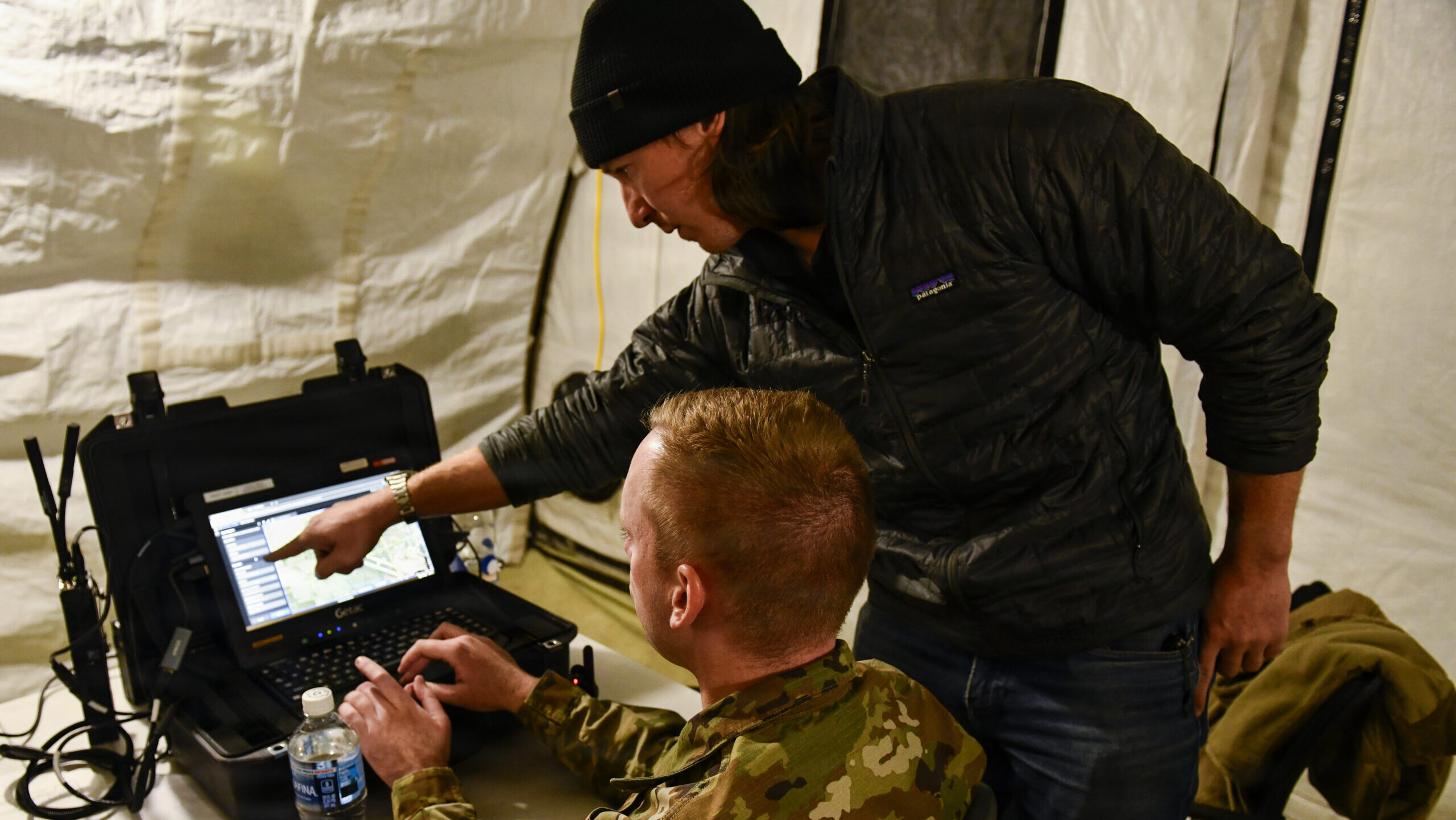
Anduril's counter-drone portfolio centers on its Lattice command and control platform, which integrates sensor data from multiple sources — radar, optical, acoustic — to detect, track, classify, and optionally engage unmanned systems. The company produces its own drone interceptors, including the Anvil kinetic defeat vehicle and the Pulsar electronic warfare system, which can jam or spoof drone communications to force them to land or return to operator.
The company has positioned itself as a software-first defense contractor, contrasting with legacy primes that developed hardware platforms over decades. Lattice is designed to be hardware-agnostic, meaning it can ingest data from and command third-party sensors and effectors as well as Anduril's own systems. This architecture has proved appealing to military customers who need software that can orchestrate diverse sensor and weapon systems intelligently.
The Counter-Drone Urgency
The Army's urgency around counter-drone acquisition reflects hard lessons from recent conflicts, particularly in Ukraine, where both sides have employed commercial and military drones at scale for reconnaissance, artillery spotting, and direct attack. First-person view drones costing a few hundred dollars have proven capable of disabling million-dollar armored vehicles. Drone swarms present a layered challenge that existing air defense systems, designed for aircraft and missiles, were not built to address.
The Pentagon has identified counter-UAS as one of its highest priority capability gaps. Multiple programs across all services are competing for funding and attention. The Army's establishment of a dedicated $20 billion contract vehicle for the mission represents a structural commitment to treating counter-drone acquisition as a sustained program rather than a series of one-off purchases.
Broader Defense AI Landscape
Anduril's success in this domain is part of a broader shift in how the Pentagon is approaching defense technology acquisition. Companies like Anduril, Palantir, and Shield AI — younger firms built on modern software development practices — have gained significant ground against legacy contractors in AI-intensive domains.
The Pentagon's Chief Technology Officer has signaled support for this shift, emphasizing speed of delivery and software agility over the traditional metrics of the defense acquisition world. The new contract vehicle is itself a product of that philosophy: streamline the process, reduce time-to-capability, and accept that iterative improvement of fielded systems is preferable to waiting for perfect requirements to be specified upfront.
This article is based on reporting by Breaking Defense. Read the original article.
Originally published on breakingdefense.com