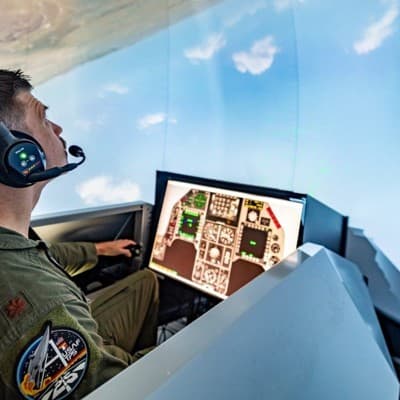
AI Takes the Stick in a Life-or-Death Moment
In a landmark test that could reshape the future of aerial warfare, U.S. Air Force test pilots have successfully used a tactical artificial intelligence system to evade an incoming missile during a live exercise. The AI processed threat data, calculated optimal evasive trajectories, and executed defensive maneuvers faster than human reaction times would allow, demonstrating a capability that military planners have pursued for decades.
The test, conducted at an undisclosed range, involved a manned fighter aircraft equipped with an AI copilot system that integrates sensor data, threat assessment algorithms, and aircraft performance models to generate real-time defensive recommendations. When the missile was detected, the AI system provided the pilot with an evasive maneuver plan and, upon authorization, executed the sequence with precision that exceeded what unassisted human pilots typically achieve in similar scenarios.
How the System Works
The tactical AI operates by continuously monitoring the aircraft's sensor suite — radar warning receivers, missile approach warning systems, and electronic warfare sensors — to build a real-time picture of the threat environment. When a missile launch is detected, the system calculates the missile's probable trajectory, speed, and guidance type within fractions of a second.
Using this threat assessment, combined with the aircraft's current flight parameters, available countermeasures, and surrounding terrain, the AI generates an optimal evasion plan. This plan may include a combination of aggressive maneuvers, chaff and flare deployment, electronic countermeasure activation, and altitude changes designed to break the missile's tracking solution.
The critical innovation is speed. A modern air-to-air missile closing at Mach 4 gives a pilot roughly three to five seconds to react. Human decision-making under such extreme time pressure is inherently limited by cognitive processing speed and the physiological effects of high-G maneuvers. The AI system compresses the observe-orient-decide-act loop into milliseconds, providing a decisive advantage in the most time-critical combat scenario a pilot can face.
Implications for Modern Air Combat
The successful test represents a fundamental shift in the relationship between human pilots and AI in combat aviation. Rather than replacing pilots, the system augments their capabilities in precisely the situations where human performance is most constrained — high-speed, high-G engagements where fractions of a second determine outcomes.
- Modern air-to-air missiles can reach speeds exceeding Mach 4, giving pilots just seconds to react
- The AI system processes threat data and generates evasion plans in under 100 milliseconds
- Human pilots retain authority to approve or override AI recommendations
- The technology builds on the DARPA ACE program's earlier autonomous dogfighting demonstrations
Military analysts note that the technology addresses one of the most significant survivability challenges facing manned aircraft in contested environments. As adversary air defense systems become more sophisticated, with longer-range missiles and improved guidance systems, the ability to execute optimal evasive maneuvers becomes increasingly critical.
The Human-AI Partnership
The Air Force has been careful to emphasize that the system operates within a human-on-the-loop framework. The pilot retains ultimate authority over the aircraft and can override or modify the AI's recommendations at any point. In the test scenario, the pilot authorized the AI's evasion plan before execution, maintaining the chain of command that military doctrine requires.
This approach reflects broader Department of Defense policy on autonomous systems, which mandates meaningful human control over lethal force decisions. While missile evasion is a defensive action, the principles governing AI authority in combat are applied consistently across offensive and defensive applications.
Test pilots involved in the program have reported high confidence in the system's recommendations, noting that the AI's proposed maneuvers were consistently more optimal than what they would have chosen independently. The trust-building process has involved hundreds of simulated engagements where pilots could compare their instinctive responses against the AI's calculated solutions.
Strategic Context
The development comes as both China and Russia invest heavily in advanced missile systems designed to challenge American air superiority. China's PL-15 and PL-21 air-to-air missiles, along with Russia's R-37M, represent a new generation of long-range threats that demand faster and more effective defensive responses than previous-generation missiles required.
The Air Force views AI-assisted survivability as a critical component of its Next Generation Air Dominance program, which aims to maintain American air superiority through the 2040s and beyond. The tactical AI evasion system is expected to be integrated into both manned and unmanned platforms, creating a layered defense architecture that combines human judgment with machine-speed execution.
While the specific timeline for operational deployment remains classified, defense officials have indicated that the technology is progressing toward integration with frontline fighter squadrons faster than initially projected, driven by the urgency of evolving threat environments in the Pacific and European theaters.
This article is based on reporting by Defense One. Read the original article.


