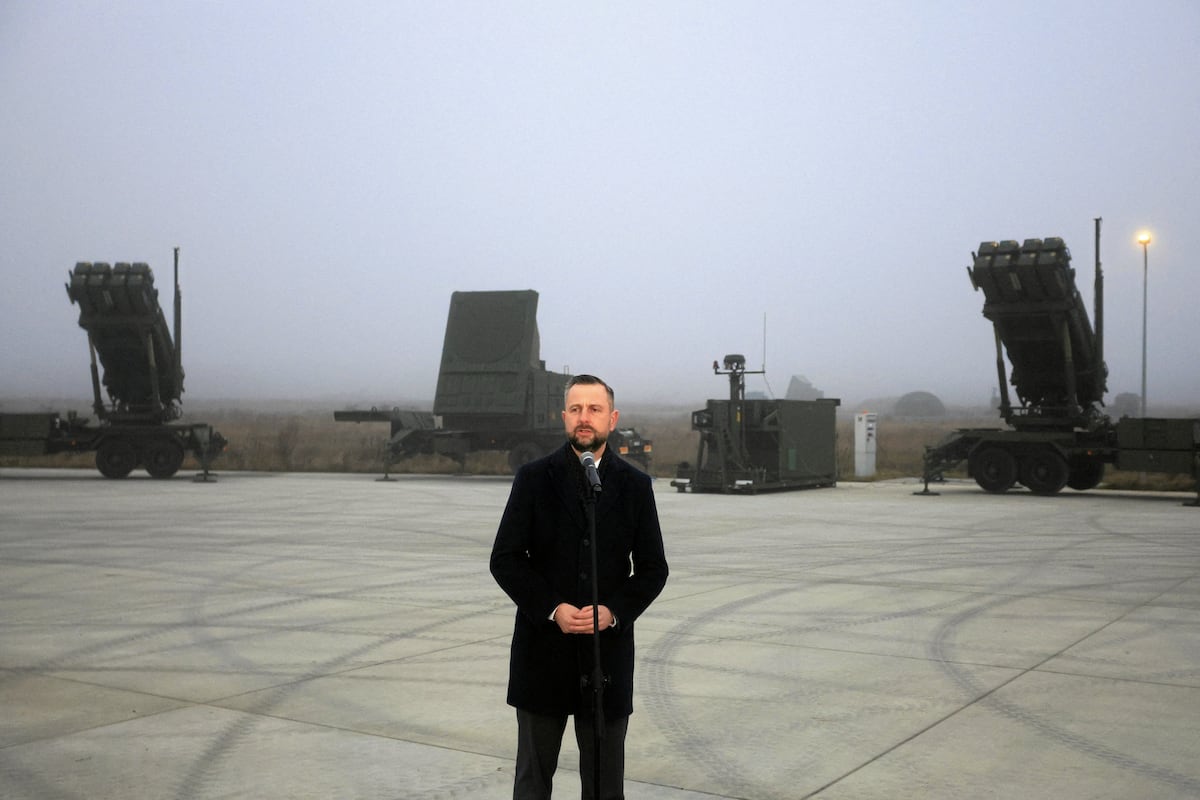
Warsaw is drawing a firm line around air defense assets
Poland has publicly ruled out moving its Patriot air-defense systems to the Middle East, responding to reports that the United States informally asked whether Warsaw could spare one of its batteries and some interceptors for Gulf partners facing pressure from Iranian attacks.
Deputy Prime Minister and Defense Minister Władysław Kosiniak-Kamysz said March 31 that Poland’s Patriot batteries and their armament serve to secure Polish skies and NATO’s eastern flank, and that nothing is changing in that area. The message was direct: Warsaw does not plan to move them anywhere.
The timing reflects two overlapping security theaters
The refusal underscores how stretched advanced air defense has become across multiple regions at once. On one side is the Middle East, where demand for missile defense is rising. On the other is Europe’s eastern flank, where Poland continues to prioritize homeland defense as Russia’s invasion of Ukraine grinds on.
For Poland, the issue is not abstract. The country signed a deal in March 2018 to purchase two Configuration 3+ Patriot batteries for about $4.75 billion, then launched a second phase of its medium-range air-defense program in May 2022 by requesting six more batteries from the United States. In December 2025, Poland declared the first two batteries fully operational. Those systems are therefore not surplus capacity. They are newly fielded assets embedded in a broader national defense buildup.
Reports point to interceptor strain as well as launcher demand
According to local reporting cited by Defense News, the informal U.S. outreach did not concern only launchers. It also asked whether Poland could supply some PAC-3 MSE interceptors from its stocks to Middle Eastern states whose own supplies are being depleted by Iranian attacks. That detail highlights a separate constraint in air defense planning: missile inventories can become a bottleneck even when launch systems are available.
Government spokesperson Adam Szłapka said at a March 31 press conference that the Patriot systems are meant to serve Poland’s security. He did not answer whether the United States had made a direct request. That leaves the reporting unconfirmed at the official level, but the operational answer from Warsaw was still clear enough.
What the decision signals inside NATO
Poland’s stance reflects the politics of deterrence on NATO’s frontier. Moving even part of a newly operational Patriot force could be read domestically and regionally as a weakening of local readiness. By refusing, Warsaw is signaling that eastern-flank defense remains the higher-order priority, even when allies may be under pressure to help elsewhere.
The broader implication is that high-end air and missile defense is now a shared scarcity problem among allies. Patriot operators in the Gulf already include Bahrain, Kuwait, Qatar, Saudi Arabia, and the United Arab Emirates, but demand can still outstrip available systems and interceptor stocks when crises overlap. Poland’s answer suggests that frontline European states do not intend to solve that shortage by reducing their own shield.
Why this story matters
- Poland has made clear that its Patriots are staying focused on homeland and eastern-flank defense.
- The episode points to pressure on both battery availability and interceptor inventories.
- It also shows how simultaneous crises can strain alliance resource-sharing even among close partners.
For now, Warsaw is treating its Patriot force as a non-transferable core asset. That may frustrate any quiet search for additional systems elsewhere, but it is consistent with how Poland sees the security map around it.
This article is based on reporting by Defense News. Read the original article.
Originally published on defensenews.com