CATL signals its next horizon after sodium-ion
CATL, the world’s largest battery manufacturer, says its long-term focus includes lithium-air batteries, a chemistry that the company says has a theoretical energy density of 12,000 watt-hours per kilogram. The announcement places one of the battery industry’s biggest players behind a technology that remains far from commercialization but could redefine expectations for electric transport if it ever matures.
The significance of the statement lies partly in timing. CATL has already moved sodium-ion batteries into mass production, showing that it is willing to invest across more than one battery pathway at a time. Now it is outlining a layered roadmap: sodium-ion in production, solid-state as a middle-range objective, and lithium-air as a much longer-range bet.
That progression matters because it shows how the industry is thinking about innovation in stages. Near-term chemistries aim to improve cost, supply resilience, and practical deployment. Longer-term chemistries aim to break through the energy-density limits that continue to shape vehicle design, range, and weight.
Why lithium-air keeps attracting attention
Lithium-air batteries are compelling for a simple reason: in theory, they approach the energy density of gasoline. CATL’s cited 12,000 Wh/kg figure is the kind of number that immediately changes the scale of what engineers and investors imagine possible. If batteries ever reached anything close to that level in real-world use at acceptable cost and durability, the consequences would extend well beyond passenger cars.
Aircraft, ships, heavy trucks, and long-range mobility systems all depend heavily on the balance between stored energy and total mass. Conventional lithium-ion cells have improved steadily, but energy density remains a central constraint. Lithium-air offers a vision of much lighter battery systems with much more energy onboard.
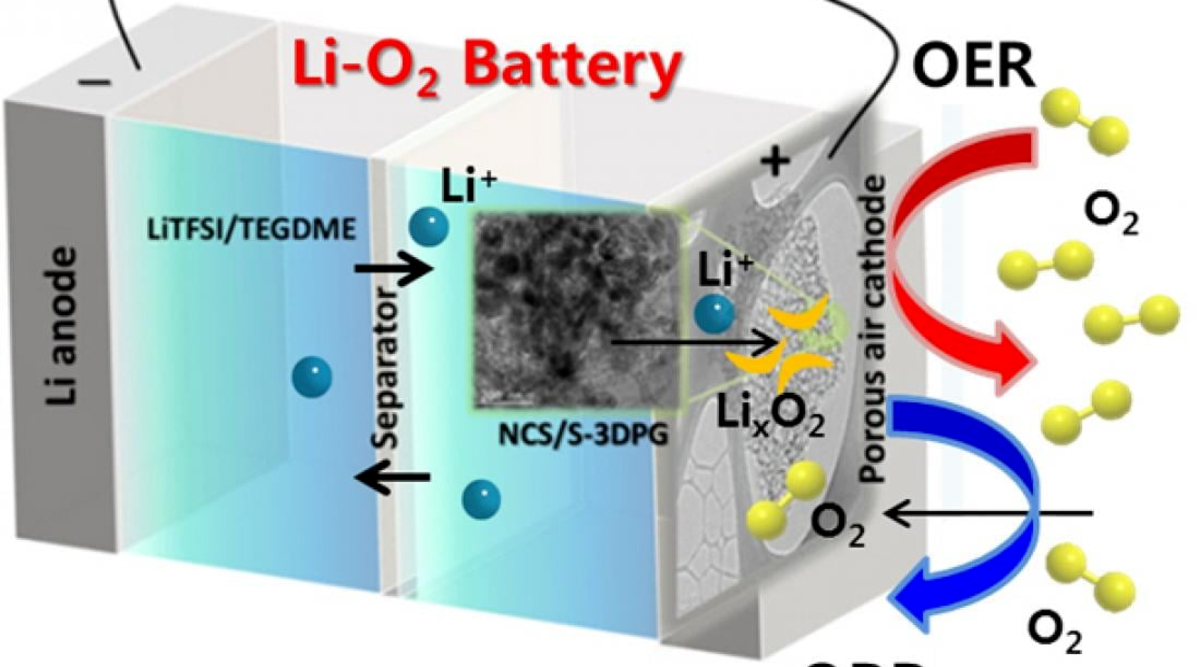
The chemistry is also structurally different from mainstream lithium-ion designs. Instead of relying on heavy metal compounds such as nickel, cobalt, and manganese to store lithium ions, lithium-air uses lithium metal as the anode and oxygen from the air as the cathode reactant. The resulting concept has earned the label of a breathable battery because part of its electrochemical process depends on oxygen rather than a fully self-contained cathode material.

Prototype progress, but still a long distance to travel
Current lithium-air prototypes have reportedly reached energy densities above 1,200 Wh/kg. That is already far above the level of most commercial batteries in use today and comfortably ahead of the roughly 500 Wh/kg often associated with expected solid-state advances. Even so, the gap between a laboratory prototype and a mass-manufactured battery remains enormous.
That is why CATL’s framing is important. The company is not presenting lithium-air as an imminent commercial product. Instead, it is describing a long-term research direction while continuing to pursue solid-state batteries as a more intermediate objective. In practical terms, that means the company appears to view lithium-air as a strategic destination rather than the next product cycle.
The distinction matters because battery announcements often blur the line between proof of concept and manufacturable technology. Here, the available information supports a more cautious reading: CATL is committing attention and credibility to a field that could matter deeply in the future, but not claiming that the hardest engineering barriers are already solved.
Why the announcement still matters now
Even without a launch timeline, the development matters for the battery sector. First, when the largest manufacturer in the field names a chemistry as a long-term focus, that can influence research priorities, capital flows, and expectations across the supply chain. Second, it highlights how quickly the competitive conversation is widening beyond conventional lithium-ion improvements.
It also reinforces a more strategic point about the energy transition. Electric vehicles do not need a single miracle battery to keep growing, but breakthrough chemistries could dramatically expand where electrification becomes practical. A battery approaching the energy density of liquid fuels would not just make today’s EVs better. It could open categories of transport that remain difficult to electrify under current constraints.
For now, the nearer benchmark remains solid-state development, which CATL is still pursuing as a more realistic medium-term goal. Lithium-air sits further out, in the category of technologies that may define the next era if they can cross from promising concept to reliable industrial product.
Key points
- CATL says lithium-air is its long-term battery focus after moving sodium-ion into mass production.
- The company cited a theoretical energy density of 12,000 Wh/kg for lithium-air chemistry.
- Reported prototypes have exceeded 1,200 Wh/kg, well above most commercial batteries today.
- CATL is still treating solid-state batteries as a nearer-term objective than lithium-air.
This article is based on reporting by CleanTechnica. Read the original article.
Originally published on cleantechnica.com