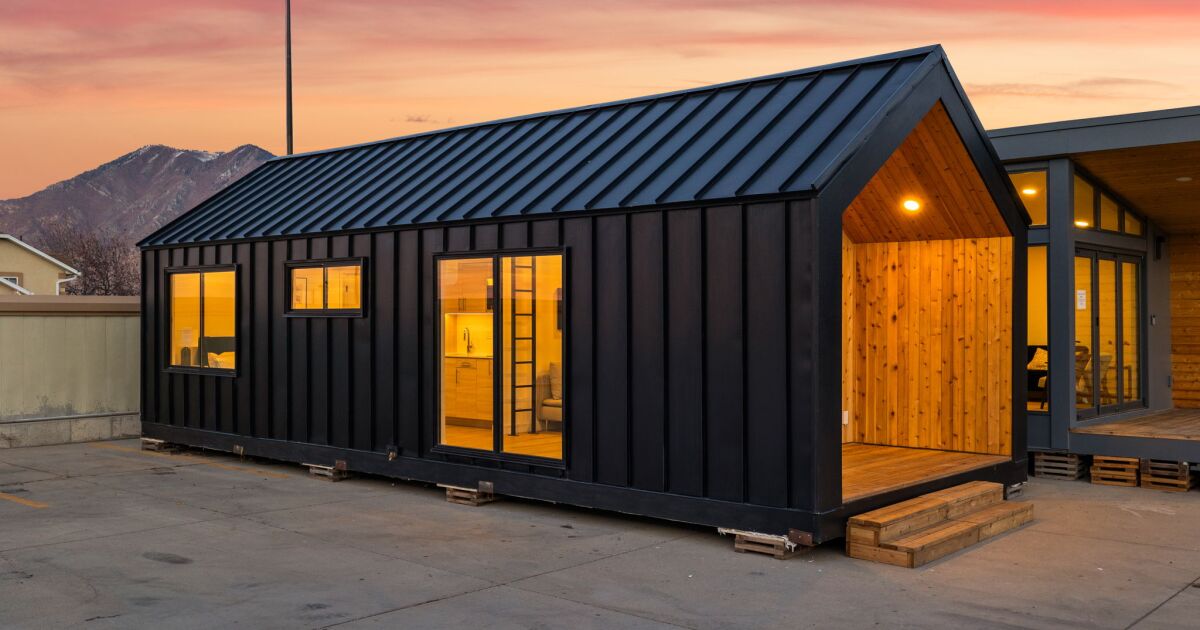
A tiny house that leans into width instead of wheels
Small-home design often revolves around one hard constraint: road width. Most North American tiny houses stay near the standard trailer-based width of 8.5 feet, which keeps them towable but also imposes a narrow, corridor-like interior. Irontown Modular’s new Mysa 400 takes a different path. It is still compact by conventional housing standards, but at 14 feet wide it breaks from the standard tiny-house template and aims for something closer to a small apartment.
That decision changes the project more than the raw square footage might suggest. The Mysa 400 measures 32 feet long and provides 397 square feet of interior space, according to New Atlas. Those numbers place it in the broad small-home category, but the wider format is what makes it feel fundamentally different from most tiny houses marketed for full-time living.
Designed as a non-towable modular home
The Mysa 400 is not meant to be a frequent-travel dwelling. Irontown Modular designed it as a non-towable model that must be transported to its site by truck or crane. That removes the towing-first design logic that defines many tiny homes and allows the company to prioritize interior usability instead.
In practical terms, that means the Mysa 400 sits somewhere between a traditional tiny house and a modular cabin. It keeps the small-home ethos of compact space planning but abandons the idea that the structure itself should behave like an RV. For buyers who care more about livability than mobility, that tradeoff is likely the entire point.
The exterior uses metal and wood, and the house is entered through a porch and trifold doors. Those doors appear to be one of the project’s strongest design moves, because they physically and visually open the main living area to the outside. Combined with multiple windows, they help the home avoid the enclosed feel that often makes narrow tiny houses feel smaller than they are.

Why width changes the experience
The difference between 8.5 feet and 14 feet may sound incremental on paper, but in plan it is transformative. Standard tiny houses often rely on tightly compressed circulation, multifunction furniture, loft-heavy layouts, and compromised room proportions. By pushing well past the usual width, the Mysa 400 can organize its rooms more like a conventional apartment, with clearer zones, less vertical dependence, and more forgiving furniture placement.
New Atlas describes the interior as more natural and apartment-like, and the provided details support that assessment. The living room has space for a sofa, chair, storage, and an entertainment center. The kitchen includes a breakfast bar that seats up to four people. These are modest features in a standard home, but in the tiny-house world they signal a shift away from pure spatial efficiency toward everyday comfort.
The wider format also helps with circulation. A narrow tiny house may technically contain the same program, but everyday movement through the space can feel constrained. Extra width improves sight lines, reduces bottlenecks, and makes basic domestic routines feel less improvised.
A small home optimized for full-time use
The Mysa 400 appears explicitly aimed at full-time living rather than short getaways. Much of its 397 square feet sits on the ground floor, which helps the design feel less dependent on sleeping lofts and ladders than many smaller models. There is still a loft bedroom accessed by a fixed ladder, but the home also includes a sizable downstairs bedroom with a double bed and built-in wardrobe units.
That downstairs bedroom connects to a spacious bathroom equipped with a glass-enclosed shower, vanity sink, and flushing toilet. Again, none of those amenities are exotic in conventional housing, but their scale and arrangement matter in this category. Many tiny homes compress bathrooms into highly constrained wet-room layouts or force occupants into loft sleeping whether they want it or not. The Mysa 400 appears to give up some transport flexibility in exchange for a far more conventional domestic experience.
The kitchen follows the same logic. It is equipped with an induction cooktop, microwave, sink, and fridge/freezer, which is enough to support everyday use rather than occasional occupancy. Paired with the breakfast bar dining area, it reads less like a novelty kitchenette and more like a compact but functional apartment kitchen.

What it says about the tiny-home market
The Mysa 400 highlights a broader divide within small-home design. One branch of the market still prioritizes portability, extreme efficiency, and the cultural identity of the tiny house as a mobile, minimalist object. Another is drifting toward compact modular housing that borrows tiny-house aesthetics and cost discipline while quietly rejecting the trailer-width limitation.
This second branch may prove more appealing to people who like the idea of living smaller but do not want to constantly negotiate with cramped geometry. Wider modular units can preserve many of the economic and environmental arguments for downsizing while producing spaces that feel durable and ordinary in the best sense of the word.
That does not make the Mysa 400 a universal solution. A non-towable home has different permitting, transport, and siting considerations. It also occupies a somewhat different regulatory and commercial niche than a traditional trailer-based tiny house. But as a design statement, it is clear: many buyers may want small living without the signature discomforts that tiny houses have normalized.
Small, but no longer narrow
The Mysa 400 is notable not because it radically reinvents compact housing, but because it targets one of its most persistent weaknesses so directly. By widening the floor plan to 14 feet, Irontown Modular turns a compact home into something that can plausibly feel like a scaled-down apartment rather than a carefully disguised corridor.
That is a meaningful design shift. The future of small housing may depend less on making spaces ever tinier and more on deciding which constraints are actually worth keeping. In the Mysa 400, the answer appears to be that road-legal width is one of the first constraints to go.
This article is based on reporting by New Atlas. Read the original article.

Originally published on newatlas.com