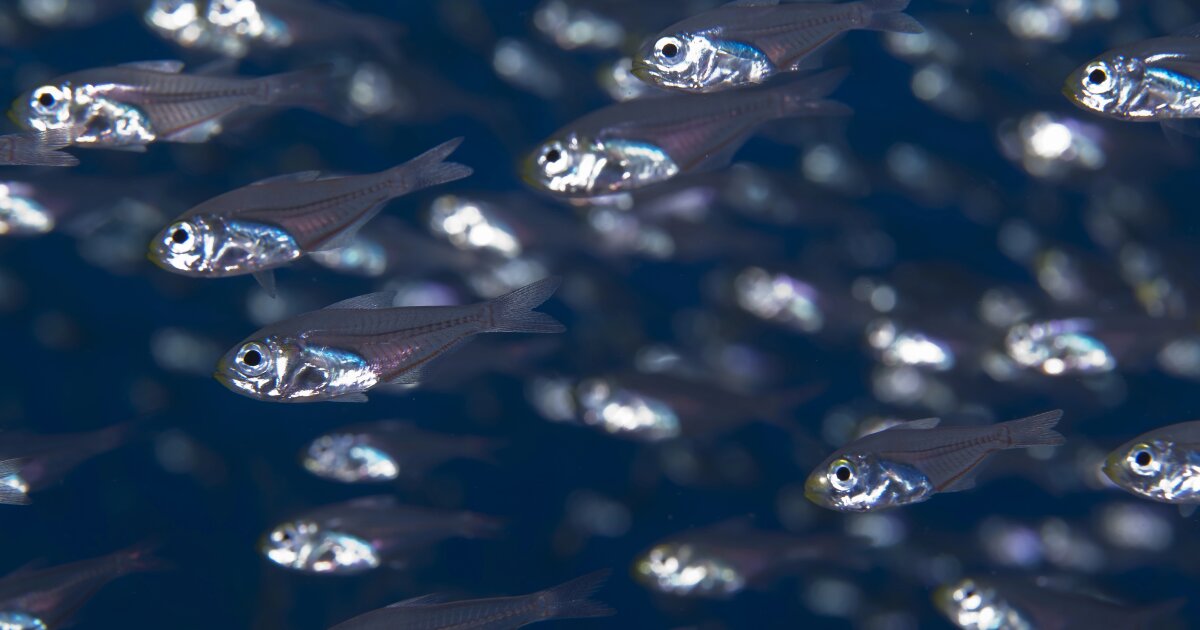
A glowing fish appears to break a basic rule of bioluminescence
A small Pacific fish has given researchers a striking new example of how evolution can solve a problem without building the usual genetic machinery. According to research described by Tohoku University scientists, the golden sweeper fish, Parapriacanthus ransonneti, does not make the key enzyme normally required for bioluminescence. Instead, it appears to obtain that capability directly from prey.
The finding centers on luciferase, the enzyme that drives many light-producing reactions in living organisms. In most known cases, an animal that glows either produces the needed components itself or relies on a symbiotic organism. Here, the researchers say the golden sweeper does neither. Using whole-genome sequencing, they found no luciferase gene in the fish and no sign that the gene had been acquired through horizontal gene transfer.
That absence matters because it rules out the simplest explanation: that the fish evolved or borrowed the genetic instructions needed to make its own glow. Instead, the study points to a more unusual strategy. The fish eats luminous ostracods, tiny crustaceans often called sea fireflies, and then sequesters the fully formed luciferase protein from that prey for its own use.
A rare kind of biological theft
The researchers describe the process as kleptoproteinism, a term that captures the idea of stealing and reusing a protein made by another organism. In this case, the “stolen” protein is not incidental. It is central to the fish’s ability to emit blue light from its underside.
That makes the result notable well beyond one species. Bioluminescence is widespread across marine life, but the mechanisms behind it are usually more straightforward. Animals either synthesize the necessary chemicals and enzymes themselves, or they host microbes that do the work for them. The golden sweeper, by contrast, appears to outsource production entirely to its food source.
Researchers had previously linked the fish’s glow to its ostracod prey, but that earlier work left open an important question. Was the prey merely providing a trigger or chemical ingredient, while the fish handled the rest internally? Or was the fish taking in the actual protein machinery ready-made? The new genomic result pushes strongly toward the second explanation.
By showing that the fish lacks the genetic blueprint for luciferase, the work gives much firmer support to the idea that the animal depends on prey-derived proteins. That is why the researchers frame the adaptation as unique rather than just uncommon.

Why the finding matters
The significance of the study lies in both its novelty and its implications. If the golden sweeper can maintain a useful biological function by harvesting proteins from what it eats, that expands the known playbook for animal adaptation. It suggests that in some circumstances, evolution may favor a strategy of capture and reuse instead of building and maintaining an expensive biosynthetic pathway.
That could be especially advantageous if the prey species is abundant and already supplies the right molecular tools. For a small fish living in a complex marine environment, obtaining a ready-made luciferase from food may be less costly than evolving a gene, regulating it, and producing the enzyme from scratch.
The glow itself is likely important for survival. The fish’s underside emits blue light, which can help it blend into faint downwelling light in the ocean. That kind of counterillumination is a well-known strategy for avoiding detection from below. The study does not need to reinvent the ecological logic of bioluminescence to show why such a capability would be useful. What is different here is the route by which the fish gets it.
The work also highlights the value of genomic evidence in settling biological debates. Without sequencing data, it is difficult to distinguish between an internally produced adaptation and one that depends on borrowed molecules. The absence of the luciferase gene, coupled with the prey link established by earlier research, gives this case unusual force.
What researchers found
According to the source text, the Tohoku University team used advanced whole-genome sequencing to examine P. ransonneti. They found no luciferase gene in the fish’s genome. They also found no evidence that the fish had picked up the gene through horizontal gene transfer, the process by which DNA can occasionally move between unrelated species.
That leaves dietary acquisition as the leading explanation. The prey species identified in the report is Cypridina noctiluca, an ostracod known for its own light-producing chemistry. The researchers conclude that the fish targets this luminous prey, takes in the already formed luciferase protein, and then uses it to support its own bioluminescence.
In practical terms, the study says the fish is not borrowing instructions. It is borrowing the finished product. That distinction is the heart of the claim and the reason the result stands out.
The researchers describe the evidence as compelling and conclusive on the narrow question of genetic capacity: the fish does not possess the gene required to make luciferase by itself. From there, the biological story becomes one of sequestration and reuse.
What comes next
Even in a study built around a strong genomic result, important questions remain. Researchers will want to understand how the fish captures, transports, stores, and deploys a protein made by another species. Proteins are delicate molecules, and maintaining their function through digestion and onward into a useful biological role is not trivial.
That opens several new lines of inquiry. Scientists can now ask how selective the fish is about prey, how long the imported luciferase remains functional, and whether the fish has specialized tissues that protect or process the protein after ingestion. Those questions matter because they would show whether kleptoproteinism is a one-off trick or a tightly evolved physiological system.
For now, the headline result is clear enough on its own. The golden sweeper appears to be the first known animal shown to import its bioluminescent power directly from prey rather than making the core enzyme itself. That makes it one of the more surprising examples of evolutionary opportunism to emerge from marine biology in recent years.
In a field full of elegant chemical solutions, this one is especially striking because it is so direct. The fish does not just eat something that glows. It seems to eat the machinery of light and make it its own.
This article is based on reporting by refractor.io. Read the original article.
Originally published on refractor.io