A certification-focused milestone for eVTOL flight
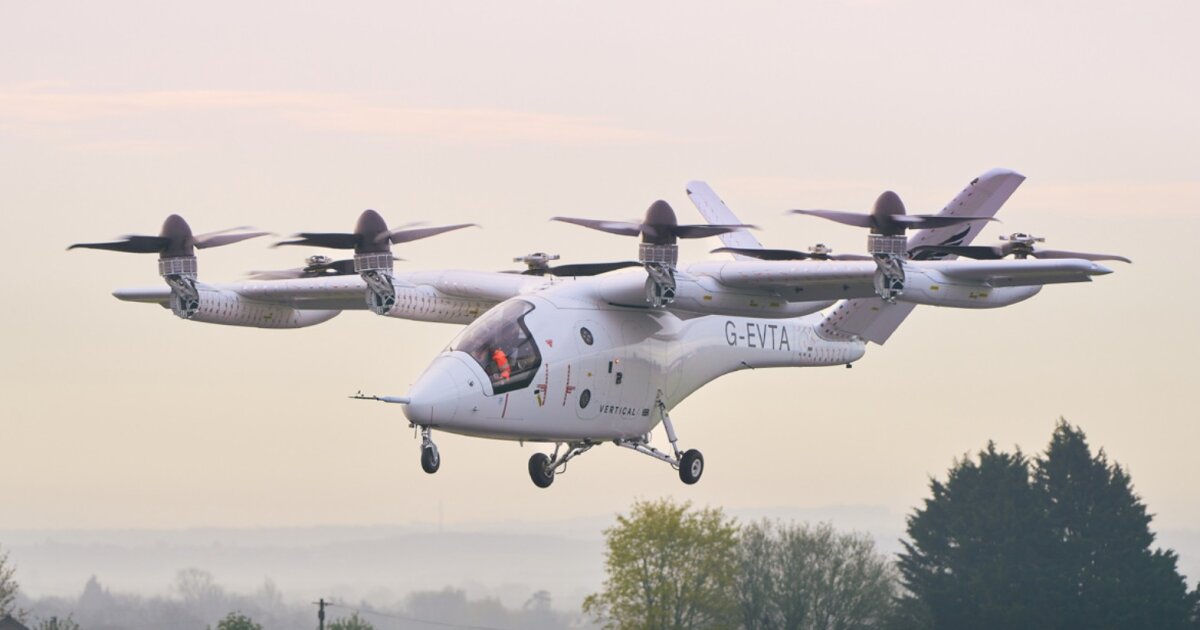
Vertical Aerospace has completed a piloted transition flight that the company describes as a first of its kind under official civil aviation regulatory oversight. The April 14 test at Cotswold Airport in southwest England saw the company’s full-scale tilt-rotor eVTOL move from vertical helicopter-style flight into horizontal airplane-style flight and back again during one continuous sortie, with Chief Test Pilot Simon Davies at the controls.
Transition is one of the hardest parts of eVTOL development. Aircraft in this category must shift between radically different aerodynamic regimes while maintaining control, stability, and safety. That makes the maneuver more than a demonstration stunt. It is a direct test of whether the aircraft and its control systems can operate through the most technically demanding portion of the flight envelope.
According to the source material, this was the second full-transition piloted flight in the broader eVTOL sector after a similar milestone by Joby Aviation last year. What distinguishes Vertical Aerospace’s test is the oversight context. The flight was conducted under Britain’s Civil Aviation Authority through Design Organisation Approval regulatory oversight, giving it added significance in the path toward certification.
Why oversight matters as much as the maneuver
The eVTOL industry has produced many announcements around prototypes, hover tests, and partial demonstrations. But regulators, investors, and future operators are increasingly focused on which milestones are being achieved inside formal certification structures rather than outside them. In that sense, the oversight attached to Vertical’s transition flight may matter as much as the aerodynamic achievement itself.
For companies trying to move from prototypes to commercial aircraft, proving capability under a regulator’s view is a different category of progress from conducting isolated internal tests. It signals not only technical competence but also maturation of the development program and the engineering documentation behind it.
That is why Vertical described the event as its most significant technical milestone to date. The source report says the flight marked the end of Phase 4 of the company’s test program and demonstrated that the aircraft can operate safely across its full flight envelope.
Building toward the transition
The April 14 flight did not arrive in isolation. The company had already logged a vertical-flight transition on April 2, along with earlier tethered hover and vertical maneuvers. It also conducted wingborne horizontal flight in July 2025 using conventional takeoff and landing between Cotswold Airport and RAF Fairford, a route of 217 nautical miles.
Taken together, those steps show a structured progression: hover and low-risk handling first, then vertical maneuvers, then horizontal wingborne flight, and finally continuous piloted transition across modes. That sequence is consistent with how high-risk flight-test campaigns are typically de-risked. Each stage isolates a narrower challenge before integrating them into a full operational profile.
For eVTOL developers, that progression is critical because the industry’s central promise depends on combining vertical takeoff convenience with the efficiency of fixed-wing flight. If the transition phase cannot be made routine, predictable, and certifiable, the broader commercial case becomes much weaker.
The aircraft and control challenge
The test was designed to show that Vertical Aerospace’s G-EVTA aircraft could master the transition phase while maintaining pilot control and stability. The source says the aircraft uses eight electric propellers, with the front rotors tilting through 90 degrees as it moves between flight modes. That places heavy demands on flight-control software and fly-by-wire systems, which must manage rapidly changing aerodynamic loads and pilot inputs.
Vertical says the flight also demonstrated the performance of its Honeywell fly-by-wire system during those aerodynamic shifts. That is a central claim because in advanced aircraft, especially ones with multiple propulsion modes, software-enabled control systems are not peripheral features. They are core safety infrastructure.
The company’s long-term target is full type certification in 2028, followed by commercial operations. The planned operating profile cited in the source is one pilot and four passengers, a cruise speed of 130 knots, and a range of up to 100 miles. Before that, Vertical is aiming for public flight demonstrations at the Farnborough International Airshow in July 2026.
What this means for the eVTOL sector
Vertical Aerospace’s test does not settle the commercial prospects of eVTOL aviation. Certification remains ahead, and scaling an aircraft program from milestone flights to routine passenger service is a far larger challenge. Manufacturing, reliability, operating economics, infrastructure, maintenance, and public acceptance still have to align.
Even so, this flight is meaningful because it addresses a core technical and regulatory hurdle at once. The eVTOL market has often been judged on renderings and projections. Milestones like this help shift the conversation back toward demonstrable engineering progress, especially when regulators are directly involved.
There is also a competitive dimension. As companies race toward certification, the credibility of each milestone increasingly depends on how rigorously it is validated. A transition flight conducted under civil aviation oversight carries more weight than one presented only as an internal achievement. That does not guarantee commercial success, but it does provide a stronger foundation for claiming readiness.
For the broader advanced-air-mobility field, the flight underscores where the real bottleneck lies. The challenge is no longer simply getting an electric aircraft into the air. It is proving that the aircraft can move through all phases of flight, under formal scrutiny, with systems robust enough to satisfy regulators. On that measure, Vertical Aerospace has cleared a consequential step.
Key takeaways
- Vertical Aerospace completed a continuous two-way piloted transition between vertical and horizontal flight on April 14, 2026.
- The company says it is the first such flight under official civil aviation Design Organisation Approval oversight from the UK CAA.
- The test marked the end of Phase 4 of the program and validated control through the aircraft’s full flight envelope.
- Vertical is targeting type certification in 2028 and public demonstrations at Farnborough in July 2026.
This article is based on reporting by New Atlas. Read the original article.
Originally published on newatlas.com