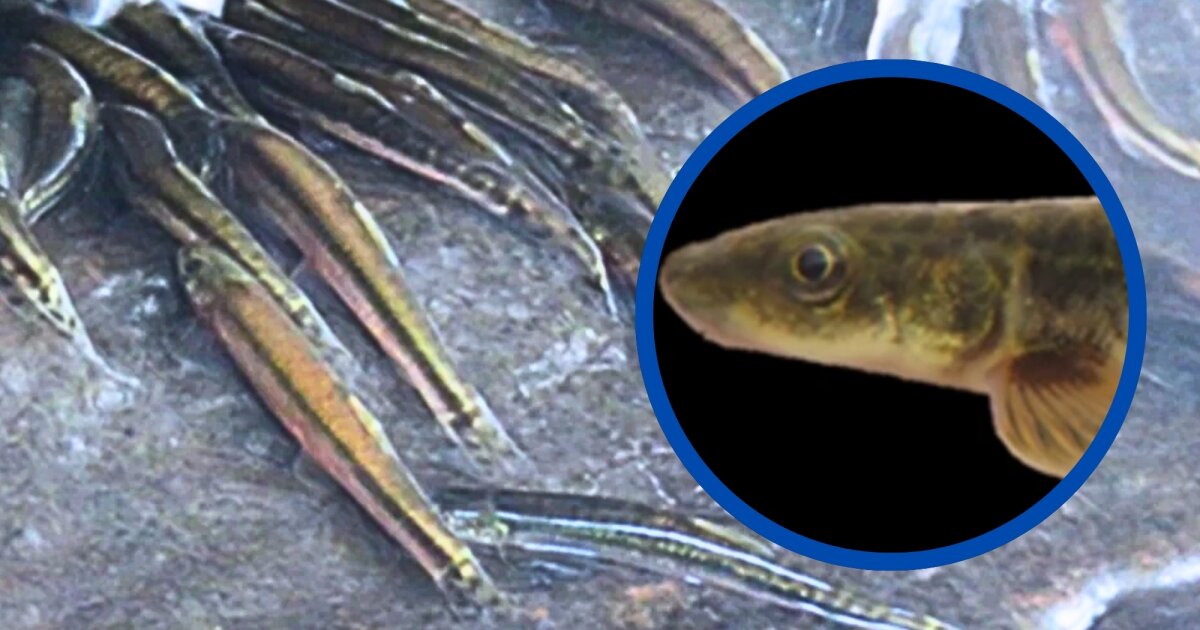
A striking animal behavior has finally been documented in detail
Researchers have captured the first cinematographic and photographic evidence of shellear fish, Parakneria thysi, climbing a near-vertical 15-meter waterfall in the Democratic Republic of Congo. The behavior had been observed before, but the new documentation turns a local natural spectacle into a more rigorous scientific record and offers a clearer picture of how a small freshwater fish solves an extreme environmental obstacle.
The climb is not fast, elegant, or universal across the species. According to the report, thousands of these fish begin ascending the splash-soaked rock face at the end of the rainy season and the start of the dry season. The route lies in the waterfall’s splash zone, where the surface remains wet enough to support breathing and adhesion while avoiding the strongest force of falling water.
The mechanics are as important as the spectacle
The fish use pectoral and pelvic fins covered with tiny hook-like projections known as unculi. Pressed against wet rock, those structures help them grip the surface. They then advance upward using lateral undulatory movements, effectively converting a swimming motion into a climbing one. The result is a stop-and-start ascent in which active bursts of movement lasting 30 to 60 seconds are followed by repeated rest periods, sometimes as long as 30 minutes each.
A successful climb can take around nine hours. That timeline makes the behavior even more remarkable. This is not a brief burst of athleticism but a prolonged, energy-managed migration through a narrow environmental window where moisture, traction, and body size all matter.

The findings raise ecological questions as well as biomechanical ones
One of the most intriguing elements in the report is that upstream and downstream populations are often genetically distinct in fish living around waterfalls, yet in this case researchers found no genetic difference between the populations above and below the falls. That suggests the climb is effective enough to preserve mixing between the two groups, despite the obvious physical barrier.
The migration also appears to be partial rather than universal. The report says only smaller fish attempt the ascent, while larger individuals do not. That points to a tradeoff between physical capability, ecological need, and risk. The climb may offer access to food, habitat, or seasonal advantages, but it is apparently not worthwhile or feasible for every member of the species.
Why the discovery matters beyond one species
First visual proof matters because unusual animal behaviors often enter the scientific record gradually. Anecdotal observation can signal something important, but detailed imagery allows researchers to analyze movement, habitat choice, anatomy, and timing in ways that simple description cannot. In this case, the documentation helps connect the fish’s specialized fin structures, its use of the splash zone, and its migration pattern into a more coherent explanation.
It also broadens public understanding of what migration can look like. Animal movement is often imagined in terms of birds crossing continents or mammals traversing plains. But here, migration is miniature, vertical, and measured in centimeters at a time. A 5-centimeter fish spending hours scaling rock in mist and spray challenges familiar ideas about what counts as a dramatic movement ecology story.
The footage does more than provide a captivating natural-history moment. It captures an adaptation at the intersection of anatomy, landscape, and seasonal pressure. That combination is why the finding stands out: not because the climb is simply strange, but because it reveals how far evolution can push a species toward solving a highly specific problem.
This article is based on reporting by refractor.io. Read the original article.
Originally published on refractor.io