JCB’s hydrogen bet is heading back to Bonneville
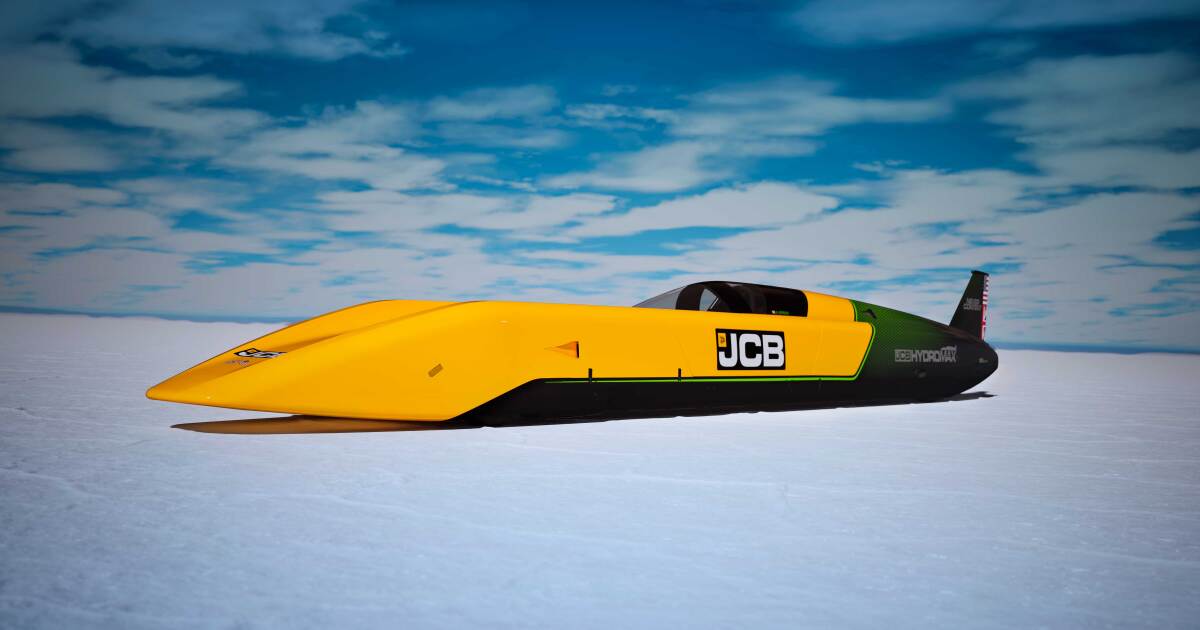
JCB is preparing a high-visibility test of hydrogen internal combustion with a machine built to do one thing: go faster than any hydrogen-powered car has gone before. The British equipment maker says its new Hydromax racer will attempt to exceed 350 mph at the Bonneville Salt Flats in Utah this August, a target that would put it above the current hydrogen internal-combustion land speed record and ahead of the fastest hydrogen vehicle of any kind cited in the supplied source material.
Land-speed programs are often dismissed as marketing theater, but this one is more strategically pointed than most. JCB is not using an exotic one-off propulsion concept detached from its commercial business. According to the source text, the Hydromax is powered by two hydrogen internal combustion engines derived from the same family already going into the company’s production excavators. That makes the run a public stress test for hydrogen combustion as an industrial technology, not just a branding exercise.
The numbers behind the attempt
The Hydromax is a 32.8-foot vehicle built around two JCB-developed hydrogen engines, each tuned to produce 800 horsepower. Together they deliver 1,600 horsepower to all four wheels through what the company describes as a twin-clutch dual-transmission system. JCB says the vehicle has been engineered for more than 350 mph and that its bodywork has been redesigned from the ground up to be more aerodynamically efficient than the company’s earlier diesel-powered record car, the Dieselmax.
If the August run reaches its declared target, it would nearly double the 187.62 mph record set by BMW’s hydrogen internal-combustion H2R prototype. The supplied source text also notes a faster benchmark for hydrogen propulsion overall: Ohio State University’s fuel-cell Buckeye Bullet 2 reached 303 mph in 2009. JCB says it is aiming to beat both marks.
The choice of driver underlines how seriously the company is treating the attempt. The car will be piloted by Andy Green, who set JCB’s diesel land-speed record of 350.092 mph in 2006 and remains the only person to break the sound barrier on land, holding the outright world record at 763.035 mph.
Hydrogen combustion, not fuel cells
The more interesting industrial angle is the technology choice itself. Hydrogen transportation debates often center on fuel cells for road vehicles, with battery-electric systems dominating much of the passenger-car market. JCB is instead arguing, at least implicitly, for hydrogen combustion as a practical route in heavy equipment and other demanding applications.
That matters because hydrogen combustion has a different operating profile and infrastructure logic from fuel cells. It can build on familiar engine architectures and maintenance models, which may appeal to industries that already run fleets of diesel machinery. By tying the Hydromax to production excavator engines, JCB is signaling that it sees hydrogen not only as a future power source but as something that can be integrated into existing machine categories without waiting for a wholesale platform rewrite.
A record attempt with product implications
The source text says every component of the racer, from suspension geometry and traction-control calibration to camera placement, has been validated through simulation and stress testing before the car touches salt. That level of preparation is expected in record-speed work, but it also reinforces a broader point: demonstration vehicles can function as accelerated development environments for production technologies.
For JCB, success at Bonneville would not prove that hydrogen combustion is universally competitive. It would, however, provide a dramatic proof point that the company’s engines can operate at high power density under extreme conditions. In sectors where uptime, ruggedness, and refueling patterns matter more than consumer charging convenience, that kind of signal has value.
There is also a narrative advantage. Hydrogen often struggles with perception because so much of the conversation lives in policy documents, infrastructure road maps, and prototype announcements. A record attempt translates the abstract into something measurable and visible. Speed is not the same as market readiness, but it is a clear way to show that the underlying machinery is real.
- JCB plans its Bonneville attempt for August.
- The Hydromax uses two hydrogen combustion engines producing a combined 1,600 horsepower.
- The company says related engines are already shipping in production excavators.
- Its target would exceed both the current hydrogen combustion record and the faster fuel-cell benchmark cited in the source text.
What to watch next
The record attempt will not settle the broader contest between batteries, fuel cells, and hydrogen combustion. But it could sharpen the industrial case for hydrogen engines in heavy-duty roles where fast refueling, mechanical familiarity, and high power matter. If JCB delivers the number it is chasing, the company will have turned a motorsport-style spectacle into a more substantive claim: that hydrogen combustion is not merely a transitional curiosity, but a serious engineering pathway with commercial relevance beyond the salt flats.
This article is based on reporting by New Atlas. Read the original article.
Originally published on newatlas.com