The Rig That Held the Camera Lens Hostage
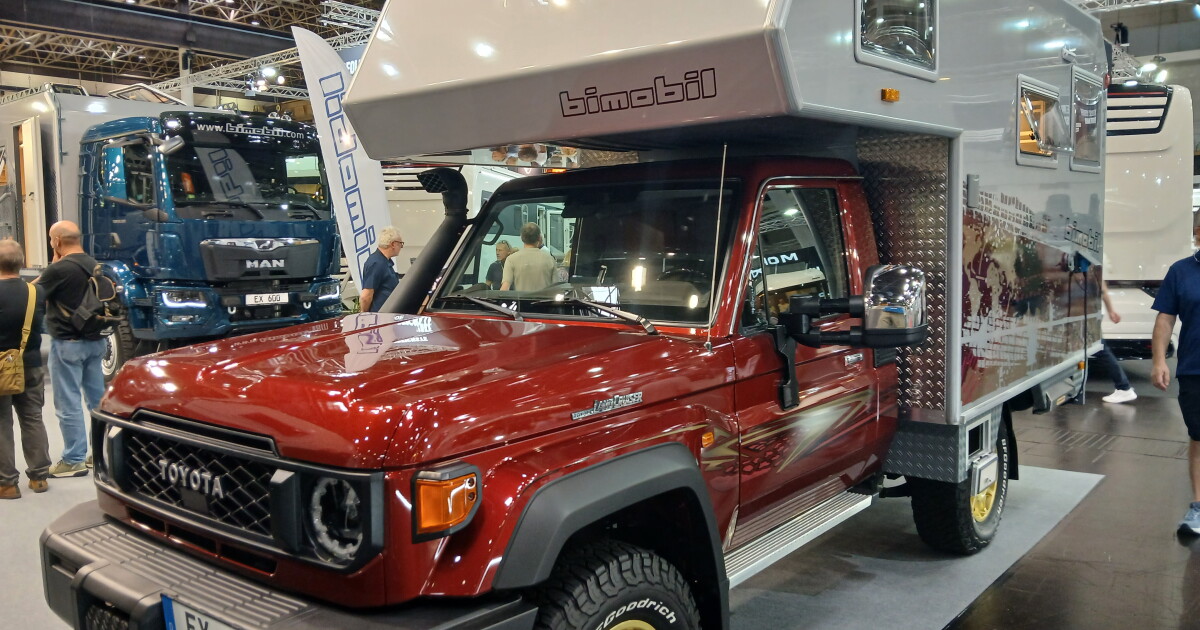
Every year as summer winds down, the Düsseldorf Caravan Salon gathers one of the broadest assortments of camping vehicles on the planet — everything from lovingly preserved classics to the newest factory-built expedition machines. Amid that sprawl, a single compact 4x4 commanded unusual attention at the 2026 edition: the Bimobil EX 270, a mini-motorhome riding on a Toyota Land Cruiser 79 Series single cab. The combination of a genuinely capable off-road truck and a right-sized camper module proved hard to walk past, and it earned the loudest praise of the publication's outing — a "BEST IN SHOW" verdict.
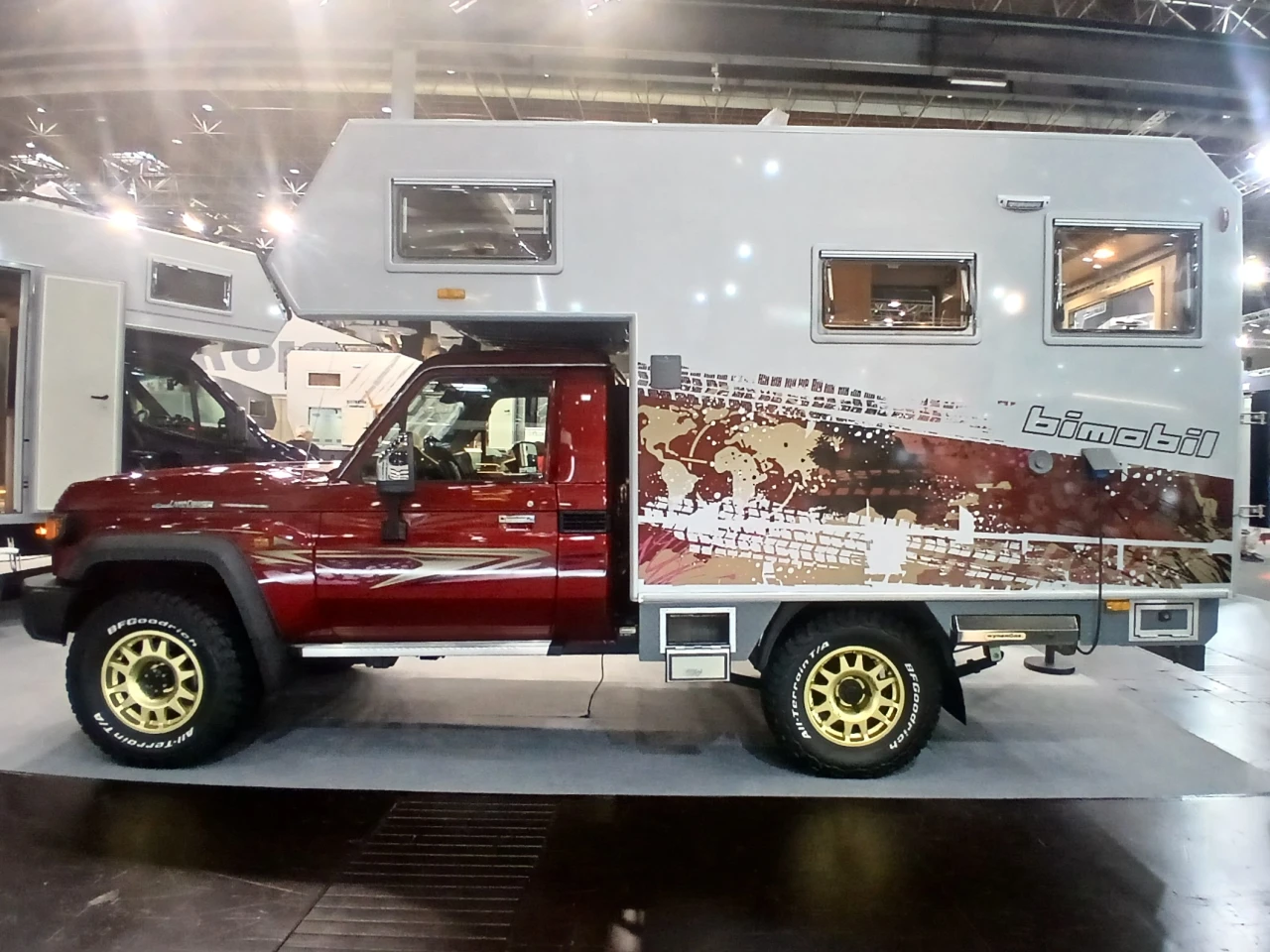
That reaction wasn't purely aesthetic. What made the EX 270 compelling was the pairing: a cab engineered for terrain most motorhomes never see, mated to a living module deliberately kept small enough to stay nimble. With a total length of 580 centimeters, the EX 270 occupies a niche between full-size expedition trucks and conventional camper vans — one that Bimobil markets as an adventurous two-person Explorer for deep escapes from everyday civilization.
A Toyota Land Cruiser Cab Meets a Bimobil Module
The heart of the build is the Land Cruiser 70 Series, a nameplate that has spent decades earning a reputation for durability in places where roads are optional. The EX 270 uses the single-cab 79 Series variant, and the truck wears its heritage openly. A model-family update rolled out several years ago brought modern LED headlights styled in a retro round shape, a detail that keeps the front end unmistakably Land Cruiser while improving nighttime visibility.
Bimobil used the platform's visual identity as a canvas for the show vehicle. The cab carries a deep red finish, accented by gold graphics and matching gold wheels. The camper cabin features a graphic world map patterned from tire tread — a small design decision that says as much about intended use as any spec sheet. It signals that this is a vehicle meant to be driven far, on surfaces that leave marks.
Living Space in 580 Centimeters
Compactness is the EX 270's organizing principle. Bimobil squeezed a functional two-person living environment into the module behind the single cab, and the layout reads as deliberately efficient rather than cramped.
- Sleeping: A transverse alcove double bed sits over the cab, using the height above the driver and passenger to keep the main floor area free.
- Kitchen: A small but fully equipped kitchen block faces the entry door, positioning the galley where it is immediately reachable when stepping inside.
- Bathroom: A wet bath handles showers and hygiene needs. It could benefit from a fold-away sink, though it compares favorably with several other compact wet baths on display around Düsseldorf.
- Dining: A convertible dinette at the rear serves as the indoor eating and sitting area.
- Dimensions: A 580-cm overall length on the Land Cruiser 79 single-cab chassis, built for two occupants.
Sleeping Above, Living Below
The alcove bed arrangement is a familiar solution in compact motorhomes, and it works especially well here. Because the Land Cruiser's single cab footprint is short, pushing the sleeping quarters over the cab preserves a dedicated living zone below — space for the dinette, the kitchen and the wet bath without stretching the vehicle to the length of a conventional coach-built RV. For two occupants on a long trip, that split between rest and daily life is what makes a small module livable rather than merely survivable.
A Kitchen and Bath That Respect the Footprint
Neither the galley nor the bathroom in the EX 270 pretends to be a full apartment. The kitchen block is compact but complete, and its placement across from the entry door keeps it usable as a pass-through workspace rather than a dead-end corner. The wet bath's main trade-off is storage and counter area, which is where the suggestion of a fold-away sink comes in — a common fix in this size class that frees floor space when the room is not in use. Reviewers who toured multiple compact campers at the salon rated the EX 270's bath as one of the more usable examples they encountered.
The Rear Hatch: Dinner With a View
One of the EX 270's most appealing features was also the hardest to photograph at the show. The rear hatch was kept closed because of how Bimobil positioned the vehicle at the corner of its booth, but when opened it turns the rear convertible dinette into an al fresco dining space. It is a pattern Bimobil uses across much of its lineup: a large hatch beside the dining area, mounted either at the rear or along the side, that blurs the line between interior and campsite.
On the EX 270, the rear configuration means the dinette can face outward directly onto wherever the truck has parked — gravel track, lakeside, or a clearing far from pavement. Bimobil's own photography shows the hatch swung open for lunch with a side of fresh wilderness air, which is a fair summary of the feature's purpose.
Proven Trucks, Purpose-Built Cabins
The EX 270 fits a clear Bimobil philosophy: start with a chassis that has already proven itself in hard conditions, then engineer the living space around its actual dimensions rather than forcing a generic box onto it. The results are often visually distinctive and genuinely capable off pavement.
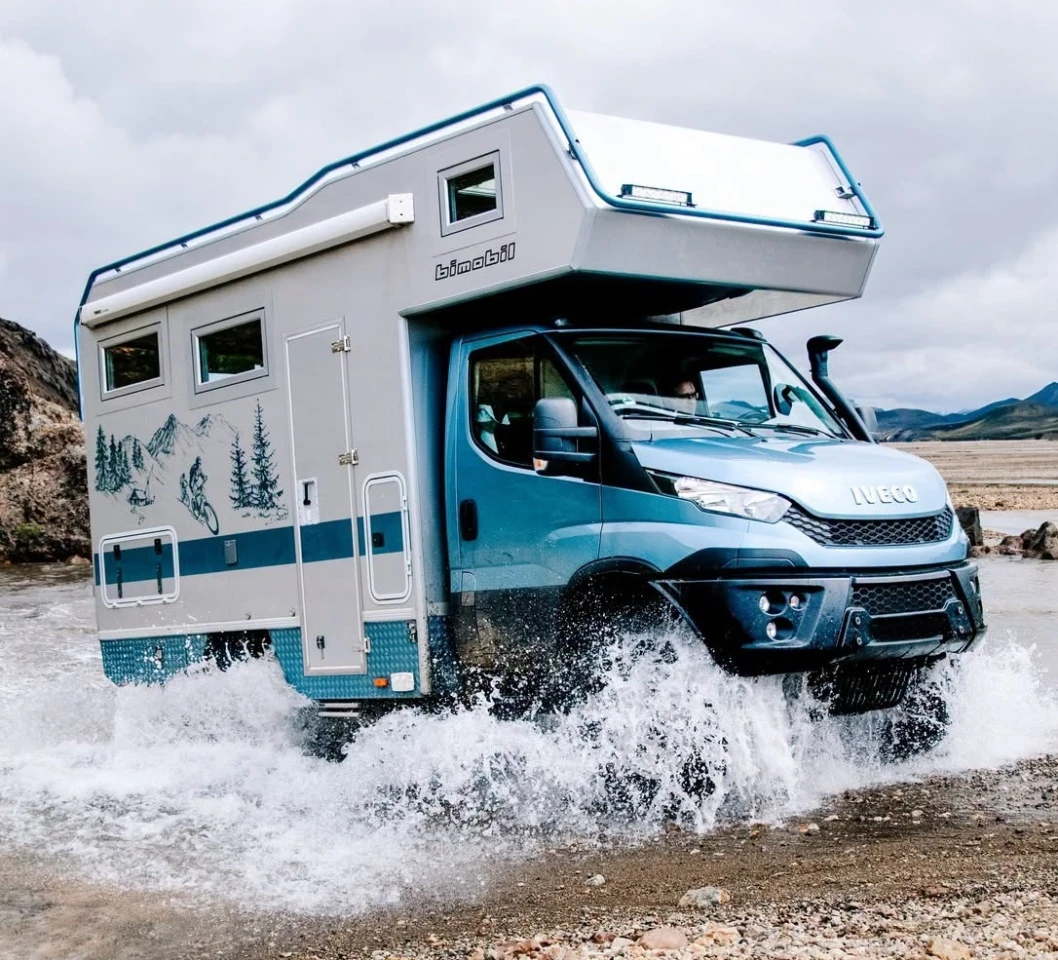
The company's booth reinforced that message with another machine. Where the EX 270 is built for two people and tight trails, the Iveco-based ST 702 represents the larger end of the range. Bimobil showed it both cleaned up for civil German society at the salon and, in action photographs, crossing icy water up north in Iceland. That pairing of show-floor polish and genuinely rough-duty imagery captures the brand's positioning: these are vehicles that look good in a hall and are expected to perform far outside one.
Why a Small 4x4 Camper Resonates Now
The enthusiasm around the EX 270 reflects a broader shift in how buyers think about camping vehicles. Interest has grown in rigs that can reach remote terrain without the size, fuel appetite and route restrictions of a full expedition truck. A Land Cruiser-based module at 580 centimeters sits in that sweet spot. It can use narrow tracks that a big overland camper cannot, it carries two people in real comfort, and it wears a badge associated with reliability in exactly the environments its owners dream about.
There is also an aesthetic dimension. The retro-round LED front end, the deep red cab, the gold wheels and the tire-tread map on the cabin connect the EX 270 to a lineage of utilitarian Toyotas rather than to the white-box look of mass-market motorhomes. At a show where hundreds of campers compete for attention, that identity is a competitive advantage — one strong enough that at least one publication walked away calling it the best thing it saw.
Bimobil has not positioned the EX 270 as a volume product, and a Land Cruiser 79 single cab is not a budget starting point. But as a demonstration of what happens when a durable 4x4 chassis and a thoughtfully compact living module are designed as one vehicle, it made a persuasive case in Düsseldorf — and gave showgoers a clear picture of the kind of travel it was built for.
This article is based on reporting by New Atlas. Read the original article.

Originally published on newatlas.com