Learning to Survive Damage
One of the most persistent limitations of robots deployed in real-world environments is their fragility. A single failed actuator, a damaged limb, or a broken sensor can render an otherwise functional machine completely inoperable. The rigid, purpose-built designs that make robots efficient in controlled factory settings become liabilities the moment those machines encounter the unpredictability of search-and-rescue operations, military deployment, or planetary exploration. A new study from a leading robotics institute has demonstrated a potential solution: robots whose physical form and control software are co-evolved using artificial intelligence, producing designs that are almost impossible to fully disable.
The work, published in Science Robotics, used a variant of evolutionary algorithms — computational processes inspired by natural selection — to simultaneously optimize both the physical morphology of the robot and the neural network that controls it. The result is a machine that does not just tolerate damage; it was designed from the ground up with the assumption that damage will occur. When tested by researchers who removed limbs, punctured pneumatic actuators, and disabled sensors, the robot continued to move and complete navigation tasks with a success rate that far exceeded conventionally designed counterparts.
How Evolutionary Design Works
The process begins with a population of randomly generated robot designs — virtual bodies with different numbers of limbs, joint configurations, material properties, and sensor placements — each paired with a randomly initialized control network. These virtual robots are subjected to a simulated physical environment and evaluated on their ability to complete a task: navigating an obstacle course, carrying a payload, or maintaining forward motion after being struck.
The designs that perform best are selected, recombined, and mutated to form the next generation — just as natural selection amplifies traits that confer survival advantages. Over thousands of simulated generations, this process converges on designs that are genuinely surprising to human engineers: asymmetric body plans, redundant actuator arrangements that seem wasteful until a limb is removed, and control networks that have learned to route motor commands around failed components in real time.
What makes the new study distinctive is its explicit inclusion of damage scenarios during the evolutionary process. Rather than optimizing purely for performance in undamaged conditions, the researchers periodically introduced random damage events during simulation — removing limbs, degrading sensors, reversing actuators — and evaluated how well robots maintained performance across both normal and damaged states. This dual optimization pressure produced a qualitatively different class of robot than performance-only evolution.

The Physical Robot
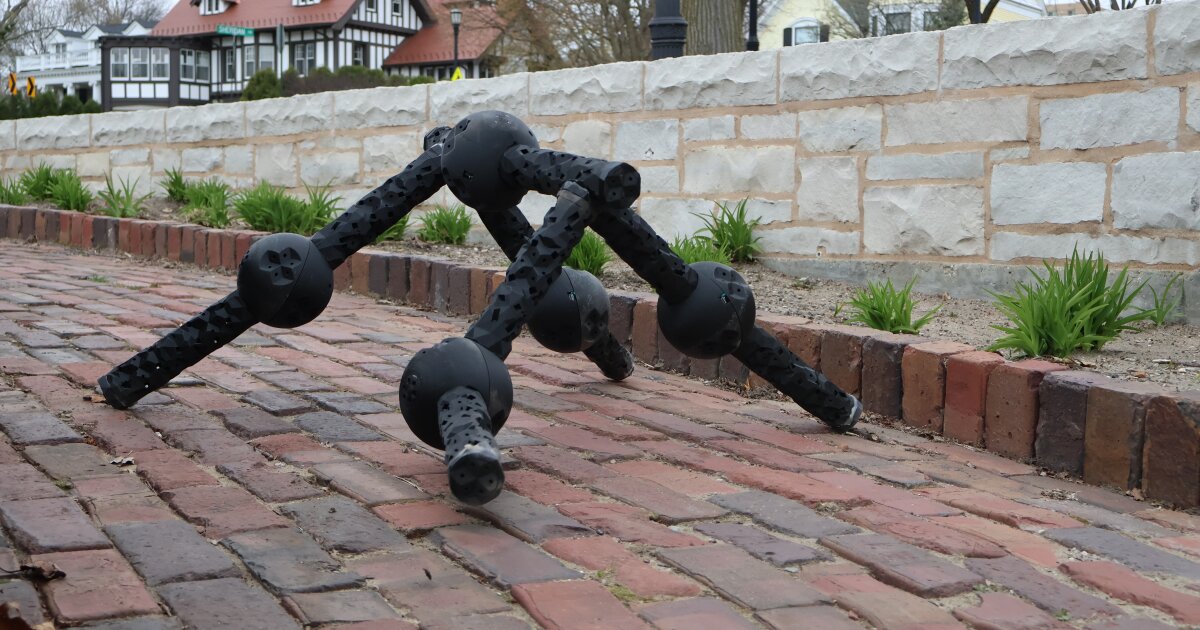
The best-evolved designs were fabricated using soft robotics techniques — combinations of flexible polymer structures, shape-memory alloys, and pneumatic chambers that can deform and recover in ways rigid robots cannot. When a portion of the robot's body is removed, the remaining structure redistributes mechanical loads across its remaining elements in a way impossible for a rigid metal chassis. The control network, running on an embedded processor, continuously monitors forces and positions sensed across the body and adjusts motor commands to compensate for whatever structure remains.
In physical testing, researchers removed up to 40 percent of the robot's total body mass — cutting away limbs, removing actuated segments, puncturing air chambers — and observed that the machine continued to move and navigate. Its gait changed radically, sometimes shifting from a walking pattern to a crawling or rolling motion, but it did not stop. The behavior was not scripted; it emerged from the trained neural network's ability to generalize across novel body configurations.
Applications in High-Stakes Environments
The implications for real-world deployment are significant. Search-and-rescue robots operating in collapsed building environments routinely encounter debris impacts, sharp edges, and mechanical stress that damage conventional platforms. Military robots deployed in combat zones face even more extreme damage scenarios. Planetary exploration vehicles must maintain function for months or years without any possibility of maintenance or repair.
Current approaches to robot resilience typically involve redundant mechanical components — adding weight, cost, and complexity — or modular designs that can self-reconfigure after damage, which requires sophisticated docking mechanisms and adds failure points of its own. The evolved approach sidesteps these trade-offs by building robustness into the fundamental design rather than layering it on top.

Toward Morphological Intelligence
The research also advances a broader philosophical shift in robotics called morphological computation — the idea that intelligence is not solely a property of the control system but is distributed across the physical form of the robot itself. A body shape that naturally redirects forces, absorbs impacts, and maintains structural integrity under stress is doing computational work that would otherwise have to be handled by the brain. The evolved robots are not just well-controlled; they are well-shaped for the problems they face.
Future work will focus on extending the evolutionary approach to more complex tasks and larger body plans, as well as investigating whether robots can learn to adapt in real time as damage accumulates during a deployment — not just surviving damage anticipated during evolution, but discovering new compensatory strategies on the fly. Combined with increasingly capable onboard AI, the prospect of robots that are genuinely difficult to stop represents a meaningful advance in the practical utility of autonomous machines in difficult environments.
This article is based on reporting by New Atlas. Read the original article.
Originally published on newatlas.com