The Marines are still refining a replacement for the LAV
The US Marine Corps has decided that its future reconnaissance vehicle program still needs both of its main contenders. Textron and General Dynamics Land Systems have each received a second rapid prototyping contract for the Advanced Reconnaissance Vehicle, or ARV, extending a competition aimed at replacing the Corps’ aging Light Armored Vehicle fleet.
Breaking Defense reports that the service is not looking for a single vehicle configuration. It wants an ARV family built around multiple mission roles. Those include a command, control, communications and computers-unmanned aerial system variant, a 30 mm autocannon and anti-tank guided missile variant, and a logistics variant. In other words, the Corps is pursuing a modular reconnaissance ecosystem rather than a one-size-fits-all replacement.
That distinction matters. Modern reconnaissance is no longer just about scouting ahead of the main force. It is about sensing, communicating, feeding targeting chains, and surviving in highly contested environments where vehicles must work alongside unmanned systems and networked sensors.
The vehicle is being defined by the information fight
The Marine Corps’ own rationale, quoted in the report, makes that explicit. Col. Chris Stephenson, the program manager for Light Armored Vehicles, said the Marine Air-Ground Task Force must outcycle the fight for information in order to shape the battlespace and deliver precision fires. He described future operating environments as drastically more complex and argued that Mobile Reconnaissance Battalions need a purpose-built capability able to sense, communicate, and fight while incorporating manned and unmanned systems.
That is a concise summary of how land reconnaissance is changing. The vehicle is still expected to move, survive, and deliver firepower. But it is increasingly judged by how well it serves as a node in a larger sensing and targeting network. The ARV is being asked to do more than replace the LAV mechanically. It is being asked to fit a different theory of combat.
That theory emphasizes sensor webs and kill chains, terms that reflect the military’s growing focus on connected battlefield systems. A recon platform that cannot feed data into that architecture risks becoming obsolete even if its mobility and weapons remain strong.
Prototype testing has already moved across land and water
The latest prototyping phase builds on work that began in July 2021, when the Marine Corps first selected Textron and GDLS to produce early prototypes. The current round is intended to refine those designs rather than start from scratch.
Both companies have already been public about recent testing progress. Breaking Defense notes that Textron said it had completed the build and evaluation period of its Cottonmouth 30 mm prototype. GDLS separately announced in February that it had finished additional testing on its own 30 mm prototype, with more testing planned through the rest of 2026.
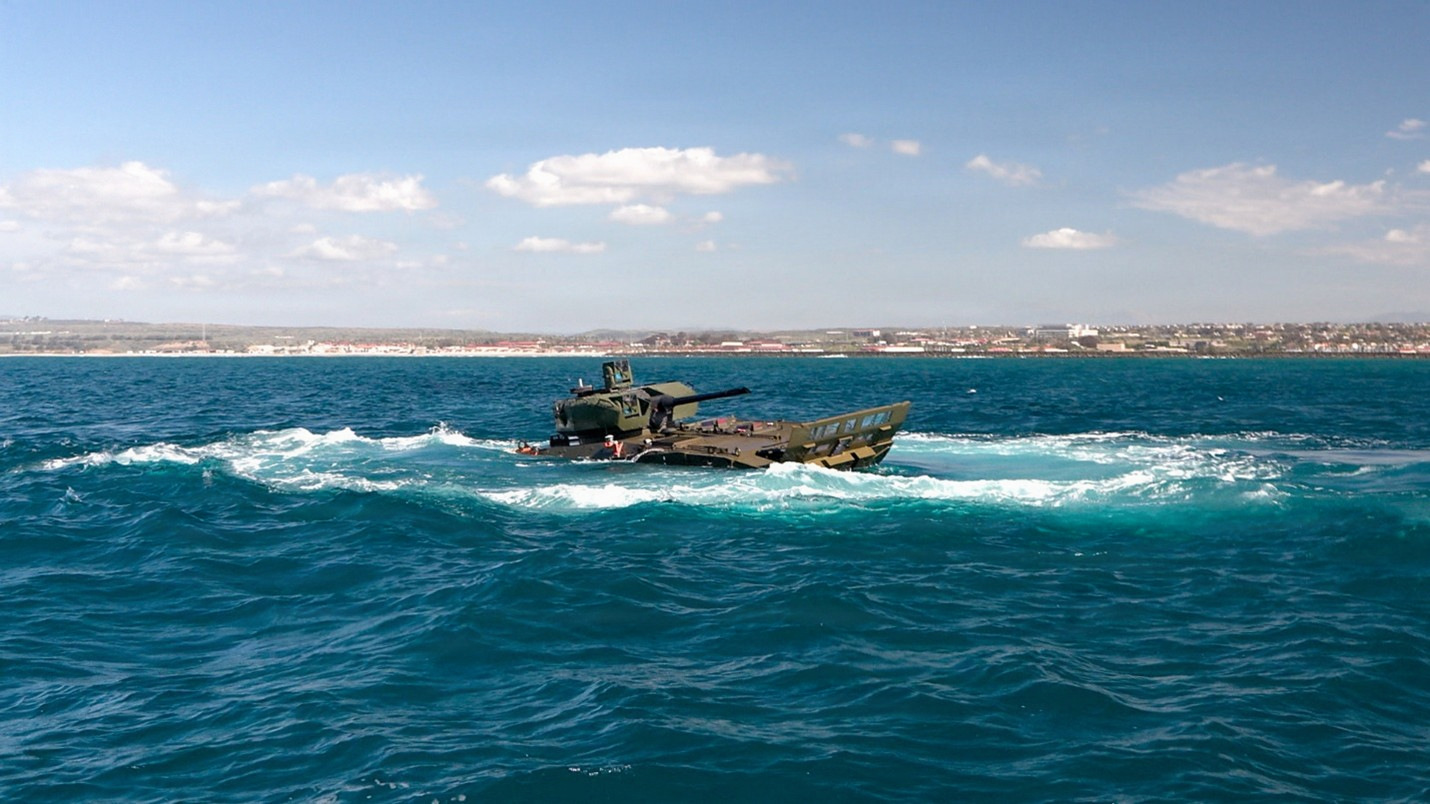
Those assessments included land mobility, lethality, and open-water or ocean-swim testing at sites including Camp Pendleton in California and the Army’s Ground Vehicle Systems Center in Michigan. That spread of evaluations reflects the Corps’ distinct amphibious requirements. A Marine vehicle must operate in terrain and conditions that go beyond what many Army-oriented designs are optimized for.
Why the program still matters despite a slow path
Defense vehicle programs often move more slowly than their early rhetoric suggests, and the ARV has already been in prototype territory for several years. But the continuing two-company competition indicates the Corps still sees enough uncertainty and enough opportunity in the design space to keep refining both approaches.
That is not necessarily a weakness. For a program intended to anchor reconnaissance, command-and-control integration, and weapons employment in future operations, premature narrowing could be costly. The Corps appears to be using prototyping to learn what kind of platform architecture best matches its evolving concept of reconnaissance.
It is also notable that the service is asking for a family of vehicles. That approach can preserve shared logistics and training while allowing specialized mission packages. If executed well, it could produce a more flexible force structure than a single replacement platform ever could.
A replacement program shaped by future doctrine
The strongest takeaway from this latest contract action is that the Marine Corps is not simply shopping for a newer armored truck. It is trying to define a reconnaissance vehicle for an era of distributed operations, contested communications, and tighter links between sensors and shooters.
Whether Textron or GDLS ultimately wins, the underlying requirement is already clear. The next Marine reconnaissance vehicle must be amphibious enough, connected enough, and lethal enough to operate inside a far denser information environment than the LAV was built for. That makes ARV less of a hardware refresh than a doctrinal platform.
- The Marine Corps has awarded Textron and GDLS a second rapid prototyping phase for the ARV program.
- The service wants a family of vehicles with reconnaissance, weapons, and logistics variants.
- Testing has included mobility, lethality, and water operations as the Corps refines requirements for future reconnaissance missions.
This article is based on reporting by Breaking Defense. Read the original article.
Originally published on breakingdefense.com