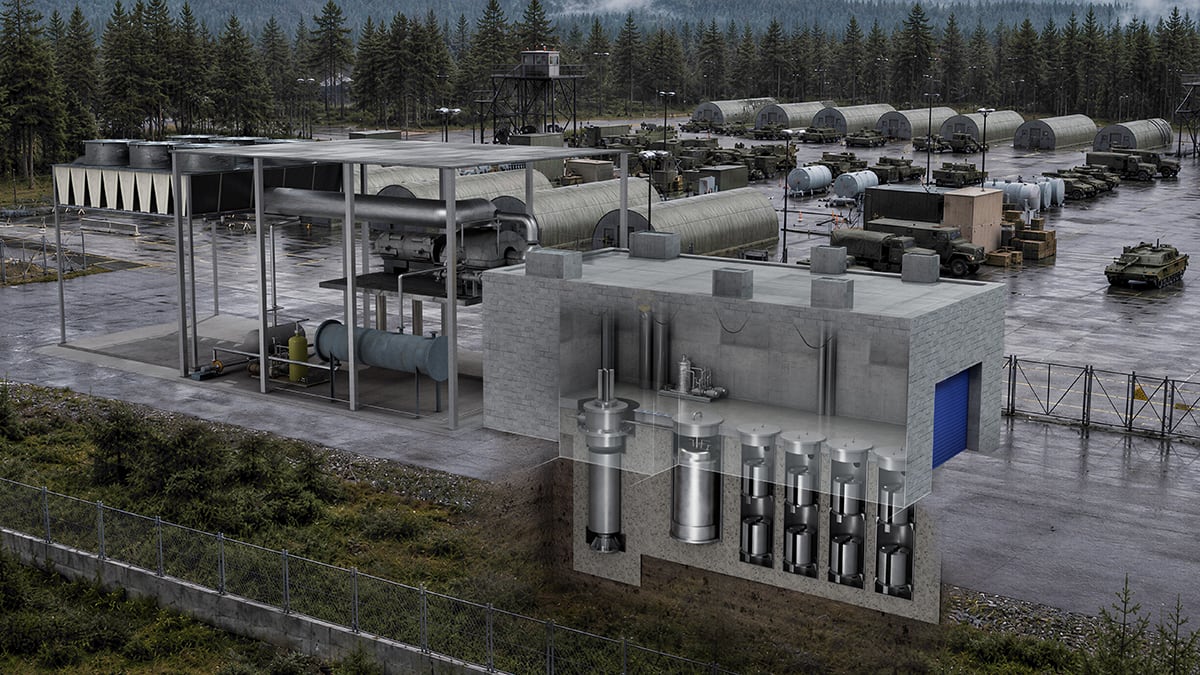
The Army is turning energy resilience into infrastructure
The U.S. Army has selected five companies to develop nuclear microreactors for military bases in a significant escalation of its effort to harden domestic installations against grid disruption and fuel-supply risk. The agreements, announced with the Defense Innovation Unit, are worth up to $2.2 billion combined and mark one of the clearest signals yet that the Pentagon sees small nuclear systems as a practical part of future base operations rather than a distant experiment.
The awardees are Antares Nuclear for Fort Bragg, North Carolina; BWXT Advanced Technologies for Fort Campbell, Kentucky; General Atomics Electromagnetic Systems for Fort Hood, Texas; Radiant Industries for Fort Benning, Georgia; and Westinghouse Government Services for Fort Drum, New York. The Army said it expects to field more than 20 microreactors across Department of Defense installations over time.
That scale matters. For years, military energy resilience has centered on backup generators, fuel storage, localized renewables, and grid-hardening measures. The Janus program points to a different model: contractor-operated nuclear generation placed at or near bases to provide steady power even when the civilian grid is compromised or fossil-fuel logistics become unreliable.
Why the Army is making the move now
The Army introduced Janus in 2025 after an executive order called for the military to speed up nuclear-power integration, with the goal of having an operational reactor at a military base by September 30, 2028. The service’s public framing is blunt. It is not treating this as a climate demonstration or an abstract research exercise. It is treating it as a readiness issue.
Army officials tied the program directly to a growing concern that U.S. installations cannot assume uninterrupted access to civilian electricity in a future conflict or major emergency. They also pointed to the logistical burden of moving diesel and other fuels to where they are needed, particularly when transportation networks or overseas shipping routes are contested.
That logic reflects a broader shift in how defense planners think about domestic infrastructure. A military base is no longer just a consumer of local utility power. It is an operational node that may need to sustain critical functions through cyberattacks, sabotage, severe weather, or wider grid instability. In that framework, dependable on-site generation becomes a strategic asset.

How the Janus model is structured
The Army said the reactors will be contractor-owned and contractor-operated, and vendors will only be paid if they hit technical milestones. That structure reduces some of the government’s execution risk while preserving pressure on the selected firms to prove their designs in real project conditions. It also suggests the Army wants to accelerate deployment without taking on full ownership and operating responsibility in the early phase.
Importantly, officials said each installation will remain connected to the commercial grid and that the microreactors are not intended to power an entire base on their own. That makes Janus less of a full replacement model than a resilience layer. A reactor could provide dependable baseload power for critical functions while the base still draws from conventional infrastructure for the rest of its demand profile.
That hybrid approach may prove more realistic than visions of fully energy-independent installations. It lowers the threshold for adoption, allows staged integration, and creates room for future combinations with storage, solar, or other distributed systems.
From Project Pele to base deployment
The new awards build on earlier Pentagon interest in mobile nuclear systems. In 2022, the Defense Department announced Project Pele, which sought to develop a portable 40-ton reactor capable of generating one to five megawatts of power. Janus appears to carry that momentum into a more installation-focused phase, emphasizing permanent or semi-permanent use at domestic bases rather than only expeditionary mobility.
The Army’s messaging also addresses one of the most politically sensitive aspects of any military nuclear initiative: fuel type. Officials said none of the future base reactors will use highly enriched, weapons-grade uranium. That point is likely intended to differentiate the program from older defense nuclear associations and reduce concern around proliferation and material security.
Even so, the program will face questions that extend beyond reactor engineering. Siting, local acceptance, regulatory coordination, emergency planning, cybersecurity, physical security, and waste management will all shape whether Janus becomes a repeatable model. The announcement shows momentum, but it does not eliminate the long path from contract award to operating hardware.
What this means for the energy and defense sectors
For the energy industry, the Army’s decision is a major validation opportunity for small-reactor developers. Commercial advanced nuclear firms have spent years arguing that smaller systems can serve industrial customers that value reliability over the cheapest possible kilowatt-hour. Military bases fit that thesis well: they have defined perimeters, mission-critical loads, and a clear willingness to pay for resilience.
For the Pentagon, the move signals that energy is becoming inseparable from force projection. Army Secretary Dan Driscoll said the contracts will help deliver safe, reliable baseload power directly to installations and support the resilience needed to project combat power globally without relying on vulnerable external grids. That framing links electrical infrastructure directly to military effectiveness.
The larger implication is that domestic bases are being treated more like contested environments. If planners assume the grid can be targeted and fuel can be disrupted, then on-base nuclear generation stops looking exotic and starts looking like one answer to a practical vulnerability.
The Army has not yet proven that microreactors can be fielded quickly, economically, and with sustained public trust. But with five companies now tied to named installations and a deadline on the calendar for an operational reactor by late September 2028, Janus has moved from concept to visible execution. The next test is whether the program can turn that ambition into functioning infrastructure.
This article is based on reporting by Defense News. Read the original article.
Originally published on defensenews.com