A closer look at pig-to-human liver support
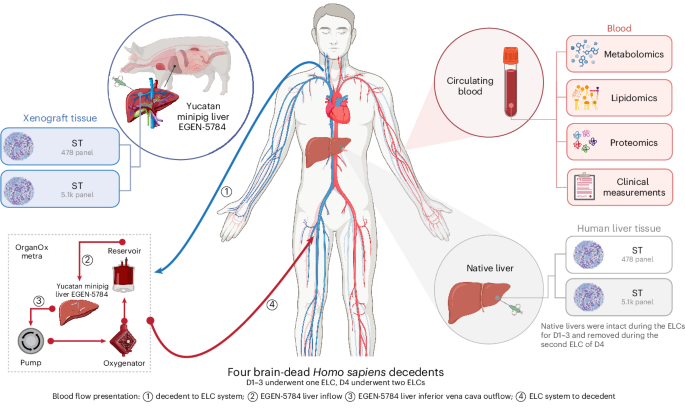
Researchers reporting in Nature Medicine have added a detailed molecular map to one of the most closely watched areas in transplant medicine: the use of genetically engineered pig organs to support human patients. The new briefing describes what happened during pig-to-human extracorporeal liver cross-circulation, a setup in which a pig liver is connected outside the body to provide metabolic support rather than being fully implanted.
The main value of the report is not that it claims the problem is solved. It does the opposite. It shows, in unusually fine detail, where the biology cooperates and where it immediately resists. Using spatial and circulating multi-omics, the researchers traced an early innate immune response, species-specific complement activity and interactions between the xenograft and human platelets. At the same time, the liver support system still appeared to preserve metabolic function even after the native liver had been removed.
That combination matters. In liver failure, timing is often everything. A support platform that can buy time for recovery or transplantation would be clinically important. But any such platform has to survive the first wave of inflammatory and clotting complications that arise when human blood meets pig tissue. The study suggests both realities are present at once: meaningful biological support and immediate immunological friction.
What the study says happens first
The briefing points to an early innate immune response as a defining feature of the cross-circulation period. Innate immunity is the body’s rapid-response system, and in xenotransplant settings it can become active before longer-term adaptive immune pathways even enter the picture. The report also highlights species-specific complement dynamics, referring to the protein cascade that helps the immune system identify and attack foreign material.
Those findings are significant because complement activation has long been one of the central barriers in xenotransplantation. Even when donor pigs are genetically modified to reduce rejection risk, human immune signaling can still react strongly to foreign organs. By identifying how these pathways behaved in the extracorporeal liver setting, the work gives the field more precise targets for intervention.
The paper also links xenograft-associated thrombocytopenia to several tissue and cellular actors, including von Willebrand factor, endothelium, hepatocytes and both resident and infiltrating immune cells. Thrombocytopenia, a drop in platelet counts, is a major concern because it can destabilize patients and limit how long cross-species support can be maintained. The implication is that platelet loss is not driven by one simple mismatch but by a network of interactions across the graft and circulating blood.

Why extracorporeal support is different from a full transplant
Much of the public discussion around xenotransplantation focuses on headline-grabbing organ implants. Extracorporeal liver cross-circulation is a different proposition. Instead of permanently replacing the organ inside the body, the pig liver functions as an external support system. That makes it potentially useful as a bridge strategy, especially in acute settings where temporary metabolic support may help stabilize a patient.
The briefing cites earlier work on five extracorporeal liver cross-circulation experiments in brain-dead human decedents and places the new molecular analysis on top of those procedures. It also connects to recent pig-to-human kidney and liver xenotransplantation studies, showing how a shared multi-omics framework is emerging across the field. In practical terms, that means researchers are moving from proof-of-concept surgery toward a more systematic accounting of what actually happens in tissue, blood and immune signaling.
That shift is essential. The next advances in xenotransplantation are unlikely to come from engineering bravado alone. They will come from better control over the specific mechanisms that trigger clotting, platelet consumption, inflammation and organ injury. Multi-omics analysis does not remove those barriers, but it narrows them into a more actionable set of biological problems.
What this means for the field
The most encouraging line in the briefing is that metabolic support appeared preserved even after removal of the native liver. That suggests the pig liver was doing clinically relevant work, not simply remaining perfused. If that result can be reproduced and extended, extracorporeal xenogeneic liver support could become a serious bridge technology for patients who cannot wait for a human donor organ.
But the study is just as notable for showing how fragile that prospect still is. The early innate immune response, complement mismatches and platelet-related complications remain central obstacles. These are not side effects at the margin of the experiment. They are core features of the biological encounter.
For the broader transplant and bioengineering community, the briefing reinforces a more sober understanding of progress in xenomedicine. The field is advancing, but not through simple yes-or-no milestones. It is advancing by characterizing failure modes with enough precision to redesign around them. That is slower, but it is also how durable clinical platforms are built.
Key takeaways
- The study mapped early human-pig immune and clotting interactions during extracorporeal liver support.
- Researchers observed preserved metabolic support alongside signs of immune activation and platelet-related complications.
- Von Willebrand factor, endothelium, hepatocytes and immune cells were implicated in thrombocytopenia.
- The findings help define the next targets for safer temporary xenogeneic liver support systems.
In that sense, this is less a victory lap than a technical field guide. It shows where pig liver support appears promising, where the biological conflict concentrates, and where future engineering or immunological interventions will have to focus. For a discipline trying to turn scarce donor supply into a more expandable system of care, that kind of map is exactly what progress looks like.
This article is based on reporting by Nature Medicine. Read the original article.

Originally published on nature.com