Personalized antisense drugs offer an early test of bespoke treatment for SCN2A epilepsy
A new report in Nature Medicine describes an unusually tailored approach to one of the most severe forms of childhood epilepsy: building a separate antisense oligonucleotide, or ASO, for each patient in order to reduce expression of the disease-causing SCN2A transcript while preserving the healthy copy. The work is still small by any conventional clinical standard, involving two single-patient studies, but it points to a possible path for treating monogenic neurological disease when a standard, one-size-fits-all drug is not available.
SCN2A variants are among the more common genetic causes of developmental and epileptic encephalopathies, a group of disorders marked by early seizures and profound developmental disruption. According to the paper, these variants account for roughly 1% to 2% of epileptic encephalopathies. A meaningful share of the causal variants increase sodium channel activity or otherwise alter channel function in ways that drive disease. That makes the gene an attractive but technically difficult target: reduce too much of the gene’s activity and treatment could create new problems; fail to distinguish the mutant allele from the normal allele and the therapeutic window narrows quickly.
The two patients in the report were 9-year-old and 14-year-old boys with SCN2A-related developmental epileptic encephalopathy. Researchers designed individualized, allele-selective ASOs that targeted heterozygous intronic single-nucleotide polymorphisms linked to the mutant copy of SCN2A. The stated goal was specific suppression of the harmful transcript while leaving the wild-type version intact. That distinction is central to the claim that the therapy could be disease-modifying rather than simply another broad antiseizure intervention layered on top of existing medicines.
In these parallel n = 1 studies, the primary endpoints included changes from baseline in seizure frequency and neurodevelopment, including motor scores. The researchers also used patient-specific efficacy measures tied to each child’s presentation, such as refractory seizures, developmental delay, autism spectrum disorder, choreoathetosis and gastrointestinal dysfunction. This individualized design reflects both the promise and the limitation of the approach: it is tightly adapted to each patient’s biology and symptoms, but difficult to generalize without broader follow-up.
What changed in the two cases
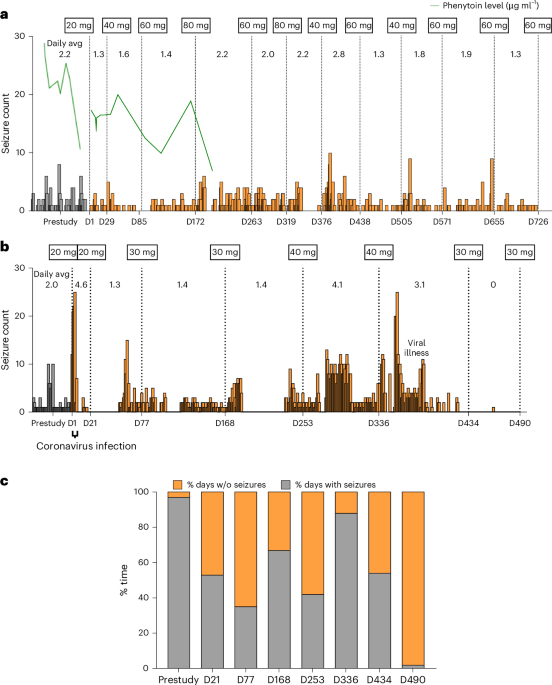
The paper reports seizure-frequency reductions of 26% in one patient and 90% in the other. Both patients also saw decreases in the use of concomitant medications and improvements in neurodevelopmental skills. Just as important for a first-in-human-style effort, the ASOs were reported to be well tolerated, with no ASO-related serious adverse events. Those are encouraging signals, especially in a field where meaningful gains can be hard to achieve and treatment toxicity is a constant concern.
Still, the authors are explicit that the findings are preliminary. Two patients are not enough to establish efficacy, durability, or broad safety. Neurological disorders can fluctuate over time, and complex treatment regimens can make attribution difficult. The paper therefore frames the results as an early demonstration of feasibility: it is possible to identify the relevant haplotype, design an allele-selective oligonucleotide, administer it, and observe positive clinical signals without an immediate serious safety penalty attributable to the ASO itself.
That feasibility matters because highly individualized medicines have often been treated as scientific exceptions rather than a scalable model. The new study attempts to bridge that gap. In a separate cohort of infants with SCN2A-related disorder diagnosed by rapid whole-genome sequencing, the authors found that 16% had compatible SNPs that could support this kind of allele-selective strategy. That does not mean all such patients are immediate candidates, but it suggests the approach may extend beyond a pair of rare edge cases.
From one-off rescue to a repeatable pipeline
The broader significance of the study lies in the proposed workflow. Instead of developing a mass-market therapy around a single mutation, the researchers outline a pathway from n = 1 to a larger group of patients with SCN2A-related disease and potentially other monogenic disorders. The concept depends on combining fast genomic diagnosis, haplotype phasing, rational ASO design, and enough regulatory and manufacturing flexibility to produce patient-matched therapies on clinically relevant timelines.
That model fits a growing trend in precision medicine, especially for severe pediatric disease, where conventional drug development can leave ultra-rare subgroups with no realistic treatment path. In that context, the SCN2A report is less a finished therapeutic story than a test of whether bespoke molecular medicine can become operational. The answer from these early data is not definitive, but it is more concrete than many conceptual discussions of individualized therapeutics.
The study also highlights the continuing importance of genetics infrastructure. Rapid whole-genome sequencing and follow-on phasing are not background details here; they are prerequisites for identifying whether a patient even has the kind of allele context needed for selective suppression. If that pipeline is not available, the therapeutic concept collapses. That means the practical impact of this work may depend as much on diagnostic speed and interpretation capacity as on ASO chemistry.
For families and clinicians, the immediate takeaway is cautious optimism rather than near-term standard of care. The report offers evidence that individualized ASOs can be designed and deployed against SCN2A-related developmental epileptic encephalopathy, and that early treatment signals can include fewer seizures, reduced medication burden, and developmental improvement. But the authors stress the need for continued long-term follow-up to confirm whether the apparent benefits persist and whether the therapy truly changes disease course.
In rare neurological disease, incremental evidence often matters because the alternative is therapeutic stagnation. This study does not settle the case for bespoke ASOs, but it does move the field from theoretical possibility toward documented clinical practice. If the results hold up and similar strategies can be extended to more patients, the long-term importance may be less about one gene than about proving a repeatable template for individualized RNA medicines.
- The study involved two single-patient clinical investigations in boys with SCN2A-related developmental epileptic encephalopathy.
- Researchers reported seizure reductions of 26% and 90%, along with developmental gains and lower use of other medications.
- No ASO-related serious adverse events were reported, but the authors say longer-term follow-up is still needed.
- A separate infant cohort suggested 16% had compatible SNPs for this allele-selective strategy.
This article is based on reporting by Nature Medicine. Read the original article.
Originally published on nature.com


