Early human trial reports encouraging safety results for spinal cord cell therapy
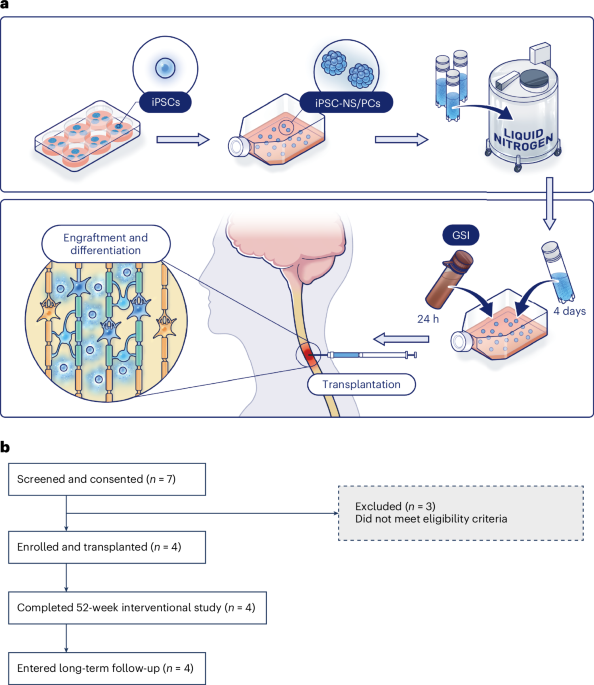
A first-in-human phase 1 trial of an induced pluripotent stem cell-derived neural progenitor cell therapy has reported an encouraging early safety result in patients with severe spinal cord injury. According to the supplied source text from Nature Medicine, researchers transplanted iPSC-derived neural stem/progenitor cells into four patients with subacute cervical complete spinal cord injury and found no tumor formation or graft-related adverse events during two to four years of follow-up. Imaging also showed stable graft sites over that period.
For spinal cord injury research, that safety signal is the central news. Spinal cord injury can cause lasting motor and sensory deficits because damaged neural connections do not naturally rebuild in a way that restores lost function. The source text states that no therapy currently restores the damaged neural circuitry. That is why cell-based repair strategies have drawn sustained attention: they aim not merely to manage complications, but to replace or support the cellular infrastructure needed for recovery.
The study is small and early-stage, but it addresses one of the most important barriers in regenerative medicine. Preclinical work had suggested that iPSC-derived neural stem or progenitor cells could improve motor outcomes in models of subacute spinal cord injury. What remained unknown was whether the approach could be delivered in people without triggering dangerous complications, particularly tumor formation or unstable graft behavior. On that question, the initial clinical data are notable.
What the trial tested
The trial was open-label and involved four patients with subacute cervical complete spinal cord injury. In this context, “subacute” indicates treatment after the immediate injury phase but before chronic scarring and long-term remodeling fully set in. That window is important because researchers hope it may offer enough biological stability for intervention while still preserving some capacity for repair. The source text identifies safety as the primary endpoint, with exploratory efficacy included as a secondary endpoint.
The results met that primary goal. Over follow-up lasting between two and four years, investigators observed no tumor formation and no graft-related adverse events. They also reported stable graft sites on imaging. Those findings matter because iPSC-based approaches carry both promise and scrutiny. Induced pluripotent stem cells can be expanded and differentiated into clinically useful cell types, but their proliferative potential has long raised concerns about whether transplanted cells could grow unpredictably or form tumors if manufacturing and differentiation are not tightly controlled.
The report therefore does not claim that the therapy is proven effective. Instead, it establishes that the transplantation procedure was feasible and that, in this very limited cohort, the major feared safety events did not occur during the reported follow-up period. For a field that has often been slowed by translational risk, that is a meaningful milestone.

Exploratory signs of motor improvement
Although the study was not designed to deliver definitive proof of efficacy, the exploratory findings are likely to attract just as much attention as the safety data. The source text reports a median improvement of 13 points in the International Standards for Neurological Classification of Spinal Cord Injury motor score from baseline, measured two weeks after injury, to week 52. Individual improvements ranged from 10 to 40 points.
Two of the four patients also improved on the American Spinal Injury Association Impairment Scale, with one moving from grade A to C and another from grade A to D. Those shifts suggest gains beyond marginal score changes, because they indicate movement across clinically recognized impairment categories. The source text further states that these gains were numerically greater than spontaneous recovery observed in a registry-based cohort.
That comparison is encouraging, but it needs to be interpreted carefully. With only four patients and no randomized control arm inside the trial itself, the data cannot establish that the cell therapy caused the observed improvements. Spinal cord injury recovery varies across patients, and cross-study comparisons can only go so far. Still, the outcomes are enough to justify further investigation, especially because the treatment appears to have cleared the first and most basic hurdle: avoiding serious transplant-related harm in early follow-up.
Why iPSC-based therapy matters
The use of iPSC-derived cells gives this work significance beyond one small spinal cord study. Induced pluripotent stem cells are generated by reprogramming mature cells into a pluripotent state, allowing them to be turned into other cell types for research and therapy. In principle, that approach could support a scalable source of transplant material for neurological repair. In practice, translating that promise into clinical use requires rigorous control over cell identity, purity, safety, and post-transplant behavior.
The source text says the findings support further clinical evaluation under short-term immunosuppression. That detail matters because transplanted cells must survive and integrate without provoking damaging immune responses, but long-term immunosuppression carries its own risks. A strategy that can work with shorter immune suppression would improve the therapeutic profile if later trials confirm benefit.
The study also contributes to the broader effort to move regenerative medicine out of experimental theory and into structured clinical development. Many cell therapies generate excitement in animal models, but far fewer produce human data with meaningful follow-up. Here, the follow-up extended up to four years, giving the report more weight than a short post-procedure snapshot.
The next step is larger, more rigorous testing
The most important conclusion is not that spinal cord injury has been solved, but that a credible path to larger trials has opened. The source text explicitly frames the new data as support for further clinical evaluation. That is the correct reading. A phase 1 study can show feasibility and characterize major safety risks, but it cannot answer the questions clinicians and patients ultimately care about most: who benefits, how much function can return, how durable the effect is, and how the therapy compares with standard care.
Those questions will require more patients, tighter controls, and endpoints designed to distinguish true treatment effects from background recovery. Even so, this report represents a meaningful advance. In a field where restoring lost neurological function has remained one of medicine’s hardest problems, evidence that human iPSC-derived neural progenitor transplantation can be performed safely over multi-year follow-up is a substantial development.
If later trials confirm benefit, the implications could extend well beyond spinal cord injury. The same core platform logic, carefully adapted, could inform regenerative strategies across other neurological conditions. For now, the result is narrower but still important: a long-awaited human safety test has produced a positive signal strong enough to keep the approach moving forward.
This article is based on reporting by Nature Medicine. Read the original article.
Originally published on nature.com


