A 1.9-Million-Person Portrait of UK Health
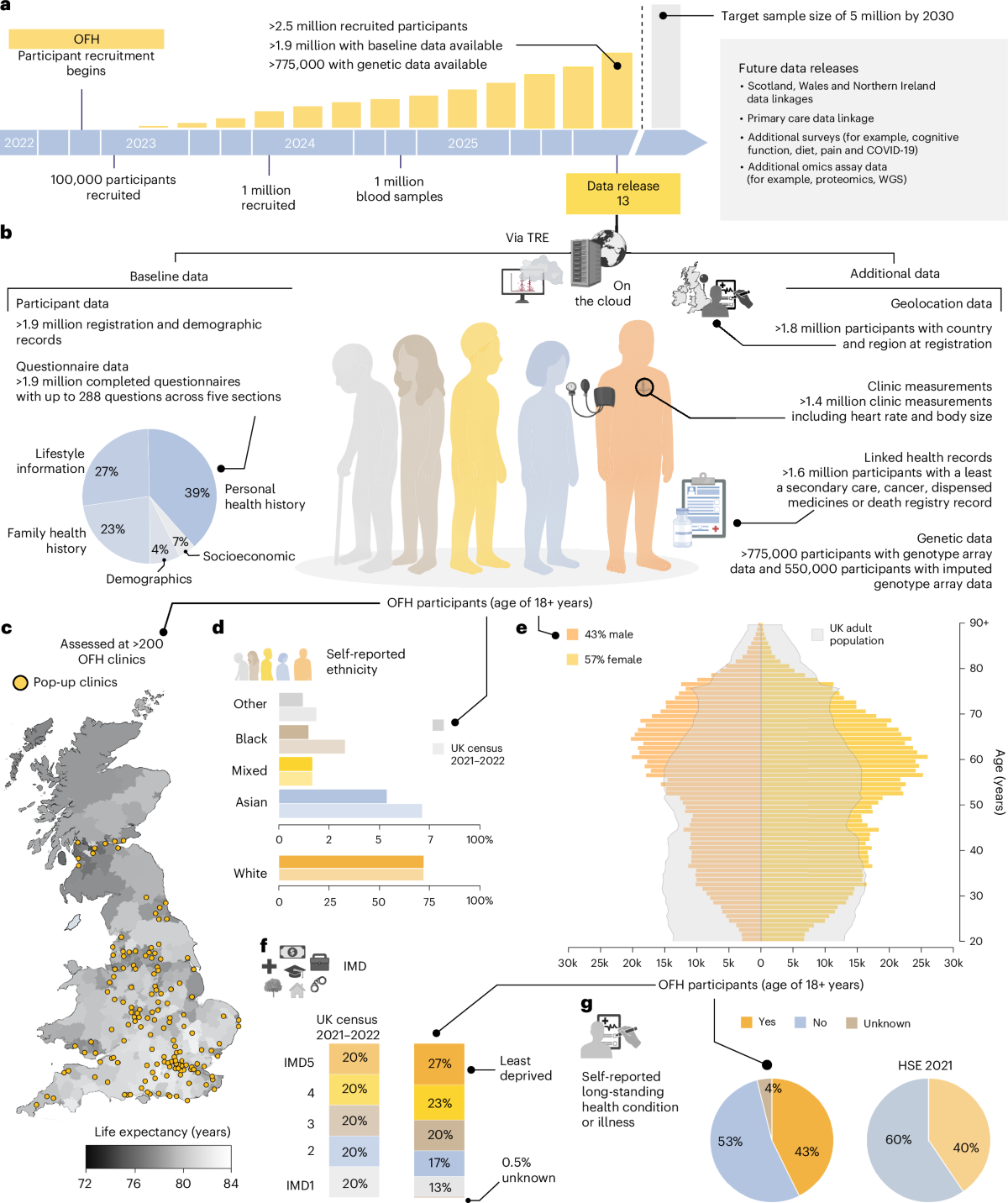
An analysis published in Nature Medicine on 10 September 2026 delivers one of the most detailed phenomic snapshots of the United Kingdom assembled so far. The work comes from Our Future Health, a prospective cohort designed to enrol 5 million UK-resident adults in order to accelerate the discovery and translation of new approaches to disease prevention, detection and treatment. Enrolment has already passed 2.5 million people, and baseline phenotypic records are now available for more than 1.9 million of them. The paper is authored by Vincent J. Straub, Stefania Benonisdottir, Giovanni Scotti Bentivoglio, Neil Wary, Robert Campbell, Augustine Kong and Melinda C. Mills.
Rather than focusing on a single condition, the study asks a broader question: what does this fast-growing volunteer population actually look like, and how faithfully do its patterns of illness mirror the country it is meant to represent? To answer that, the authors benchmarked the cohort against national estimates and against the older UK Biobank cohort.
What the Cohort Actually Records
The phenotyping effort is the foundation of everything that follows. Baseline data span a wide range of health-relevant domains, drawing on both participant reporting and registry linkage.
- Self-reported health-related behaviours, including lifestyle characteristics
- Geolocation information for participants
- Self-reported diagnoses and medication use
- Inpatient and outpatient visit records
- Cancer registry data
- Cause-of-death information
That combination matters because it allows researchers to move beyond a single data stream. Behaviours, diagnoses, prescriptions, healthcare contact and registry outcomes can be assessed side by side, which is precisely what population-scale prevention research requires.

Does the Cohort Look Like the Country?
On sociodemographic, lifestyle and health-related measures, the participant pool broadly reflected UK population patterns — an encouraging signal for a study that depends on voluntary enrolment at enormous scale. But the picture is not uniform. All but one minority ethnic group were underrepresented relative to the national population, and the most socioeconomically deprived groups were also underrepresented.
That gap is not a footnote. Deprivation and ethnicity are strongly linked to disease burden and to access to care, so any cohort that under-samples these groups risks understating the very inequities that prevention programmes need to target. The authors are explicit that systematic assessment of such biases remains an open task as recruitment continues.
Mental Health Conditions Stand Out
Prevalence estimates for several major self-reported conditions came in above national benchmarks, with mental health conditions — depression and anxiety in particular — among the clearest examples. The direction of that discrepancy was consistent with what UK Biobank reports, with a correlation of 0.78 between the two cohorts across conditions.
Several explanations are plausible and not mutually exclusive: volunteer cohorts tend to attract people already engaged with their health, self-report captures conditions that never reach a formal diagnosis, and national estimates are built on different measurement instruments. The concordance with UK Biobank suggests the pattern is a property of large volunteer studies in the UK rather than an artefact of this particular dataset.

Replication of Known Clinical Relationships
The analysis also tested whether associations with established clinical correlates held up. They did: replication across both cohorts reached a correlation of 0.80. In practical terms, the relationships researchers already expect to see between risk factors, conditions and outcomes were reproduced at scale — a validation step that gives downstream discovery work a firmer footing.
Medication Use, Cancer and Age Gradients
Medication-use patterns and cancer prevalence followed the age-related gradients that clinicians would predict, with older participants carrying the heavier burden. One noteworthy deviation appeared in lung cancer, where rates in the cohort fell below national data — a finding the authors flag rather than explain, and one that sits alongside the broader question of how volunteer sampling shapes what a cohort observes.

Bias, Electronic Records and the Road to Five Million
The study frames itself as a baseline assessment rather than a final verdict. As recruitment progresses, the authors argue, electronic health records can help specify disease patterns more precisely and allow biases to be measured systematically rather than inferred. Linking cohort data to routine records would let researchers track participants across the health system, catching conditions that self-report misses and quantifying how far the enrolled population drifts from the national one.
That matters for translation. If a cohort is to support prevention and early detection, its estimates need to be trustworthy at the level of specific diseases, specific age bands and specific communities — not just in aggregate.
Why Cohorts Like This Matter Now
Healthcare systems face mounting pressure from a growing chronic disease burden driven by ageing, lifestyle change and environmental exposures, alongside persistent health inequities and fragmented data. Biomedical research has responded by combining diverse data types — multiomics, lifestyle factors, social determinants and environmental measures — to assess population health and identify groups at higher risk.
Large cohort studies and biobanks sit at the centre of that shift, systematically collecting, storing and managing health and biological data over long periods. Our Future Health's scale, if representation improves, would make it one of the most powerful instruments available for studying how disease emerges across an entire national population.
What to Watch Next
- Whether enrolment closes the gaps for underrepresented ethnic minority and deprived groups
- How far electronic health record linkage shifts prevalence estimates for depression and anxiety
- Whether the below-national lung cancer signal persists as the cohort ages
- How the cohort's genetic and biological layers connect to the phenotypic baseline described here
For now, the analysis provides something rare: a transparent accounting of what a very large UK cohort contains, how it compares with the nation and with an established biobank, and where its blind spots remain.
This article is based on reporting by Nature Medicine. Read the original article.
Originally published on nature.com