A large randomized clinical trial has reached a clear, if disappointing, verdict on one of the more mechanistically attractive drug targets in heart failure research. In a phase 2b study published in Nature Medicine, the myeloperoxidase (MPO) inhibitor mitiperstat proved safe and well tolerated in patients with heart failure and an ejection fraction above 40%, but it did not improve symptoms or exercise function.
The multicenter, randomized, double-blind, placebo-controlled, three-arm trial enrolled 711 patients, 45% of them women, with chronic heart failure and an ejection fraction greater than 40% — a population spanning preserved and mildly reduced ejection fraction. Participants were randomized 1:1:1 to mitiperstat 2.5 mg, mitiperstat 5 mg or placebo, and treatment continued for 48 weeks. Both co-primary endpoints came back null, and every secondary endpoint was neutral as well.
The rationale: blocking an oxidative driver
The trial was built on a specific mechanistic hypothesis. MPO-derived oxidants reduce the bioavailability of nitric oxide and promote coronary microvascular dysfunction, stiffening of cardiomyocytes and interstitial fibrosis. Those processes are implicated in the pathogenesis of heart failure with preserved and mildly reduced ejection fraction, which is why an enzyme sitting upstream of them drew interest as a therapeutic target.
If oxidant-driven pathways of this kind contribute meaningfully to how the disease develops and progresses, suppressing MPO could plausibly translate into patients feeling better and moving further. Mitiperstat was developed to test that proposition directly, and the phase 2b program was designed to see whether the underlying biology would carry through to clinical benefit.

How the trial was designed
The study was a multicenter, randomized, double-blind, placebo-controlled, three-arm, parallel-group phase 2b trial. Its key design features were:
- Participants: patients with heart failure and an ejection fraction greater than 40%.
- Randomization: 711 patients allocated 1:1:1 to mitiperstat 2.5 mg, mitiperstat 5 mg or placebo; 45% of the enrolled population were women.
- Treatment duration: 48 weeks.
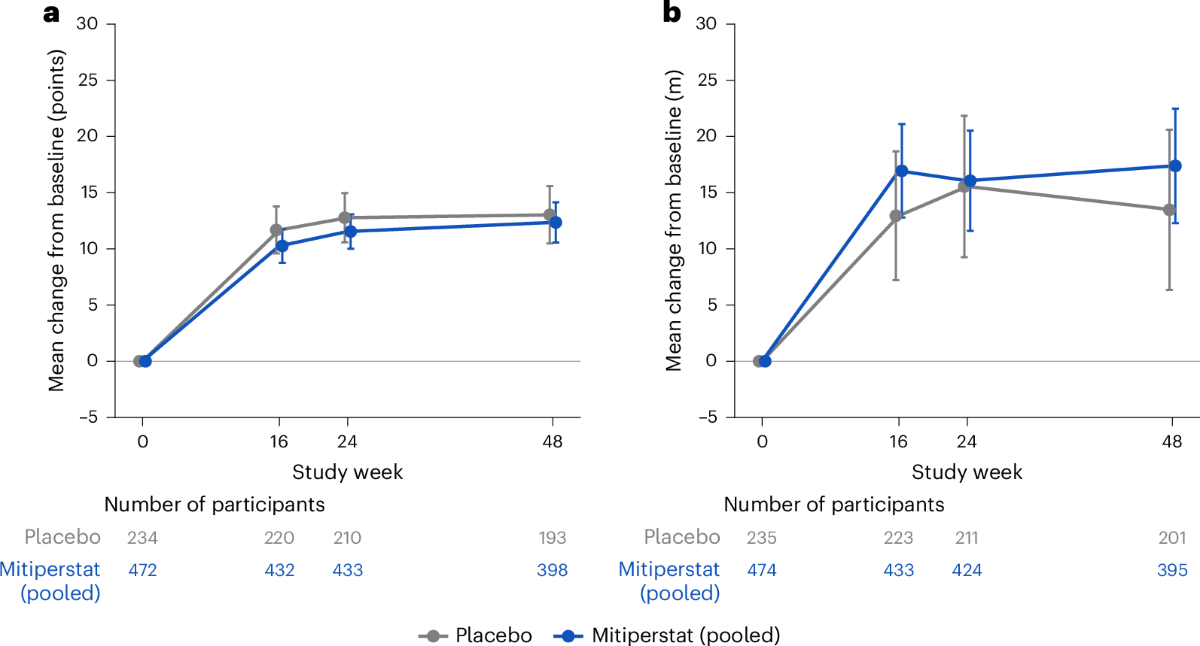
- Co-primary endpoints, assessed at 16 weeks: change in the Kansas City Cardiomyopathy Questionnaire Total Symptom Score (KCCQ-TSS) and change in 6-minute walk distance (6MWD).
- Secondary endpoints: changes in natriuretic peptides and inflammatory markers measured out to 48 weeks, plus echocardiographic parameters measured out to 24 weeks.
- Registration: the trial is registered on ClinicalTrials.gov.
Because the co-primary endpoints paired a patient-reported symptom measure with an objective functional measure, the design asked mitiperstat to demonstrate benefit on both how patients felt and how far they could walk.
Both co-primary endpoints missed
When the two mitiperstat dose groups were pooled for the primary analysis, neither endpoint separated from placebo. On the KCCQ-TSS, the placebo-corrected difference in mean change from baseline was –1.4 points (95% confidence interval –3.9 to 1.2; P = 0.29). On the 6-minute walk distance, the corresponding difference was 3.8 meters (95% CI –3.1 to 10.8; P = 0.28).
Neither result approached statistical significance, and the confidence intervals were tight enough to rule out anything beyond a small treatment effect. The symptom result was numerically in the wrong direction — patients on mitiperstat reported slightly worse scores than those on placebo — though the gap was well within the range of chance. The walking-distance point estimate favored mitiperstat numerically, but only by a few meters, and it too was statistically indistinguishable from no effect.

No signal in secondary endpoints
The neutral result extended beyond the co-primary measures. According to the trial report, mitiperstat did not improve any secondary endpoint, including the changes in natriuretic peptides and inflammatory markers tracked for up to 48 weeks and the echocardiographic parameters assessed for up to 24 weeks.
The breadth of that null finding is notable. A drug can miss a symptom score for reasons tied to the instrument itself, but when circulating biomarkers and imaging-based cardiac measures also fail to move, the absence of benefit looks less like a measurement problem and more like a genuine lack of clinical effect at the doses tested.
Safety and tolerability
On the safety side, the picture was reassuring. Adverse events and serious adverse events, including infections, occurred at similar rates across the mitiperstat and placebo groups. The one notable exception was maculopapular rash, which appeared in 3.6% of patients receiving mitiperstat compared with 0.4% of those on placebo.
That skin reaction was the only safety finding that distinguished active treatment from placebo in the reported data. Otherwise, the drug's tolerability profile was comparable to placebo — an important consideration for any therapy intended for long-term use in a chronic condition.

What the result means
The authors' conclusion is direct: mitiperstat was safe and well tolerated but did not improve symptoms or exercise function in chronic heart failure with preserved or mildly reduced ejection fraction. The trial therefore stands as a negative result for MPO inhibition as a route to clinical benefit in this population, at least at the doses and duration studied.
That outcome is a reminder of the gap that can open between a well-supported mechanism and a measurable patient benefit. MPO-derived oxidants remain implicated in nitric oxide depletion, microvascular dysfunction, cardiomyocyte stiffening and fibrosis; this trial does not overturn that biology. What it fails to show is that intervening on the pathway with this agent, in these patients, over this period, changes how they feel or function.
Phase 2b programs exist to detect a signal before sponsors commit to larger and more expensive confirmatory studies. Here the phase 2b signal was absent on both patient-reported and functional measures — precisely the situation such trials are designed to identify.
Where this leaves heart failure research
Heart failure with preserved or mildly reduced ejection fraction has long been a difficult arena for drug development, and this trial adds another neutral result to that record. The population is heterogeneous, the condition is often driven by multiple overlapping processes, and demonstrating incremental benefit on top of background therapy is hard.
For mitiperstat specifically, the data do not support advancing this indication on the strength of symptom or exercise improvements. Whether the MPO pathway might still prove tractable through a different patient selection strategy, a different dosing approach or a different endpoint remains an open question this trial cannot answer.
Key takeaways
- In a 711-patient phase 2b trial, the MPO inhibitor mitiperstat did not improve the KCCQ-TSS or 6-minute walk distance in heart failure with an ejection fraction above 40%.
- Both co-primary endpoints were assessed at 16 weeks, while treatment continued to 48 weeks.
- No secondary endpoint improved, including natriuretic peptides, inflammatory markers and echocardiographic parameters.
- Adverse and serious adverse events, including infections, were similar to placebo, with maculopapular rash more frequent on mitiperstat (3.6% versus 0.4%).
- The investigators conclude the drug was safe and well tolerated but ineffective for symptoms and exercise function in this chronic heart failure population.
The trial's value lies in what it rules out. A mechanistically compelling hypothesis about oxidative stress and cardiac stiffening has now been tested in a substantial, placebo-controlled population, and the answer was negative. For clinicians and drug developers, that is a useful, if unwelcome, piece of evidence — one that narrows the search for effective treatments in a condition that still needs them.
This article is based on reporting by Nature Medicine. Read the original article.
Originally published on nature.com