A nationwide look at vaccine timing and immunotherapy
The question of when a patient with cancer should receive a COVID-19 mRNA vaccine relative to the start of immune checkpoint inhibitor (ICI) therapy is the focus of a newly published nationwide, population-based analysis in Nature Medicine. The paper appeared online on 10 September 2026 and examines survival outcomes among patients with cancer who were vaccinated either before or after beginning treatment with checkpoint inhibitors — a class of immunotherapy that has become a mainstay of modern oncology while raising distinctive questions about how the immune system behaves under treatment.
According to the study's summary, the analysis is large and population-based rather than a single-center series, and it reports that both pre-ICI and post-ICI COVID-19 mRNA vaccination were associated with outcomes the authors describe in the full paper. The framing matters: rather than asking simply whether vaccination is beneficial in general, the study interrogates the calendar of immunization relative to a specific, immunologically potent cancer treatment.
That distinction is not academic. Checkpoint inhibitors work by releasing brakes on T cells so the immune system can attack tumors. Anything that further perturbs immune activation — including a vaccine designed to provoke a strong immune response — is worth studying in that context, both for signals of benefit and for any signal of interference.
Why checkpoint inhibitors make vaccine timing a live question
Immune checkpoint inhibitors target proteins such as PD-1, PD-L1 and CTLA-4 that normally keep T-cell responses in check. Blocking those pathways unleashes anti-tumor activity, but it can also drive immune-related adverse events affecting the skin, gut, lungs, thyroid, pituitary and other organs. Into that already complicated picture comes vaccination, which deliberately stimulates the immune system.
Clinicians and researchers have therefore asked a set of practical questions that a nationwide cohort is well suited to explore:
- Does vaccination immediately before or shortly after ICI initiation alter how well patients ultimately fare?
- Is there a window around treatment start in which immunization is more or less advantageous?
- Do the patterns differ between patients who are vaccinated before exposure to checkpoint blockade and those vaccinated afterward?
Because patients with cancer were among the groups prioritized for COVID-19 vaccination during the pandemic, and because checkpoint inhibitors are used across a wide range of malignancies, real-world data accumulated quickly. A population-level dataset allows researchers to observe patterns across many hospitals, tumor types and treatment schedules rather than relying on a narrow trial population.

What the cohort analysis examined
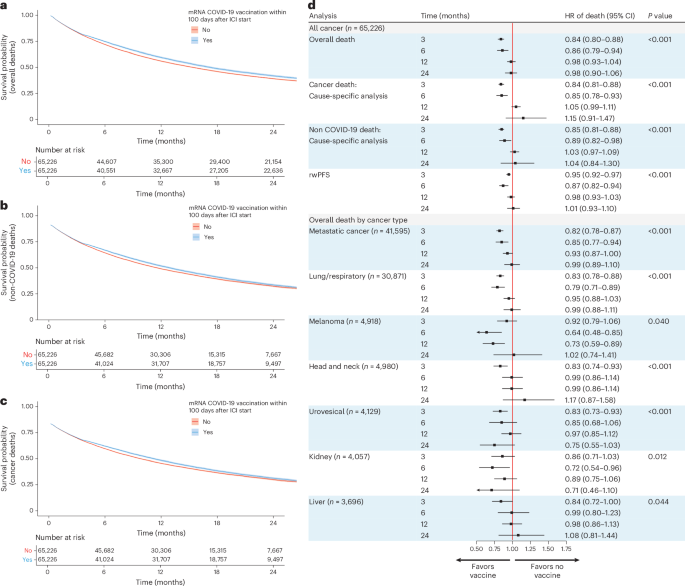
The study is described as a large, population-based analysis of patients with cancer, tracking COVID-19 mRNA vaccination in relation to the start of immune checkpoint inhibitor therapy and following survival outcomes. By structuring the analysis around the ICI start date, the researchers created a natural dividing line: vaccination before that point versus vaccination after it.
That design lets the study speak to a scenario oncologists face constantly in practice — a patient who is about to begin immunotherapy and who also needs or has recently received a COVID-19 booster. The relevant clinical decision is rarely abstract; it is a scheduling question with a real calendar attached.
The abstract preview indicates that the analysis found associations between mRNA vaccination and outcomes in both the pre-ICI and post-ICI windows. The full paper carries the specific effect estimates, adjustment strategies and subgroup analyses that give those associations their weight; readers should consult the published article for the precise figures rather than relying on the summary alone.
Why observational evidence carries weight here
Randomized trials remain the gold standard for causal inference, but they are difficult to run for every question about vaccine scheduling in immunocompromised populations. Nationwide observational cohorts fill part of that gap by capturing patients who would rarely be enrolled in a tightly controlled study: older adults, people with multiple comorbidities, and those receiving combinations of cancer therapies.
At the same time, observational designs introduce their own interpretive cautions, and any reader of this literature should keep several in mind:
- Confounding by indication. Patients who are vaccinated may differ systematically from those who are not, in ways that also affect survival.
- The healthy-vaccinee effect. People well enough to be vaccinated and to mount a response may simply be healthier at baseline.
- Immortal time bias. Analyses anchored to a treatment start date can inadvertently grant vaccinated patients survival time that unvaccinated patients could not have accrued.
- Treatment heterogeneity. Checkpoint inhibitors are used across many cancers and in combination with chemotherapy, radiation and targeted agents, all of which complicate comparison.
Well-conducted population analyses address these issues through careful cohort definition, adjustment and sensitivity testing, but they remain associations rather than proof of cause and effect.

What this means for patients and oncologists
For patients with cancer preparing to start immunotherapy, the practical takeaway from a study like this is reassurance-oriented rather than prescriptive. Evidence that mRNA vaccination around the time of ICI initiation is compatible with — and in the reported analysis associated with — survival outcomes does not suggest that vaccination should be delayed or avoided. Guidance from oncology and infectious disease bodies has generally favored keeping cancer patients up to date on COVID-19 vaccination, and this analysis does not point in the opposite direction.
It does, however, sharpen the conversation. Instead of treating vaccination as an afterthought in the immunotherapy workflow, clinicians can consider timing explicitly as part of treatment planning, and can discuss with patients what the current evidence does and does not establish.
The broader research context
This paper sits within a wider effort to understand how mRNA vaccines perform in people whose immune systems are altered by disease or treatment. Patients receiving checkpoint inhibitors occupy a particularly interesting niche: their immune systems are not suppressed so much as redirected. Understanding how a vaccine stimulus interacts with that state has implications beyond COVID-19, extending to how oncologists think about immunization generally during immunotherapy.
The study also underlines the value of national data infrastructure. Questions that would take years to answer through prospective trials can be examined at scale when vaccination records, cancer registries and survival data can be linked. The result is faster, more representative evidence — with the caveats that come with observational research.
What the Nature Medicine analysis ultimately contributes is a population-scale snapshot of how COVID-19 mRNA vaccination and immune checkpoint inhibitor timing intersect in the lived experience of patients with cancer. It does not close the book on the question, but it substantially widens the evidence base on which the next round of clinical guidance can rest.
This article is based on reporting by Nature Medicine. Read the original article.

Originally published on nature.com