Antibody-drug conjugates are moving into a more complex era
Antibody-drug conjugates, or ADCs, were built around a straightforward premise: use a monoclonal antibody to deliver a potent cancer-killing payload directly to tumor cells. That concept has already produced an important class of oncology drugs, but a new Nature Medicine perspective argues that the field is now entering a more demanding phase. The central issue is no longer whether ADCs can work. It is how to make the next generation work better, in more patients, with development strategies that can keep up with the pace of laboratory innovation.
The authors describe a field that has rapidly accumulated new knowledge about how ADCs act in patients, how tumors adapt, and why resistance emerges. That expanding understanding has generated a large menu of possible improvements, from changes in the chemistry of ADC constructs to more rational drug combinations. But the article makes a pointed case that innovation itself has become part of the problem. There are now so many plausible ways to improve ADCs that the clinical system cannot test them all efficiently.
That mismatch, the authors argue, is becoming a defining challenge for the sector. Clinical trial capacity is limited, early-stage development is expensive, and the number of potentially useful construct modifications keeps growing. In that setting, moving one incremental idea at a time into the clinic is unlikely to be enough.
Why single upgrades may not deliver meaningful gains
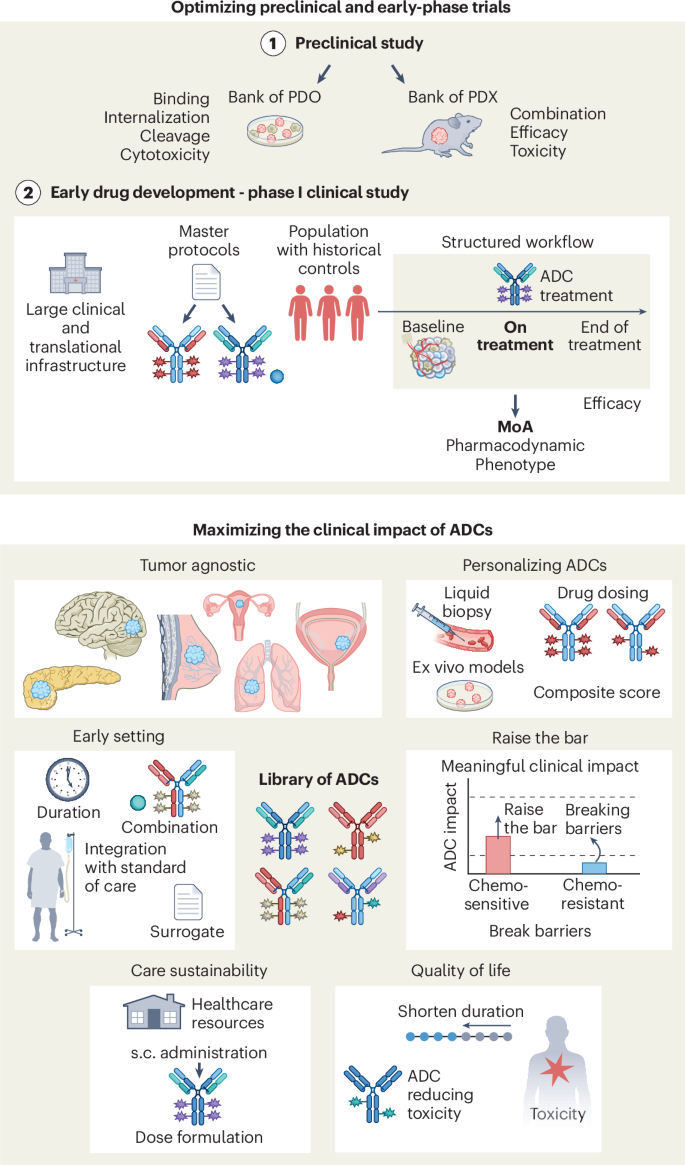
The perspective emphasizes that no single modification is likely to produce a large clinical benefit on its own. That is an important signal for the industry because ADC development has often been discussed in terms of individual components: a better payload, a better linker, a different antibody target, or a different drug-to-antibody ratio. The authors instead argue for integration. Their view is that the most meaningful advances will come from combining several chemistry improvements inside one ADC, then pairing that design work with better translational tools and more disciplined development frameworks.
In practical terms, this means developers may need to stop treating each upgrade as a largely separate innovation track. The field has matured to the point where the real gains could come from coordinated design choices that improve delivery, efficacy, durability, and resistance management at the same time. That also raises the bar for preclinical evidence. If next-generation ADCs are going to combine multiple engineered advantages, companies and researchers will need stronger ways to determine which combinations are worth taking into human studies.
The paper frames this as a de-risking problem as much as a scientific one. With trial capacity constrained, every weak candidate sent forward consumes time and resources that could have gone to more promising programs. That makes selection discipline and development infrastructure as strategically important as the chemistry itself.

Resistance, prediction, and the need for better tools
A major theme in the article is that a deeper understanding of ADC action and resistance in patients should shape the next phase of development. The authors point to the need for multidimensional molecular tools that can predict which tumors are most likely to respond. That is a notable shift from the earlier, more platform-centered framing of ADCs. Instead of asking only how to build a more effective drug, the field increasingly has to ask which biological contexts are most suitable for a given construct.
If those predictive tools improve, ADC development could become more selective and more personalized. Better sensitivity prediction would help identify patient populations more likely to benefit, potentially improving trial efficiency and outcomes. It could also reduce the temptation to advance broadly applicable but biologically underdefined programs that struggle once they reach real-world tumor heterogeneity.
The perspective also highlights the importance of understanding adaptation and resistance in patients, not just in preclinical models. That matters because ADC performance in practice can diverge from early expectations. Resistance mechanisms may limit payload effectiveness, alter internalization, or change how tumors tolerate treatment pressure. The article suggests that studying these mechanisms more closely should not be treated as a post hoc exercise after setbacks appear, but as part of a more deliberate development strategy from the start.
Early-stage disease may become a bigger ADC opportunity
Another forward-looking point in the article is the role of ADCs in earlier-stage cancers. Much of the field’s momentum has historically centered on advanced disease, where the need for new options is acute and clinical testing pathways are more established. But the authors argue that optimal use of newer ADCs in earlier-stage settings could help improve patient outcomes.
That does not mean early-stage expansion will be simple. It increases the importance of patient selection, comparative benefit, toxicity management, and evidence quality. Moving powerful targeted cytotoxics earlier in treatment naturally demands a stronger justification than using them later after other options have failed. Still, the perspective suggests that the long-term upside could be significant if developers can match better constructs with better molecular guidance.
This is also where the article’s broader integration argument becomes more consequential. Earlier-stage use is unlikely to reward marginal gains or loosely defined development programs. It will likely favor ADCs that show clear biological rationale, carefully engineered design, and a stronger framework for demonstrating benefit.

A path toward diversified, more personalized ADC libraries
The authors ultimately point toward a future in which ADC development becomes more diversified rather than more standardized. They predict that over the longer term, developers could build broader libraries of ADCs with distinct constructs and different drug-to-antibody ratios, creating treatment options that better align with individual tumor biology.
That vision implies a more modular and personalized ADC ecosystem. Instead of a one-size-fits-most platform, the field could evolve toward a portfolio model in which different constructs are intentionally matched to different biological settings. If that happens, success will depend not only on chemistry innovation but on the infrastructure needed to compare candidates, generate translational evidence quickly, and prioritize the right programs for early clinical study.
The Nature Medicine perspective does not announce a single breakthrough product. Its importance lies elsewhere. It captures a field at an inflection point: scientifically richer than before, but operationally constrained by the sheer number of ideas now competing for validation. The message is that the next leap for ADCs may come less from one new ingredient than from the ability to combine several advances intelligently, test them efficiently, and identify the patients most likely to benefit. For oncology developers, that is both a technical roadmap and a warning that the old pace and structure of experimentation may no longer be sufficient.
This article is based on reporting by Nature Medicine. Read the original article.
Originally published on nature.com