An Antiseizure Drug Positioned as a Therapeutic Candidate
A study published in Nature Medicine on 17 September 2026 reports that levetiracetam, an antiseizure medication in routine clinical use, therapeutically targets GABAergic synapses in diffuse midline glioma. According to the journal's summary of the work, the findings rest on two separate evidence streams: experiments conducted in models of the disease and data assembled from patient cohorts. The paper appears under the DOI 10.1038/s41591-026-04646-6.
The claim is notable for what it asks readers to accept. Levetiracetam is described in the study summary as an antiseizure medication, a category of drug normally prescribed to control seizures rather than to alter the course of a tumor. The paper's title, however, frames the drug as acting on GABAergic synapses — the junctions where the nervous system's principal inhibitory signal is transmitted. That reframing turns a familiar treatment for a symptom into a candidate for disease-directed therapy.
Why Diffuse Midline Glioma Has Been So Hard to Treat
Diffuse midline gliomas are widely regarded as among the most stubborn tumors of the central nervous system. Their defining characteristic is infiltration: rather than forming a contained mass with clear borders, these tumors spread through midline structures, intermingling with normal tissue. That growth pattern complicates surgical removal, because there is rarely a clean margin between tumor and healthy brain.
Location compounds the problem. Midline tumors sit near structures that govern functions no surgeon can safely disturb, which narrows the range of feasible interventions and raises the stakes of any therapy that damages surrounding tissue. In practice, treatment has leaned on radiation and systemic approaches, with recurrence remaining a persistent concern. Against that backdrop, any signal that an already-approved drug might influence tumor biology at all is likely to attract attention from clinicians and researchers alike.

GABAergic Synapses as a Therapeutic Target
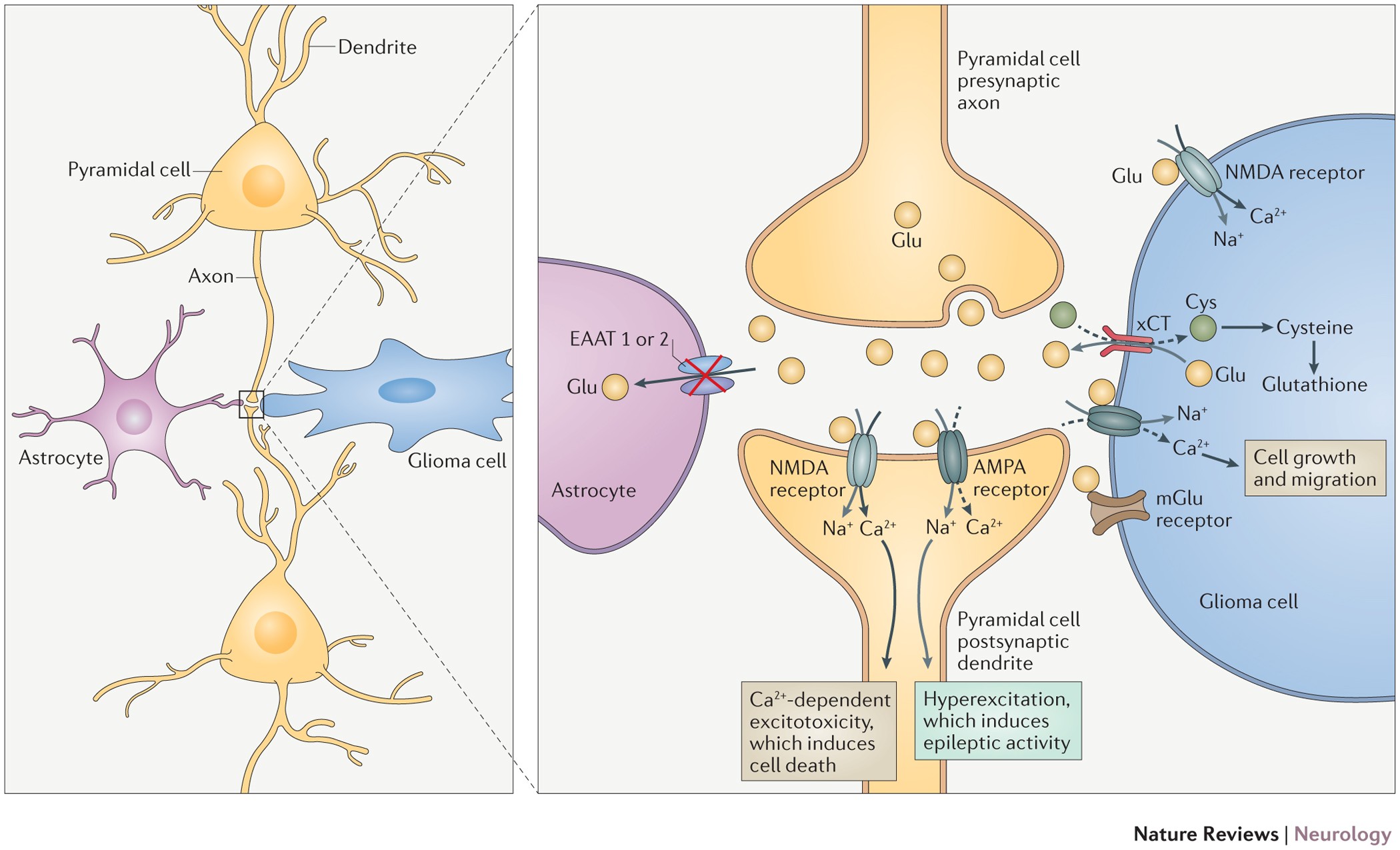
GABAergic synapses are the points at which neurons release gamma-aminobutyric acid, the central nervous system's main inhibitory neurotransmitter, onto neighboring cells. Because inhibition shapes how circuits fire, these synapses are central to how the brain regulates its own activity. The study's title asserts that levetiracetam's therapeutic effect in diffuse midline glioma is directed at this specific junction, rather than at a generic target associated with cell division.
That framing matters for how the result should be interpreted. A synapse-level mechanism implies the drug is not simply poisoning tumor cells but altering signaling relationships between cells in and around the tumor. It also suggests that the effect could depend heavily on context — on which cells are present, what inputs they receive, and at what stage of disease the drug is given.
What the Evidence Base Includes
The summary states that results come from experimental models and from patient cohort data. Each stream answers a different question. Laboratory models are the standard setting for demonstrating that a proposed mechanism is real and reproducible under controlled conditions, where variables can be isolated deliberately. Patient cohort data, by contrast, speak to whether patterns observed in the laboratory are visible in people who have actually received the drug.
Together, the two approaches are complementary, but they are not interchangeable. Model systems cannot fully reproduce the complexity of a human tumor and its immune and vascular environment. Cohort analyses can reveal associations in real-world care, but observational data of this kind cannot by itself prove that exposure to a drug caused a change in outcome, because patients who receive a given medication may differ systematically from those who do not.
Why Drug Repurposing Changes the Calculus
Working with an established medication alters the practical implications of a finding like this one. Levetiracetam has already been characterized in clinical use as an antiseizure agent, meaning its general tolerability profile and handling in the body are comparatively well understood. A novel compound would need to pass through early-stage safety assessment before it could be tested in patients with this disease. An existing drug avoids some of that lead time, which is why repurposing strategies are frequently pursued in cancers with few effective options.
That advantage is also a limit. A drug already in circulation has typically been studied in populations and at doses chosen for a different purpose. Whether the exposures that control seizures are the same exposures that influence a diffuse midline glioma is an open question that cohort data alone are unlikely to settle.
How to Read the Result
Several cautions follow directly from the design described in the study summary:
- The evidence combines experimental models with cohort data, a structure that supports hypothesis generation more strongly than it establishes causation.
- No randomized comparison is described in the summary, so the findings should not be read as proof that levetiracetam improves outcomes in patients.
- Because the drug is already prescribed for seizure control, some patients in any glioma cohort will have received it for that reason, introducing the possibility of confounding by indication.
- The summary does not report effect sizes, dosing strategies, or duration of exposure, so the magnitude of any clinical benefit remains unspecified in the material released.

The Questions That Now Matter
The obvious next steps follow from the gaps. Researchers will want to know whether the GABAergic mechanism operates uniformly across diffuse midline gliomas or only in a molecularly defined subset. They will need to determine whether the drug reaches the relevant synapses at concentrations achievable in patients, and whether its synaptic action interacts with radiation or other standard treatments already in use.
It also matters whether the effect reflects a direct action on tumor cells or an indirect one, mediated by altering the excitability of surrounding neural tissue. Those two possibilities carry very different implications for how a trial would be designed and which patients would be enrolled. A prospective, controlled study would be required before any of this changes clinical practice.
The Bottom Line
What has been reported is a mechanistic claim with supporting evidence from models and patient cohorts: levetiracetam, an antiseizure medication, appears to act therapeutically at GABAergic synapses in diffuse midline glioma. Published in Nature Medicine, the work points toward a repurposing pathway for a tumor type with few good options. It does not, on the basis of the summary released, establish a new standard of care. The value of the result lies in where it directs attention next — toward synaptic signaling as a lever in a disease that has resisted more conventional attacks.
This article is based on reporting by Nature Medicine. Read the original article.

Originally published on nature.com