Nature Medicine has issued a correction to a 2021 randomized phase 3 trial that evaluated toripalimab plus chemotherapy as a first-line treatment for advanced nasopharyngeal carcinoma. The correction updates several numerical values, a data cutoff date, supplementary-table language and source-data labels in the previously published study.
The notice is an update to the record of the original trial, not a report of a new clinical trial or a newly announced treatment result. Its value is in making the underlying published materials more accurate and easier to interpret, particularly for readers examining treatment exposure, adverse-event data and survival analyses.
What the correction changes
One correction concerns the number of patients who continued maintenance treatment after chemotherapy. The published Results section should have stated that 233 patients, or 80.6%, continued maintenance treatment, rather than 231 patients, or 79.9%. The legend to Extended Data Figure 1 has likewise been corrected to show 233 rather than 231.
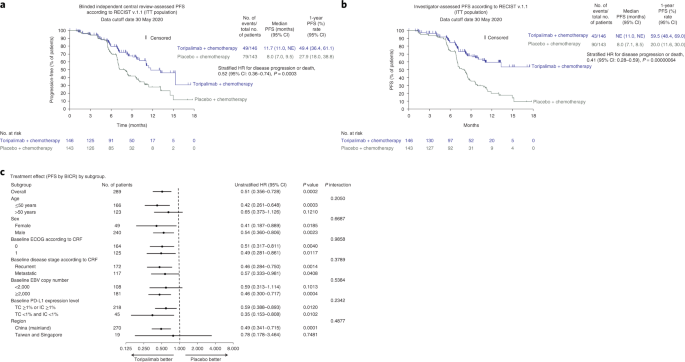
The data cutoff date in Figure 2 was also corrected. It should read 18 February 2021, not 18 February 2020. That distinction matters because a cutoff date defines the period covered by a clinical analysis. Readers using a figure to understand the maturity of survival data or the timing of follow-up need the correct date to interpret it properly.
The notice further corrects values in Table 3 for the toripalimab plus GP group. The any-grade thrombocytopenia value should be 92 patients, or 63.0%, rather than 93 patients, while grade 3 or higher hypochloremia should be listed as two patients, or 1.4%, rather than two patients, or 1%.

Clarifying survival data
Several updates involve the study’s supplementary material and source data. In Supplementary Table S10, the relevant footnote should say that an assessment was determined by BIRC, rather than by an investigator. BIRC generally refers to blinded independent review, a process used in many clinical trials to provide a standardized assessment of outcomes.
Supplementary Table S13 also receives a numerical correction: the number listed as alive should be 219 patients, or 75.8%, rather than 219 patients, or 76.1%.
The correction explains the coding used in source data for Figures 1 and 2 and Extended Data Figure 2. In those files, zero denotes an event and one denotes censoring, consistent with the censor variable used in the study’s SAS survival analyses. Explicitly defining that convention is important for researchers who reuse, inspect or attempt to reproduce analyses from the published data.
The authors additionally clarify the handling of three patients in progression-free-survival and duration-of-response analyses. Although the patients subsequently died, they were censored under prespecified rules because they had missed two or more consecutive scheduled tumor assessments or had begun new anticancer therapy before documented progression or death.
Why corrections are part of the scientific record
Clinical-trial publications contain multiple layers of information: narrative results, tables, figures, figure legends, supplementary files and machine-readable source data. An error or ambiguity in any one layer can create confusion even when it does not alter the central purpose of a trial. Corrections make the record more reliable by aligning those layers and documenting exactly what has changed.
In this case, the notice identifies both numerical corrections and interpretive clarifications. The latter are especially relevant for survival endpoints, where the treatment of events and censoring can affect how a dataset is read. A reader should not infer from the correction notice alone that the trial’s overall clinical conclusions have changed; the supplied notice specifies the corrections and clarifications but does not report a revised efficacy conclusion.
The original article was published online on 2 August 2021 and examined toripalimab or placebo plus chemotherapy in the first-line setting for advanced nasopharyngeal carcinoma. The 2026 correction links directly to that paper and records the amended values for future readers.

What clinicians and researchers should take away
For clinicians, investigators and evidence reviewers, the practical lesson is to consult the corrected version of a study and its associated notice when drawing on detailed safety, exposure or survival information. Even small discrepancies can matter when values are incorporated into reviews, analyses or treatment discussions.
For the public, the correction illustrates a routine but essential part of scientific publishing. Peer review and publication are not the final endpoint of scrutiny. When authors and journals identify inaccuracies or potential sources of misinterpretation, a public correction allows the record to be updated rather than leaving the original wording unqualified.
The corrected article now provides revised maintenance-treatment numbers, an updated data cutoff date, amended adverse-event entries, clarified supplementary material and explicit definitions for event and censoring codes. Those revisions improve the traceability of the trial record while preserving a clear link to the original publication.
This article is based on reporting by Nature Medicine. Read the original article.
Originally published on nature.com