A first-in-class myeloma therapy posts encouraging early data
A phase 1 clinical trial published in Nature Medicine suggests that cevostamab, a bispecific antibody designed to direct T cells toward myeloma cells, may offer a meaningful new option for people with relapsed or refractory multiple myeloma who have already exhausted many standard treatments.
The study evaluated cevostamab in 324 patients as of February 24, 2025. This was a particularly difficult-to-treat population: the median number of prior treatment lines was six, nearly 90% of patients were triple-class refractory, and almost half had previously received B-cell maturation antigen, or BCMA, targeted therapy. In other words, many participants had disease that had already resisted the most important currently available drug classes.
That context matters. In multiple myeloma, treatment advances have steadily improved outcomes, but patients whose disease returns after repeated therapy still face narrowing options. A drug that can work after broad prior exposure, and do so without requiring indefinite treatment, would stand out in a crowded but still incomplete field.
How cevostamab works
Cevostamab targets FcRH5, a membrane protein described in the paper as being ubiquitously expressed on myeloma cells. The drug is engineered as an FcRH5xCD3 bispecific antibody, meaning one end binds the cancer-associated target while the other binds CD3 on T cells. The aim is to bring immune cells into direct contact with malignant plasma cells and trigger tumor killing.
The phase 1 study, known as GO39775, used step-up dosing followed by treatment every three weeks at the target dose for up to 17 cycles, or roughly one year, unless patients experienced disease progression or unacceptable toxicity. The main goals were to assess safety, determine the maximum tolerated dose, and identify a recommended phase 2 dose and schedule. Secondary goals included measuring response rates and duration of response.
One headline result was that the maximum tolerated dose was not reached across the tested target-dose range of 0.15 mg to 252 mg. In early-stage oncology development, that does not by itself prove a drug is safe or easy to tolerate, but it does indicate the trial did not encounter a dose ceiling severe enough to halt escalation.

What the trial found
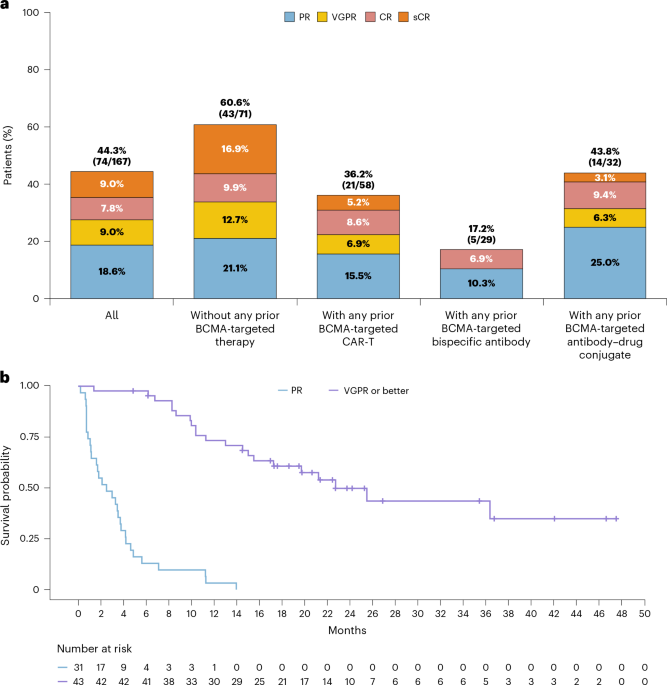
Across the enrolled population, the objective response rate was 42.1%. The rate of very good partial response or better was 25.1%. Median duration of response was reported at 11.2 months, suggesting that when patients did respond, those responses were not merely brief tumor reductions.
For a heavily pretreated myeloma population, those efficacy signals are notable. The study does not establish how cevostamab compares against other available therapies in a head-to-head setting, and phase 1 trials are not designed to settle that question. But the combination of measurable response activity and months-long durability is the kind of result that can justify larger follow-on studies.
The fixed-duration design is also important. Many modern cancer therapies continue until progression or intolerance. A regimen planned for about a year could prove attractive if later trials confirm benefit, particularly for patients and clinicians trying to balance disease control with cumulative burden from long treatment courses.
Safety remains the central question
The study also makes clear that cevostamab is not a low-risk therapy. Grade 3 or 4 adverse events occurred in 59.6% of patients, and serious adverse events were reported in 60.2%. Grade 5 adverse events, excluding disease progression, occurred in 4.6% of patients. The paper says 0.9% were considered treatment related, including two cases of hemophagocytic lymphohistiocytosis and one case of disseminated intravascular coagulation in the setting of pseudomonal sepsis.
Those figures underline the basic reality of advanced myeloma drug development: therapies aimed at deeply refractory disease often operate in a narrow band between needed potency and significant toxicity. The study’s results are encouraging because the safety profile appears manageable enough to support continued development, but they do not suggest a benign treatment course.
That balance will shape the next stage of evaluation. Investigators and regulators will need to determine whether the responses are strong enough, durable enough, and reproducible enough to justify the risks in broader use. Dose selection and patient selection will be central to that process.

Why the study matters beyond one drug
The myeloma field has recently been defined by successive waves of immune-targeting treatments, including BCMA-directed approaches. Cevostamab points to a different antigen, FcRH5, and therefore to a strategy that may expand the target landscape for patients who have already received other immunotherapies.
That is one reason the prior-treatment history in this study stands out. Nearly half the participants had already been exposed to BCMA-targeted therapy. Activity in such patients suggests the drug may have a role even as treatment sequencing becomes more complex and as clinicians move newer agents earlier in care.
The results also strengthen the case for bispecific antibodies as a practical bridge between standard regimens and more individualized cellular therapies. Some patients are not candidates for more resource-intensive approaches, and others need treatment that can be started on a more conventional schedule. A successful FcRH5-directed bispecific could help fill that gap.
What comes next
Because this is a phase 1 trial, the findings should be read as an early but important signal rather than a final verdict. The next step is to confirm the recommended dose and schedule in later-stage testing and to clarify which patients benefit most. Researchers will also need to better define how cevostamab fits among other myeloma options, especially in an era when prior exposure to multiple targeted agents is becoming common.
Still, the core takeaway is clear. In a population with extensive prior therapy and high levels of drug resistance, cevostamab showed antitumor activity, durable responses for many responders, and a development path that remains open because the maximum tolerated dose was not reached. For patients with relapsed or refractory multiple myeloma, that is enough to make this one of the more consequential early-stage hematology results of the week.
Key numbers from the study
- 324 patients enrolled as of February 24, 2025
- Median of 6 prior treatment lines
- 89.5% were triple-class refractory
- 47.5% had prior BCMA-targeted therapy
- 42.1% objective response rate
- 25.1% achieved very good partial response or better
- 11.2 months median duration of response
- Maximum tolerated dose was not reached
This article is based on reporting by Nature Medicine. Read the original article.

Originally published on nature.com