From expo floor hardware to programs of record
SOF Week 2026 offered a concentrated look at one of the fastest-moving segments of the defense market: loitering munitions and launched effects. What stood out was not only the variety of systems on display, but the degree to which several of them are now tied to formal Army demand signals and production planning rather than remaining experimental concepts.
Breaking Defense reported that Teledyne FLIR used the event to unveil Block 2 of its electrically propelled quadrotor Rogue 1 lethal unmanned aerial system, while AV and BlueHalo showcased systems including the Mayhem 10 launched effect and the Switchblade 400 loitering munition. Together, the displays pointed to a market that is rapidly consolidating around range, survivability, modular payloads and manufacturability.
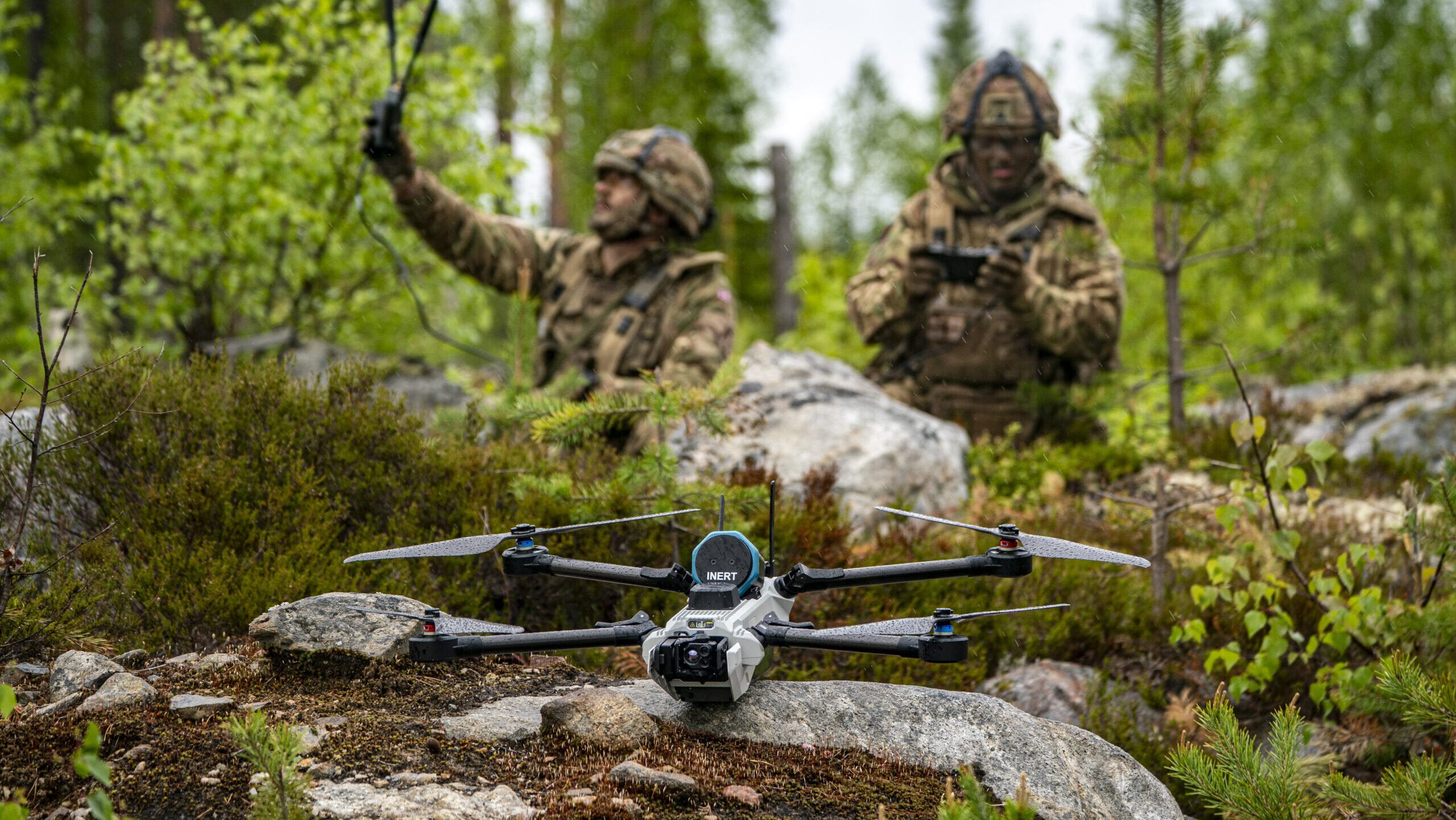
Rogue 1 moves toward heavier battlefield utility
The upgraded Rogue 1 is notable because it pushes a quadrotor-style loitering munition beyond short-range expectations. Teledyne FLIR says the Block 2 version more than doubles the range of the earlier model to over 20 kilometers. It also adds a shape-charge anti-armor payload intended for hardened vehicles, along with improved communications, autonomy and resilience against electronic warfare.
The system’s relevance is reinforced by its link to the Army’s Low Altitude Stalking and Strike Ordnance program. That connection matters. Once a capability enters an institutional pipeline like LASSO, its future is less dependent on novelty and more dependent on whether it can meet procurement, integration and delivery expectations at scale. Deliveries for Block 2 are scheduled to begin by the third quarter of 2026.
Mayhem 10 and Switchblade 400 point to modular mass
AV and BlueHalo emphasized a different dimension of the trend: flexibility across launch methods and mission sets. Mayhem 10 can be fired from the Common Launch Tube and is pitched for intelligence, surveillance, reconnaissance or precision strike missions. The company says it can carry electronic warfare sensors as well as the Javelin Multi-Purpose warhead. So far, however, the report notes that Mayhem 10 has only been ground-launched, not live-fired from an aircraft.
The Switchblade 400 adds another signal about where the market is heading. It uses the same Javelin warhead as the larger Switchblade 600 but shortens overall length through a smaller gimbal design. Like Rogue 1, it has also entered the Army’s LASSO program of record. That suggests the Pentagon is not merely testing concepts in this class; it is starting to formalize a family of expendable, precision systems that can be fielded in meaningful numbers.
Production, not just performance, is the new test
One of the most consequential claims in the report is industrial rather than tactical. A company spokesperson said both Mayhem 10 and Switchblade 400 are ready for mass production with capacity for thousands of units per month in line with Pentagon demand signals. AV is also establishing an additional manufacturing facility.
That reflects a larger shift in defense procurement after recent conflicts demonstrated the importance of affordable, attritable and rapidly replaceable weapons. In this segment, the winner may not be the system with the most elegant spec sheet. It may be the system that can be built in quantity, updated quickly and sustained through electronic warfare pressure and changing mission requirements.

A capability class is becoming a category
For years, loitering munitions sat in a somewhat ambiguous space between drone, missile and precision artillery. Events like SOF Week increasingly show them becoming a distinct category with its own upgrade cycles, production logic and doctrinal role. The systems on display ranged from tube-launched effects to quadrotor strike aircraft, but all were being sold on a common promise: fast, distributed precision at lower cost than many traditional munitions.
That does not mean every showcased platform will achieve wide adoption. Integration, survivability and real-world operator feedback will remain decisive. But the direction is becoming clearer. Loitering munitions are moving from special-purpose showcase items toward standard components of how U.S. forces plan to sense, strike and adapt at the tactical edge.
This article is based on reporting by Breaking Defense. Read the original article.
Originally published on breakingdefense.com