Battery storage posted its strongest first quarter yet in the US
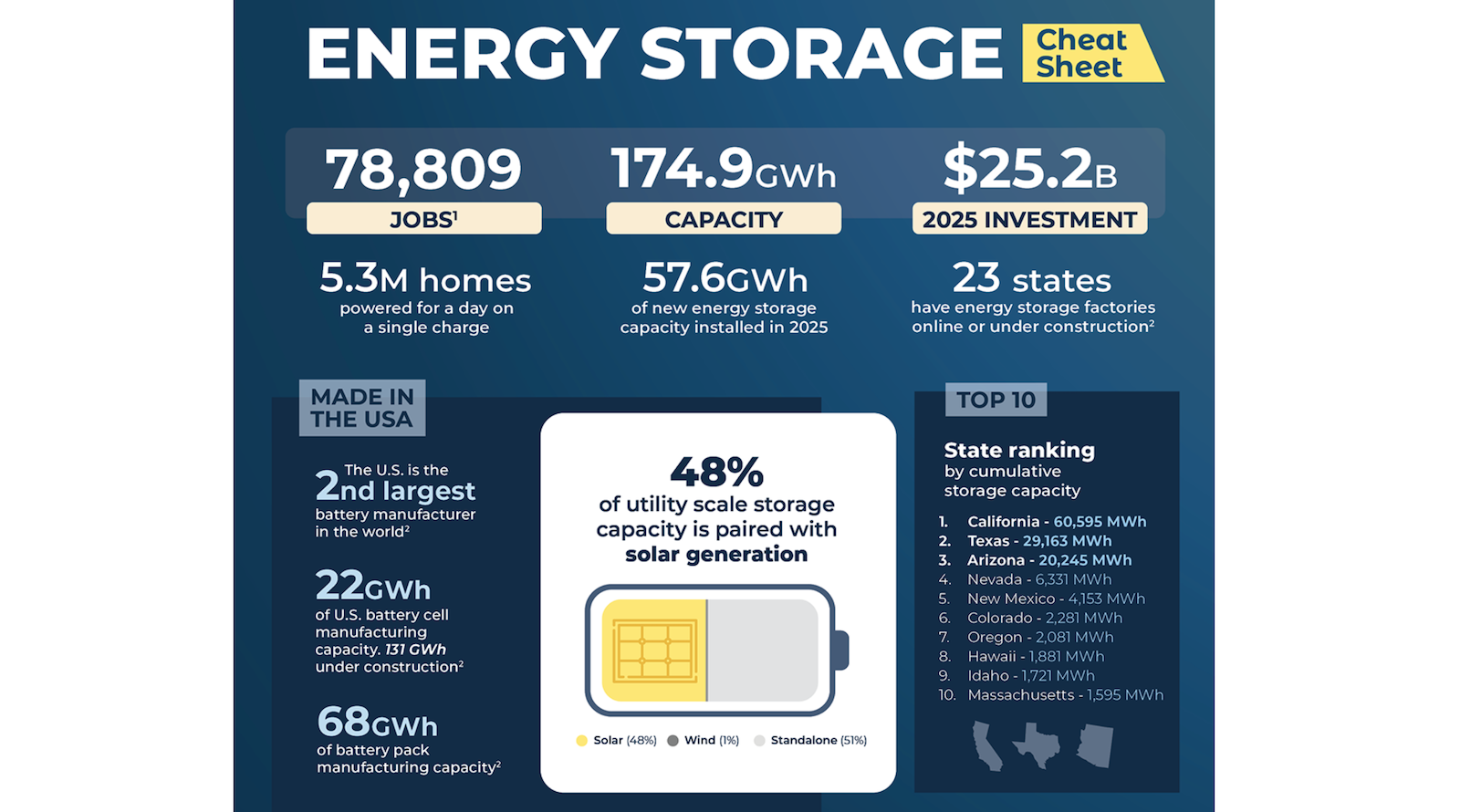
The US energy storage market installed 9.7 gigawatt-hours of new capacity in the first quarter of 2026, according to the U.S. Energy Storage Market Outlook Q2 2026 released by the Solar Energy Industries Association and Benchmark Mineral Intelligence. The report describes that as the strongest first quarter in the sector’s history and says installations were up 32% year over year.
That is a large number on its own, but the more important point is what it says about the role of storage in the broader power system. Batteries are no longer being framed simply as backup assets or add-ons to renewable projects. In the supplied material, industry groups present storage as a central response to power price volatility, grid reliability needs, and rising electricity demand from large loads such as data centers.
Why the forecast moved higher
The updated outlook now expects more than 610 GWh of energy storage to be installed in the US by 2030, an increase from previous projections. The source ties that upward revision to a mix of market and geopolitical pressures. Investors, developers, and grid operators are responding to disrupted global gas and gas turbine supplies and the resulting price volatility. In that environment, solar and storage become more attractive because they are less exposed to fuel-price swings and are increasingly being manufactured domestically.
This is a notable shift in the way storage is being discussed. The argument is no longer only about decarbonization. It is about insulation from external shocks. A battery does not remove every risk from a power system, but it changes the exposure profile in ways utilities, corporate buyers, and policymakers increasingly care about.
That framing also helps explain why batteries are drawing attention from sectors far outside traditional utility planning. The report says companies including Google and Meta have announced deals this year to procure tens of thousands of megawatt-hours of energy storage. That suggests large technology firms are treating storage as a strategic operational asset tied to uptime, cost management, and access to power for expanding digital infrastructure.

Storage is becoming part of the AI buildout story
One of the strongest signals in the supplied material is the explicit connection between batteries and AI infrastructure. Benchmark Mineral Intelligence’s energy lead says supportive policy for battery energy storage systems will be important to enabling AI and data center rollout while reducing cost impacts. That linkage matters because it turns storage from a clean-energy subsector into a foundational piece of industrial planning.
As data centers multiply, the grid has to absorb more concentrated demand while keeping service stable. Storage can help shift energy across time, manage peaks, and support reliability when generation and demand do not align. In effect, batteries are moving closer to the center of the conversation about whether the US can build enough electrical infrastructure to support new compute-heavy industries.
That does not mean storage alone solves the problem. It does mean the sector has gained a clearer strategic role. When power planners, hyperscalers, and manufacturers all want the same class of infrastructure for overlapping reasons, deployment can accelerate quickly.
Policy remains the biggest uncertainty
Despite the strong quarter, the report warns that permitting bottlenecks in Washington could slow progress. SEIA says 467 solar and storage projects have permits pending and remain vulnerable to delays or cancellations. That is the key tension in the outlook: demand is strengthening, the economic case is widening, but project delivery can still be constrained by policy and administrative friction.
The warning is not abstract. If projects stall while power demand rises, electric bills can increase and reliability planning becomes harder. The supplied text also presents the policy risk as part of a larger international competitive race, arguing that delays could leave the US further behind China in sectors linked to AI and advanced energy deployment.
Whether or not one agrees with every part of that framing, the operational risk is real. Large infrastructure pipelines are sensitive to uncertainty. Batteries may be modular compared with many other grid assets, but they still require approvals, interconnection, procurement, and financing discipline. A strong market signal can be blunted quickly if those layers fail to move.

The quarter marks a milestone, not a finish line
The first-quarter record matters because it confirms storage demand is durable under pressure. The sector grew despite federal actions the report says have targeted clean energy. It also grew at a time when the rationale for batteries is broadening beyond emissions reduction and into energy security, industrial resilience, and digital-economy expansion.
The next question is whether the policy environment allows the market to keep compounding. If permitting eases and procurement pipelines stay active, the higher 2030 forecast could prove conservative. If bottlenecks deepen, the US may discover that recognizing storage as critical infrastructure is easier than building it at the scale the economy now expects.
This article is based on reporting by CleanTechnica. Read the original article.
Originally published on cleantechnica.com




