Researchers are targeting one of solar recycling’s most difficult steps
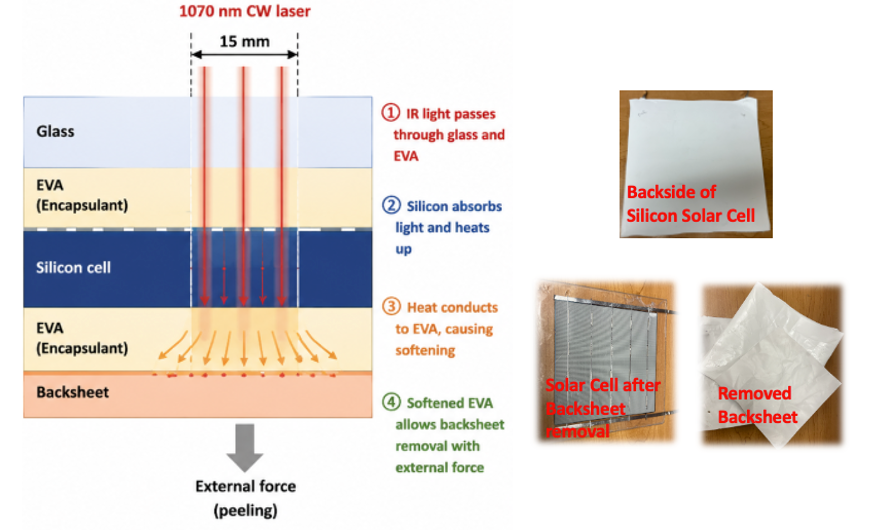
A team at the University of Virginia has developed a laser-based method to remove backsheets from end-of-life silicon solar modules without damaging the glass or silicon wafers underneath. The work, reported by pv magazine on May 13, describes a continuous-wave infrared laser process that the researchers say avoids chemicals, reduces energy use, and preserves valuable components for downstream recovery.
The development addresses a stubborn problem in solar recycling. Many retired panels still contain materials with residual value, but separating the laminated stack cleanly is difficult. Conventional recycling routes can rely on thermal or chemical treatments that are energy-intensive, costly, or damaging to components that might otherwise be reused or more efficiently processed.
That makes delamination a critical point in the recycling chain. If the backsheet can be removed without harming the tempered glass or the silicon wafers, recyclers have a better chance of recovering more value from modules that would otherwise be shredded, burned, or processed through harsher methods.
How the method works
According to the report, the researchers use an infrared continuous-wave laser to heat the silicon-EVA interface through the front glass of the module. That controlled heating weakens the bond enough to allow clean mechanical delamination of the backsheet while preserving device performance.
The approach is notable because it works through the glass rather than by directly attacking the module with chemicals or broad high-temperature treatment. The stated goal is to selectively affect the interface that matters for separation while leaving the major structural elements intact.
Corresponding author Mool C. Gupta told pv magazine that the technique is non-chemical, environmentally friendly, and both cost- and energy-efficient, while preserving the tempered glass and silicon wafers. He also stressed the significance of maintaining the structural and functional integrity of the remaining module components for downstream recovery and recycling of valuable materials.
That emphasis on preservation is important. In recycling systems, value often depends not only on whether a material can be recovered, but on the condition in which it is recovered. A cleaner separation can improve the economics of later processing steps and may widen the set of practical reuse or recovery options.

Why end-of-life solar handling matters more now
The solar industry is still in a long growth phase, but the pipeline of aging equipment is growing with it. As more modules approach end of life over time, pressure increases to build recycling methods that can handle volume without excessive cost or environmental burden. Processes that conserve high-value materials and avoid aggressive chemical treatment are likely to attract attention.
The Virginia team’s process is positioned directly in that discussion. Pv magazine described it as a lower-energy, lower-cost alternative to conventional thermal or chemical recycling methods. If that performance holds up outside the lab, it could improve how recyclers deal with silicon module construction, especially where preserving glass and wafers changes project economics.
The method also reflects a broader pattern in clean-energy manufacturing and recycling research: precision tools are increasingly being used to make disassembly more selective. Instead of treating an entire device as waste and breaking it down by force, researchers are looking for ways to separate materials with enough control that the most valuable portions remain usable.
Potential implications for the recycling chain
One practical implication of the reported process is that it may help move solar recycling toward more component-aware recovery. A module is not a uniform object; it is a layered product with materials that behave differently under heat, stress, and chemical exposure. A technique that can weaken a specific interface while limiting damage elsewhere could make later stages of sorting and recovery more predictable.
Another implication is environmental. The researchers explicitly frame the method as non-chemical and environmentally friendly. That matters because chemical-intensive recycling methods can introduce their own waste-handling burdens, even when they succeed technically. A process that reduces those burdens while also cutting energy input would be attractive in a sector already under pressure to prove lifecycle sustainability.
The report also points to cost. Recycling often struggles when the value of recovered materials is marginal relative to collection, transport, and processing costs. Lower-energy methods that preserve more of the module’s useful material base could make some recycling streams more commercially viable.
At the same time, the article does not claim commercial deployment or full industrial validation. What it does establish is a proof of concept: a laser-driven way to remove backsheets without damaging major module components, and a rationale for why that matters to recovery economics and environmental performance.
What to watch next
The central question now is whether the process can scale beyond a research setting. For any recycling technology, the path from demonstration to adoption depends on throughput, cost per module, equipment integration, and how consistently the method handles real-world panel conditions. End-of-life modules vary by age, wear, manufacturing history, and physical damage, all of which can complicate controlled separation.
Still, the reported result is meaningful because it targets a bottleneck directly. Instead of offering a broad claim about cleaner recycling, the Virginia researchers identified a specific challenge, used a specific tool to address it, and tied the outcome to recoverable module value.
As solar deployment continues to expand, those kinds of process improvements will matter more. Recycling systems do not become effective through policy or collection alone; they also depend on better ways to take complex products apart. This laser-based backsheet removal technique is an example of that engineering work becoming more precise, and potentially more useful to the economics of large-scale solar recovery.
This article is based on reporting by PV Magazine. Read the original article.
Originally published on pv-magazine.com